

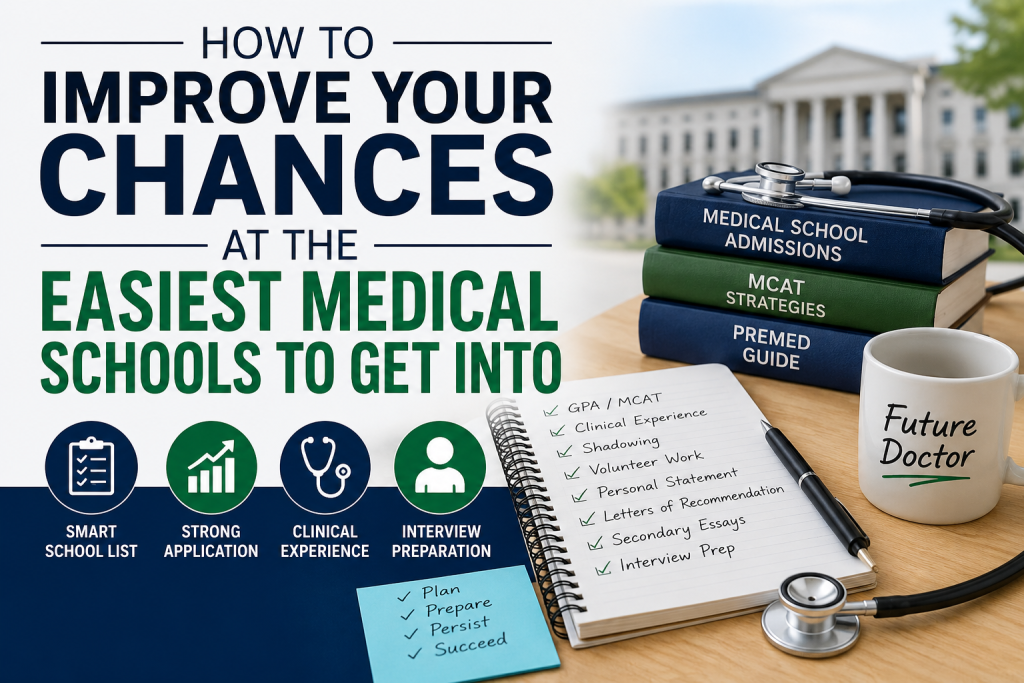
Many premed students search for the easiest medical schools to get into when they start building their application list.
That makes sense. Medical school admissions are competitive, expensive, and stressful. Students want to apply wisely, not waste money on schools where they have very little chance.
But there is one big problem. A lot of applicants misunderstand what “easy” means.
The easiest medical schools to get into are not easy. They may have higher acceptance rates, slightly lower average GPA or MCAT scores, stronger in-state preference, or more holistic admissions. But they still expect serious applicants with strong academics, clinical exposure, well-written essays, and a clear reason for medicine.
If students treat these schools like guaranteed options, they can hurt their chances. Here are the common mistakes students make when applying to the easiest medical schools to get into, and how to avoid them.
Mistake 1: Thinking “Easy” Means Guaranteed
This is the biggest mistake. Some students assume that if a school appears on a list of easier medical schools, they have a strong chance of getting in. That is not how medical school admissions work.
A school may be easier compared to other schools, but it can still reject most applicants. It may receive thousands of applications for a limited number of seats. It may also have specific requirements that make it harder for some applicants than it looks on paper.
A better way to think about it is this:
- Easier does not mean easy.
- A higher acceptance rate does not mean low standards.
- A lower average GPA does not mean weak competition.
- A realistic school still requires a strong application.
Applicants should treat every school seriously, even the ones that seem more accessible.
Mistake 2: Choosing Schools Only by Acceptance Rate
Acceptance rate is useful, but it can be misleading if you use it alone.
A school may have a higher overall acceptance rate, but that number may not apply equally to every applicant. Public medical schools, for example, may strongly prefer in-state applicants. That means an in-state student may have a much better chance than an out-of-state student with similar stats. Before adding a school to your list, look beyond the headline number.
Review things like:
- In-state vs out-of-state preference
- Average accepted GPA
- Average accepted MCAT
- Mission statement
- Required coursework
- Clinical experience expectations
- Service focus
- Interview format
- Secondary essay themes
- Location and residency rules
The medical school acceptance rate can help you understand selectivity, but it should not be the only reason you apply. A smarter school list looks at both numbers and fit.
Mistake 3: Ignoring Mission Fit
Many medical schools care deeply about mission fit. Some schools focus on primary care. Some focus on rural medicine. Some value research. Some have a strong community health mission. Some want students who are committed to serving underserved communities.
If your application does not match the school’s mission, your chances may be lower even if your GPA and MCAT are within range.
For example:
- A rural-focused school may want to see interest in rural communities.
- A primary care-focused school may value patient-facing experience.
- A research-heavy school may expect meaningful research exposure.
- A community-focused school may look closely at service and volunteer work.
Do not apply just because a school looks easier online. Ask yourself:
- Why does this school fit me?
- Do my experiences match their mission?
- Can I explain why I want this program?
- Will my secondary essays sound specific or generic?
If you cannot answer those questions, the school may not be as good of a fit as it looks.
Mistake 4: Sending Generic Secondary Essays
Secondary essays are where many applicants lose points. Some students treat secondaries like a copy-paste task. They reuse the same answer for multiple schools and make small changes to the name of the program.
Admissions committees can usually tell. A strong secondary essay should show that you understand the school and have a real reason for applying.
Good secondary essays often include:
- A clear connection to the school’s mission
- Specific programs, clinics, or learning opportunities
- Your relevant experience
- How you can contribute to the class
- Why the location or community matters
- A clear link between your goals and the school’s values
Generic essays can make even a strong applicant look careless. If you are applying to the easiest medical schools to get into, do not assume the essays matter less. They may matter even more because many applicants may have similar stats.
Mistake 5: Treating DO Schools as Backups
Some students apply to DO schools only because they think they are easier to get into. That is a mistake.
Osteopathic medical schools train physicians and expect applicants to understand the DO path. They want students who respect osteopathic medicine, not students who see the school as a backup option. If you apply to DO programs, your application should show real interest.
That may include:
- Understanding osteopathic principles
- Shadowing or learning from DO physicians
- Explaining why the DO approach fits your goals
- Showing patient-centered values
- Writing strong school-specific essays
DO schools are not a fallback plan. They are a real medical training path, and applicants should treat them with the same care as MD schools.
Mistake 6: Applying Too Late
Timing matters in medical school admissions. Many schools use rolling admissions, which means applications are reviewed as they come in. If you apply late, there may be fewer interview spots available. A late application can hurt you even if your profile is strong.
To avoid this, prepare early:
- Finalize your school list before the application opens
- Ask for letters of recommendation early
- Draft your personal statement ahead of time
- Prepare your activity descriptions
- Plan for secondary essays
- Submit as early as you can without rushing quality
Applying early will not fix a weak application, but applying late can weaken a good one.
Mistake 7: Relying on Stats Alone
GPA and MCAT matter, but they are not the whole application. Some students think that if their numbers match the school’s averages, they are safe. Others think that if their stats are slightly below average, they have no chance.
Both views are too simple. Medical schools look at the full application. They may consider:
- Clinical experience
- Volunteer work
- Research
- Leadership
- Shadowing
- Personal statement
- Secondary essays
- Letters of recommendation
- Interview performance
- Life experience
- Academic trend
- School fit
This is why a student with strong stats can still be rejected, while another student with average stats may get accepted because the overall application is stronger.
BeMo Academic Consulting often emphasizes strategy, school fit, and application quality because medical school admissions are not only about numbers. A strong application needs to tell a clear and convincing story.
Mistake 8: Not Explaining Weaknesses Properly
Some applicants have weaknesses in their profile.
That may include:
- Lower GPA
- Lower MCAT
- Course withdrawals
- Academic gaps
- Limited research
- Less clinical exposure
- A non-traditional path
- A past semester with poor grades
A weakness does not always ruin your application. But ignoring it can be a problem. If there is a clear issue, applicants should show growth and maturity.
For example:
- If your GPA improved, highlight the upward trend.
- If you struggled early, explain what changed.
- If your MCAT is lower, make sure the rest of the application is strong.
- If you have less research, apply to schools where research is not the main focus.
- If your clinical hours are lower, avoid applying before you are ready.
The goal is not to make excuses. The goal is to show that you understand the weakness and have taken steps to improve.
Mistake 9: Applying Without Enough Clinical Experience
Medical schools want to know that you understand the reality of patient care. Watching medical shows, enjoying science, or wanting to help people is not enough. Applicants need real exposure to healthcare settings.
Clinical experience can include:
- Hospital volunteering
- Scribing
- Medical assistant work
- EMT work
- Hospice volunteering
- Clinic volunteering
- Patient care roles
- Shadowing physicians
The number of hours matters, but reflection matters too.
Admissions committees want to see what you learned from those experiences. They want to know that you understand patients, teamwork, stress, communication, and the responsibility of medicine. If you apply with weak clinical experience, even schools with higher acceptance rates may not take your application seriously.
Mistake 10: Building an Unbalanced School List
A strong school list should not include only reach schools or only “easy” schools. It should be balanced. A good list may include:
- Reach schools
- Target schools
- More realistic schools
- In-state options
- DO schools, if appropriate
- Mission-fit programs
- Schools where your GPA and MCAT are in range
- Schools where your experiences support the mission
An unbalanced list can waste time and money. Applying only to highly competitive schools may lead to no interviews. Applying only to schools you think are easy may still backfire if you do not fit their mission. The best school list is strategic, not random.
Mistake 11: Not Preparing for Interviews Early
Many students focus so much on getting interviews that they forget to prepare for them. That is risky. An interview invite means the school is interested, but it does not mean you are accepted. You still need to show communication skills, maturity, professionalism, and fit.
Prepare for questions like:
- Why medicine?
- Why this school?
- Tell me about a meaningful clinical experience.
- What is a challenge you faced?
- How do you handle stress?
- What is your biggest weakness?
- How would you handle an ethical situation?
- What kind of physician do you want to become?
Students should also prepare for MMI-style questions if the school uses that format. Good interview prep helps you sound natural, clear, and thoughtful instead of memorized.
Mistake 12: Looking for Shortcuts Instead of Strategy
Searching for the easiest medical schools to get into is not wrong. It can be part of smart school list planning. But it becomes a problem when students use it as a shortcut.
There is no shortcut that replaces:
- Strong academic preparation
- Meaningful clinical exposure
- A clear personal statement
- Tailored secondary essays
- Strong letters
- Good interview preparation
- Smart school selection
The better goal is not to find the easiest school. The better goal is to apply to schools where your application makes sense.
Final Thoughts
The easiest medical schools to get into are not easy. They are simply more realistic for certain applicants when the school list is smart and the application is strong.
Students make mistakes when they focus only on acceptance rates, ignore mission fit, send generic essays, apply late, or treat certain schools as backups.
A better strategy is to look at the full picture. Review your GPA and MCAT. Understand your clinical experience. Research each school’s mission. Write specific essays. Apply early. Prepare for interviews. Build a balanced school list.
Medical school admissions are competitive, but smart planning can make a real difference. For students who need help building a stronger application strategy, BeMo Academic Consulting can be a useful resource because the process is not just about finding easier schools. It is about presenting your profile in the strongest possible way and applying where you truly fit.