

Mining contractors need maintenance software that works in remote field conditions. See what field-first systems deliver for heavy equipment fleets operating far from the workshop.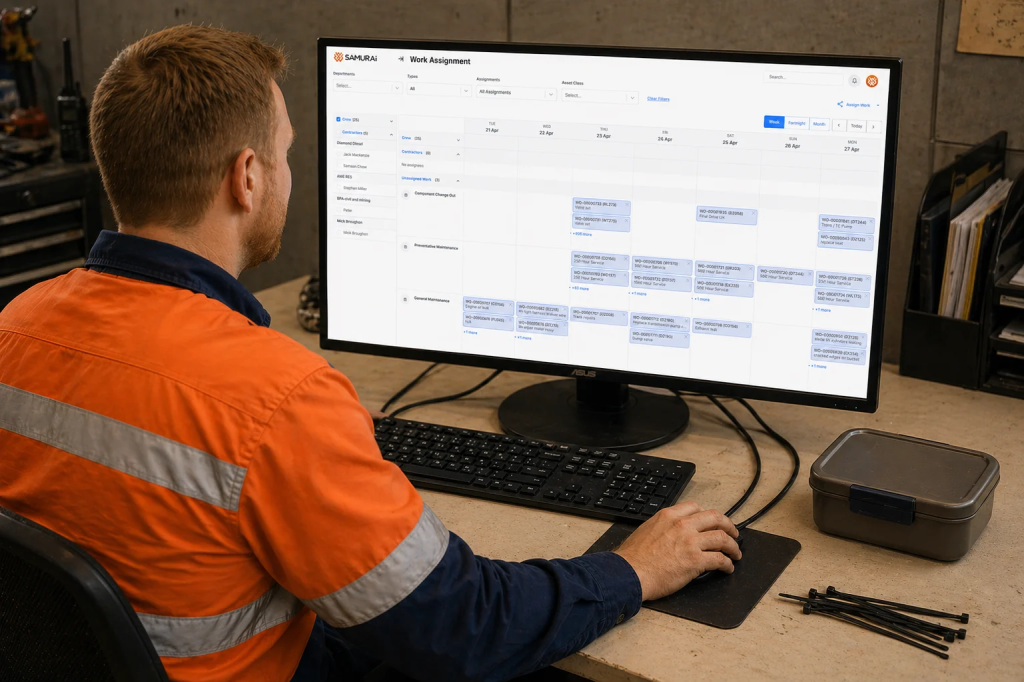
Mining support and contract mining operations present some of the most demanding conditions a maintenance system will ever face.
Machines work long hours in harsh environments. Sites are often remote, with limited connectivity and no nearby workshop. Fitters travel significant distances to reach equipment. Breakdowns happen in conditions that make detailed record-keeping difficult. And the pressure to keep machines running is constant because downtime on a mining contract has direct commercial consequences that go well beyond the cost of the repair itself.
Managing maintenance effectively in that environment requires more than a standard CMMS with a mobile app bolted on. It requires a system that was designed around the reality of remote field operations from the beginning.
When a machine breaks down three hours from the nearest town, the maintenance system needs to work just as well there as it does back at the workshop. That is not a given with most platforms.
What Makes Remote Mining Maintenance Different
Contract mining operations face a set of maintenance challenges that most CMMS platforms were simply not built to handle.
Connectivity is unreliable or absent on many remote sites. A system that requires a live internet connection to record a job, raise a work order, or update machine hours is not going to work reliably in those conditions. Fitters need to be able to capture maintenance information offline and have it sync when connectivity is restored.
Response times are longer. When a machine goes down on a remote site, the time between the breakdown occurring and a fitter arriving can be measured in hours rather than minutes. Every detail of the fault needs to be captured accurately at the time of the breakdown so that the fitter arrives prepared with the right parts, the right tools, and a clear understanding of what they are dealing with.
Shift patterns are demanding. Mining operations often run around the clock with rotating crews. Maintenance information needs to transfer clearly between shifts so that nothing gets lost in the handover and incoming crews have an accurate picture of the fleet’s current status.
Equipment utilization is intense. Machines that work twelve-hour shifts accumulate hours fast. Service intervals arrive more frequently than they would for the same machine on a lighter duty cycle. Staying ahead of the schedule requires accurate, up-to-date information at all times.
The Cost of Incomplete Records in Mining Operations
In most operations, incomplete maintenance records are a problem that builds slowly. In mining support contracting, the consequences can be immediate and significant.
A machine with an incomplete service history going into a new mining contract creates compliance risk. Most principal contractors require evidence of current maintenance for equipment working on their sites. If the records are incomplete or cannot be produced quickly, the machine may not be permitted to work.
A breakdown fault that was not properly recorded in the previous shift leads to a delayed diagnosis and a longer repair. The fitter arrives without the right parts because the fault description was vague. The machine sits for an additional half day while parts are sourced. The delay affects the contract schedule and the relationship with the principal.
A component that was approaching end of life but not flagged in the system fails unexpectedly. The replacement cost is higher than a planned rebuild would have been. The downtime is unplanned. And the recovery from a remote site adds logistics cost on top of the repair.
These are not hypothetical scenarios. They are the real operational consequences of maintenance systems that do not capture information reliably in field conditions.
Offline Capability Is Not Optional
For mining contractors operating in remote areas, offline capability in a maintenance system is not a nice-to-have feature. It is a basic operational requirement.
A fitter completing a scheduled service at a remote site needs to be able to record the job, log the parts used, note any observations about the machine’s condition, and update the hours, all without a reliable internet connection. That information needs to be stored locally on the device and sync to the system when connectivity is restored, without any manual intervention required.
Systems that do not handle offline workflows cleanly create a situation where fitters have to choose between doing the job properly and doing the paperwork properly. In practice, the job wins every time. The paperwork gets deferred, simplified, or skipped.
Samurai CMMS supports offline field workflows so that maintenance capture does not depend on having a reliable internet connection. Work gets recorded when and where it happens. The system catches up when connectivity returns. And the maintenance record is complete regardless of what the signal was like on site.
Shift Handover and Fleet Status Visibility
In a mining operation running continuous shifts, the quality of information transfer between crews is directly related to the quality of the maintenance decisions made by the incoming crew.
An outgoing crew that records machine faults, hours, and outstanding issues clearly in the system gives the incoming crew a starting point that is accurate and actionable. An outgoing crew that records nothing, or records the minimum required to close out a shift, leaves the incoming crew starting from scratch.
The difference between those two outcomes is largely a function of how easy the system makes it to record information at the end of a shift. If entering shift information is quick and straightforward on a mobile device, it gets done. If it requires navigating a complicated desktop interface or filling in a form that does not reflect how the shift actually ran, it gets skipped or simplified.
Mining contractor maintenance software that is genuinely designed for shift-based operations makes the end-of-shift record as easy as possible to complete. Machine status updates, outstanding faults, hours worked, and upcoming service requirements are all captured in a workflow that fits the rhythm of the operation rather than interrupting it.
Managing Contractors Within a Mining Support Operation
Mining support contractors often work with a mix of their own maintenance team and external specialist contractors for major repairs, rebuild work, and servicing that requires equipment or expertise not available on site.
Keeping all of that activity in one coherent maintenance record is a genuine challenge. Internal work is relatively straightforward to track. Contractor work often ends up as an invoice and an emailed report that someone has to manually match to the right machine and job.
When the contractor activity is not properly integrated into the maintenance record, the machine’s history develops gaps. The true cost of maintaining that machine is harder to calculate. And the compliance record that a principal contractor might request at any time is incomplete.
Samurai maintenance software brings external contractor activity into the same system as internal maintenance. Contractors work within the platform. Their records are attached to the same machine history as everything else. And the maintenance picture stays complete regardless of who did the work or where it happened.
Real-Time Visibility for Remote Fleet Management
One of the most consistent challenges for mining support contractors managing multiple remote sites is the gap between what is happening in the field and what management can see from the office.
Without real-time visibility, decisions get made on information that is already out of date. A machine that went down this morning might not show up in the daily report until this afternoon. By then, decisions about whether to mobilize a fitter, source parts, or escalate the response have already been delayed.
When maintenance is captured at the source in real time, that gap closes. A breakdown reported from a site appears in the system immediately. Machine status updates as work orders are opened and closed. Hours update as fitters complete jobs. And management has a current picture of the fleet without having to chase phone calls or wait for someone to compile an update.
For operations where every hour of downtime has a direct cost, that visibility is not just useful. It is a practical tool for managing the operation more effectively.
Built for the Conditions That Mining Contractors Actually Work In
Most maintenance software was designed to be used in comfortable office or workshop conditions. Remote mining sites are neither comfortable nor controlled. Dust, heat, limited connectivity, demanding shift patterns, and the constant pressure to keep machines productive create an environment that exposes the weaknesses of systems that were not designed for it.
The Samurai mobile maintenance platform was built around the reality of field-based heavy equipment maintenance. Not as a theoretical exercise, but as a practical response to the operational problems that mining contractors and earthmoving businesses actually face when they try to manage maintenance across remote, distributed operations.
For contractors who have struggled to get reliable maintenance data from remote sites or who have watched their compliance records develop gaps because the system did not fit the conditions on the ground, it represents a practical step forward rather than just another software upgrade.
See how Samurai works on a real mining contractor fleet.