
In 2025, managing enterprise Azure settings will include more than just virtual machine provisioning, storage configuration, and basic networking setup. Azure administrators now work at the nexus of technology, security, governance, and business effectiveness. In this blog, let’s see what challenges Azure administrators face in Azure Enterprise Environments and how the AZ-104 certification helps in overcoming them.
What Challenges Do Azure Admins Face in Enterprise Environments?
Azure administrators face challenges managing multi-subscription environments, hybrid cloud setups, and enterprise security requirements. They must ensure high availability, cost optimization, governance enforcement, and compliance while scaling infrastructure efficiently. These responsibilities require both technical expertise and strategic decision-making.
Today’s organisations operate with Azure environments with multiple subscriptions, hybrid and multi-cloud designs. Here is where Azure administrators are expected to facilitate innovation and scalability while guaranteeing high availability, cost effectiveness, governance enforcement, and security.
All these practical operational skills are validated by Microsoft’s Azure Administrator Associate (AZ-104) certification. It is intended for experts who oversee Azure daily and must make judgments with assurance in a live environment.
But passing the AZ-104 exam is just one step in the process. Applying AZ-104 ideas to enterprise-scale cloud operations is where the true value is found.
This AZ-104 exam guide shares expert strategies, tools, and AZ-104 training and tips to help you:
- Pass the certification exam with confidence
- Manage complex Azure environments effectively
- Bridge the gap between theory and enterprise reality
Additionally, you will discover how Whizlabs’ AZ-104 practical labs and practice exams help turn exam preparation into cloud administration abilities that are employable in 2025.
Key Takeaways for Enterprise Azure Administrators (AZ-104)
You will be able to comprehend and become an expert in five core AZ-104 domains, such as identity, governance, storage, compute, and networking.
Not just with that, you also develop your confidence through hands-on learning using Whizlabs’ AZ-104 labs and real-world scenarios. Utilise Azure-native solutions to streamline complicated infrastructure and make the most of cost-optimization, automation, security, and monitoring methods.
Why Is AZ-104 Important for Enterprise Cloud in 2026?
AZ-104 certification is important because enterprises increasingly rely on Azure for scalable, secure cloud operations. It validates real-world skills like governance, automation, networking, and cost management, making it essential for managing complex enterprise cloud environments in 2026.
Enterprise adoption of products in the cloud is rapid across business models, industries, and locations. Hence, the Azure Administrator certification is indeed highly relevant and in high demand.
1. Enterprise Cloud Complexity Has Scaled
Now, many businesses no longer operate a single Azure subscription. They oversee hundreds of subscriptions, multiple Azure Active Directory tenants, hybrid environments connected to on-premises infrastructure, and workloads across diversified zones.
Manual setup and ad-hoc management are no longer a viable option, but Azure administrators employ automation, governance frameworks, and centralized monitoring.
2. Business-Critical Security and Compliance
Security as an afterthought is no longer. Azure administrators will implement encryption, both in transit and at rest, of data, role-based access control (RBAC), Azure Policy to ensure regulatory compliance, and regular monitoring of the organization’s security posture.
Banking, healthcare, government, etc., need highly skilled Azure administrators since they need to be compliant with both regional and international regulations as well.
3. Cost Optimization Is a Strategic Priority
Organizations with cloud spending rise in cost, and in this way, they want more transparency. Implementing budgets and alarms, enforcing tagging policies, appropriately sizing computing and storage resources, and utilizing Azure Advisor advice for performance and cost optimization are daily occurrences for Azure administrators.
Whizlabs Insight: Through advanced governance and automation, Azure administrators, who marry technical know-how to business acumen, help organizations optimize costs by as much as 30%.
“Azure administrators who align technical decisions with business goals can reduce cloud costs by up to 30%.”
What Career Opportunities Does AZ-104 Offer Globally?
AZ-104 certification opens opportunities in cloud administration, DevOps, and infrastructure management roles globally. It is in demand across industries like IT services, fintech, SaaS, and consulting, especially in regions like India, the US, and Europe.
In India, the US, Europe, the Middle East, and the APAC area, the AZ-104 certification is highly considered worldwide.
Demand in India
In India, Azure Administrator roles are highly sought after across:
- IT services and system integrators
- Fintech and digital banking platforms
- SaaS product companies
- Big business consulting firms
Businesses depend on Azure-certified experts to oversee hybrid environments, guarantee reliability, and assist with digital transformation projects.
Global Career Relevance
Globally, enterprises running multi-region and hybrid Azure environments depend on Azure administrators for:
- Governance and compliance
- High availability and disaster recovery
- Performance optimization
The AZ-104 certification is a powerful certificate for international career mobility since it closely matches cloud employment needs in North America, Europe, and Asia.
What Skills Are Required for AZ-104 Enterprise Roles?
AZ-104 requires skills in identity management, storage, compute, networking, and monitoring. These core areas enable administrators to manage Azure environments effectively, ensuring security, performance, and cost optimization across enterprise workloads.
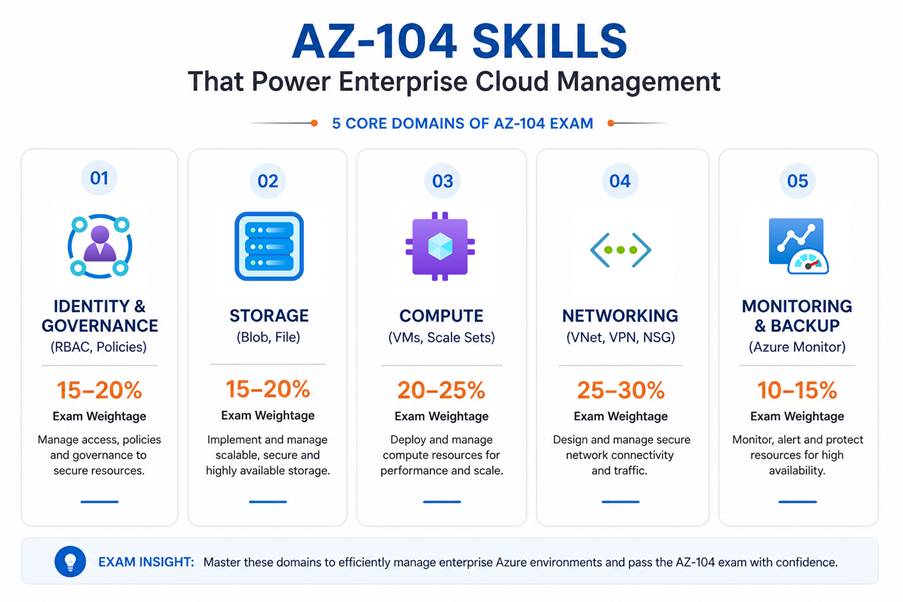
Five practical pillars that represent actual administrative duties form the foundation of the AZ-104 test.
| Domain | Weightage | Focus Area |
| Manage Azure identities and governance | 15–20% | RBAC, policies, subscriptions |
| Implement and manage storage | 15–20% | Blob storage, file shares, replication |
| Deploy and manage compute resources | 20–25% | VMs, scale sets, containers |
| Configure virtual networking | 25–30% | VNets, VPNs, NSGs, load balancers |
| Monitor and back up resources | 10–15% | Azure Monitor, alerts, Recovery Services Vault |
Exam insight: Azure management practices in the real world are very similar to AZ-104. Candidates with real-world experience frequently outperform those who only use theory.
How Do You Manage Enterprise Azure Environments with AZ-104?

Managing enterprise Azure environments involves implementing governance policies, automating operations, centralizing monitoring, optimizing storage, designing resilient compute systems, securing networks, and controlling costs using Azure-native tools.
1. Master Azure Governance Early
Governance forms the foundation of enterprise cloud management. Using Azure Policy to enforce standards and compliance, and using Management Groups to arrange subscriptions in a hierarchical manner are two examples of best practices.
The best strategy for implementing RBAC is through Azure Policy, Management Groups, and Azure Blueprints tools.
Whizlabs Tip: To learn how governance functions in actual settings, try out policy enforcement and RBAC assignments in sandbox labs.
“In enterprise cloud, governance is not optional, it is the foundation of scalable and secure operations.”
2. Automate Routine Administration Tasks
Automation unquestionably reduces operating expenses and human error. Important automation solutions that allow administrators to focus on strategic operations instead of tiresome activities include Azure Automation, Runbooks, Azure CLI, PowerShell scripting, scheduled virtual machine start/stop, and automatic patching.
3. Centralize Monitoring and Alerts
Enterprise workloads require proactive monitoring and fast incident response.
It allows users to easily monitor stacks like Azure Monitor for metrics and logs, and its analytic workspaces for centralized visibility. It also keeps track of application insights for performance improvement.
It uses action Groups for automated alert notifications. Centralized monitoring improves uptime and enables data-driven results.
4. Optimize Storage Management
Storage management directly impacts both performance and cost. Some of the best practices are to implement storage lifecycle policies.
This enables soft delete and encryption, and chooses the right replication option (LRS, GRS, ZRS). Efficient storage strategies ensure scalability without unnecessary spending.
5. Design Resilient Compute Environments
All-time availability is highly non-negotiable in enterprise environments. To achieve these, Azure offers services like Availability Sets and Availability Zones.
There are also Virtual Machine Scale Sets for elastic workloads and Azure Recovery Services Vault for backup and recovery. More than all, resilient compute design minimizes downtime and supports business continuity.
6. Secure Networking Across Hybrid Setups
Networking is the backbone of enterprise Azure architecture. Performance and security are both enhanced by a well-designed network.
Virtual networks, subnets, peering, Network Security Groups (NSGs), Azure Firewall and Web Application Firewall (WAF), VPN Gateway, and ExpressRoute for hybrid connection are used to do this.
7. Control Costs Proactively
Cost control is a core responsibility for Azure administrators. By using the key tools offered by Azure, proactive cost management aligns cloud usage with business goals.
Some of the tools include Azure Cost Management with Budgets, Resource tagging strategies, and Azure Advisor recommendations.
Azure Administrator Certification – Tools You Must Master
| Tool | Purpose |
| Azure Portal | Day-to-day operations |
| Azure CLI / PowerShell | Automation and scripting |
| Azure Monitor | Performance and health tracking |
| Azure Policy | Compliance enforcement |
| Azure Cost Management | Budget and cost optimization |
| Azure Arc | Hybrid and multi-cloud management |
| Azure Blueprints | Governance templates |
How to Prepare for the AZ-104 Exam Step-by-Step?
To prepare for AZ-104, start with the official exam blueprint, learn concepts through structured courses, practice hands-on labs, take mock tests, and revise weak areas. A consistent 6–8 week study plan is typically sufficient.
Here is the Step-by-Step Preparation Strategy:
- Understand the official AZ-104 exam blueprint
- Learn concepts through Whizlabs’ structured AZ-104 course
- Practice real-world scenarios using hands-on labs
- Attempt full-length AZ-104 practice tests
- Review weak areas and revise consistently
Suggested Preparation Time: 6–8 weeks with regular hands-on practice.
AZ-104 – Most Frequently Asked Questions
1. How hard is the AZ-104 exam for Azure admins?
The AZ-104 exam, which covers real-world Azure administration responsibilities like networking, automation, monitoring, and governance, is somewhat difficult. Candidates with practical lab experience will perform significantly better.
2. How long does it typically take to prepare for AZ-104?
Most learners prepare in 6 to 8 weeks with consistent study and practical lab work.
3. Is the Azure Administrator certification valid globally?
Yes. AZ-104 is recognized across India, the US, Europe, the Middle East, and APAC.
4. Does AZ-104 require coding skills?
No. You may not need advanced programming skills. However, basic skills with Azure CLI or PowerShell are beneficial.
5. Is AZ-104 worth it in 2025?
Absolutely. AZ-104 remains the most demanded certification for enterprise cloud roles with increasing Azure adoption worldwide.
Final Thoughts: Is AZ-104 Enough for Enterprise Azure Roles in 2025?
You may position yourself to succeed as a corporate Azure administrator in 2025 by studying the AZ-104 key areas, getting practical experience, and practising with Whizlabs’ real-world labs and practice exams.
To wrap up, a mix of automation skills, governance awareness, and strategic thinking is expected out of Azure Administrators as businesses need them for global expansion. The combination of organised learning and real-world experience is crucial if your objective is both long-term cloud career advancement and first-time AZ-104 success.