

If you’ve ever watched a tiny screw tumble into an engine bay, bounce off a motherboard, or vanish behind a wall cavity, you already understand why a magnetic screwdriver set is not a luxury — it’s a genuine productivity tool. Whether you’re a weekend DIY enthusiast, a professional electrician, or a production-line assembler, magnetic tip retention changes the way you work. It’s one of those upgrades that seems small until you actually use it, and then you can’t imagine going back.
This guide covers everything: how magnetic screwdrivers work, the real-world benefits they deliver, when you should avoid them, and honest reviews of today’s best options. We’ll also look at IRONCUBE’s own lineup, which has earned a loyal following among tradespeople who want professional quality without the inflated brand premium.
Before we dive in, it’s worth noting that screwdrivers are just one piece of the hand-tool ecosystem. If you’re building out a proper kit, IRONCUBE Works offers a full range of professional-grade hand tools designed for demanding use — from impact-rated wrenches to precision driver sets.
What Is a Magnetic Screwdriver Set and How Does It Work?
A magnetic screwdriver set is a collection of screwdrivers — or a handle with interchangeable bits — where the tip holds ferrous (iron-containing) fasteners through magnetic attraction. The screw sits on the tip without falling off, freeing one hand for positioning, bracing, or holding a workpiece. That’s the simple version. The physics behind it is worth understanding because it explains why some magnetic screwdrivers perform better than others.
Steel screws are ferromagnetic. When they come close to a magnetized tip, the magnetic field induces a temporary alignment in the screw’s own metal domains, creating enough attraction to suspend the screw against gravity. The strength of that hold depends entirely on the field intensity at the tip — measured in gauss — and the contact surface area between the tip and the fastener.
Permanent Magnet vs Magnetized Tip — The Difference
Permanent magnet tips use a small rare-earth or ferrite magnet embedded behind or around the driver tip. These maintain field strength over years of use and are the gold standard in professional tools. Magnetized tips, on the other hand, are conventional steel tips that have been exposed to a strong external magnet during manufacturing, inducing a temporary magnetic state. They work well initially but can lose magnetism over time — especially if the tip is repeatedly struck, dropped, or exposed to heat above 80°C (176°F), which is the Curie temperature threshold for common tool steel alloys.
High-quality sets like the IRONCUBE professional line use permanent magnet systems integrated into the bit holder or driver tip, giving consistent pull-force across the product’s lifespan. Budget sets often rely on surface magnetization alone, which explains why they seem to lose grip within months.
How Magnetic Retention Improves Efficiency
The efficiency gain is measurable, not just anecdotal. In repetitive assembly tasks — think flat-pack furniture, electrical panel work, or PCB mounting — a technician who doesn’t have to pinch-start every screw saves an estimated 2–4 seconds per fastener. Across hundreds of fasteners in a workday, that compounds into significant time savings. A 2019 ergonomics study from the Institute of Industrial Engineers found that magnetic bit retention reduced assembly cycle times by up to 11% in standardized repetitive screwdriving tasks.
Beyond speed, magnetic retention reduces micro-errors. When a screw doesn’t seat properly before driving, it can strip threads or cam out. Magnetic grip keeps the screw centered on the bit, which is especially critical in cross-recess (Phillips) and square-drive (Robertson) heads where alignment is everything.
5 Key Benefits of Using a Magnetic Screwdriver Set
Most tool reviews list magnetic features as a nice-to-have. In reality, the performance gap between magnetized and non-magnetized drivers is significant enough to affect job quality and worker comfort. Here are the five benefits that matter most in practice.
One-Handed Screw Starting in Tight Spaces
Overhead conduit work, deep-well socket access, recessed panel installation — these are situations where both hands simply cannot reach the same point simultaneously. A magnetic tip screwdriver solves this by holding the fastener on the bit until it engages the pilot hole or receiver. This single benefit is enough to justify the upgrade for any electrician or HVAC technician who regularly works inside enclosures. The screw stays put while your second hand braces the workpiece or holds a flashlight.
Prevents Dropping Screws into Unreachable Areas
The cost of a dropped screw isn’t just the fastener itself. Inside a computer chassis, a loose screw can cause a short circuit. Inside automotive components, it can create a rattling hazard or jam a mechanism. A quality magnetized screwdriver eliminates this risk entirely during the pickup-and-position phase, which is when most fasteners get dropped. It’s a small thing until the day it saves you from pulling apart a finished assembly.
Faster Assembly Work on Production Lines
Industrial users were among the first to systematize magnetic screwdriver usage because the productivity gains are so easy to quantify. On a production line, screwdrivers with magnetic bits aren’t optional — they’re standard issue. Parts manufacturers in automotive, aerospace, and consumer electronics have built entire ergonomics programs around magnetic bit retention because it reduces fumbling, shortens cycle time, and cuts repetitive stress events. If you’re doing any kind of volume work — even assembling 50 units of something in your garage — magnetic screwdrivers will matter.
Better Control with Small and Micro Fasteners
Anyone who has tried to start a #0 Phillips screw with unsteady hands knows the frustration. Micro fasteners used in electronics, eyewear, and precision instruments are nearly impossible to manage without magnetic retention. A magnetized screwdriver holds the fastener flush to the tip under its own weight, giving you a stable, centered starting point. This directly reduces stripped heads and cross-threading, which are the most common failure modes when working with micro hardware.
Reduces Wrist Strain During Repetitive Driving
This benefit is underappreciated but physiologically significant. When you’re repeatedly picking up screws by hand and transferring them to a driver tip, each transfer involves a pinching motion and subtle rotational correction. Over hundreds of repetitions, these micro-movements accumulate into meaningful wrist and finger fatigue. Magnetic retention eliminates most of those micro-corrections, reducing the total number of joint movements per task. For anyone managing early signs of repetitive strain injury, this is a practical, tool-based intervention.
When NOT to Use Magnetic Screwdrivers — Important Exceptions
Magnetic tools are not universally appropriate. There are specific contexts where magnetism can cause harm, and any responsible tool guide needs to address them directly. The good news is that these situations are narrowly defined and easy to recognize.
Sensitive Electronics with Magnetic-Sensitive Components
Speakers, microphones, sensors, and Hall-effect devices all contain components that can be affected by strong magnetic fields. Permanent magnet drivers used near a speaker’s voice coil can temporarily magnetize adjacent metalwork and shift the speaker’s bias point. In precision sensors, stray magnetic fields can alter calibration. The practical rule: use a non-magnetic screwdriver for final assembly of any product that contains its own magnetic elements, or ensure the driver tip is never brought closer than 20mm to a sensitive component while the screw is not yet engaged.
Working Near Hard Drives or Magnetic Media
Traditional spinning hard disk drives (HDDs) use ferromagnetic platters with precisely organized magnetic domains to store data. According to research on magnetic storage media and data integrity, fields above approximately 200 gauss can begin to affect data on poorly shielded drives. A standard permanent magnet driver tip typically generates 30–80 gauss at 10mm distance — below the threshold for most modern, well-shielded drives. However, if you’re working inside a NAS enclosure or drive array with unshielded exposed platters, keep magnetic tools at least 2–3 cm away from the drive surfaces and avoid contact. SSDs and USB flash media are not affected by magnetic fields and require no precaution.
Top Magnetic Screwdriver Sets Reviewed for 2026
The market in 2026 offers a wide range of magnetic screwdriver options, from basic homeowner kits to professional-grade ratcheting sets. We’ve focused this review section on sets that deliver genuine value — not just the most expensive option on the shelf.
IRONCUBE 21-in-1 Magnetic Multi-Ratcheting Screwdriver Set
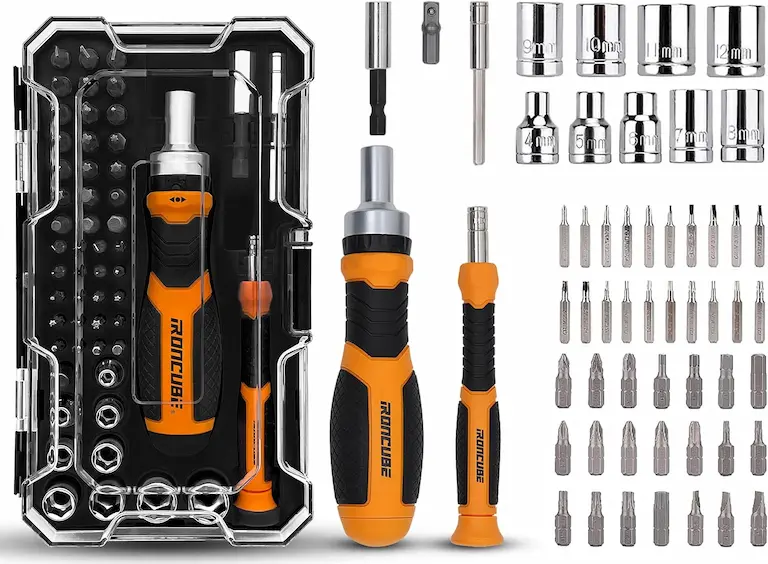
The IRONCUBE 21-in-1 Magnetic Multi-Ratcheting Screwdriver Set is the most versatile option in IRONCUBE’s driver lineup and the one most likely to become a permanent fixture in your tool bag. It ships with 20 bit types covering Phillips (#1, #2, #3), Slotted (4mm, 5mm, 6mm), Torx (T10 through T30), hex, and square-drive profiles. Every bit is retained by a strong permanent magnet in the ratcheting chuck — no adapters, no wobble.
The ratcheting mechanism is the real differentiator here. It uses a 72-tooth ratchet (5-degree swing arc), which means usable torque in spaces too tight for a full-turn driver. The handle is CRV-steel reinforced with TPR grip zones that prevent slippage even with greasy hands. For professional daily use, this set benchmarks well against options costing twice as much. You can also see a hands-on demonstration at the IRONCUBE YouTube channel.
IRONCUBE 6-Piece TPR Handle Screwdriver Set
For users who prefer individual fixed-blade drivers over bit sets, the IRONCUBE 6-Piece TPR Handle Screwdriver Set is a straightforward, well-executed option. It includes three Phillips heads (PH1, PH2, PH3) and three slotted drivers (SL4, SL6, SL8), all with magnetized S2 steel tips and ergonomic TPR tri-lobe handles. The handles are non-slip and comfortable for extended use. This set sits in the everyday carry tier — reliable for home, workshop, and light professional tasks without any unnecessary complexity.
The magnetic retention on these fixed-blade drivers is noticeably strong and consistent. S2 chrome vanadium tool steel holds magnetization better than lower-grade steel, and IRONCUBE’s manufacturing process includes a final magnetization step after tip hardening, which preserves the field strength at the point of actual use.
IRONCUBE 56-Piece Ratcheting Screwdriver Set on Amazon
For the most comprehensive kit, the IRONCUBE 56-Piece Ratcheting Screwdriver Set available on Amazon covers virtually every drive type a professional might encounter. The set includes 52 precision bits plus four extension bars, all stored in a blow-molded case with custom foam. The magnetic bit holder provides strong retention across all bit sizes, and the ratcheting handle has a direction selector on the handle cap for clean left/right/lock switching. At its price point, it’s the best-value professional screwdriver with magnetic bits currently available in this category.
Quick Comparison: IRONCUBE Magnetic Screwdriver Sets
| Set Name | Pieces | Drive Types | Best For | Ratcheting |
| 21-in-1 Multi-Ratcheting | 21 | Phillips, Slotted, Torx, Hex, Square | Professional daily use | Yes — 72 tooth |
| 6-Piece TPR Handle Set | 6 | Phillips, Slotted | Home & light pro use | No — fixed blade |
| 56-Piece Ratcheting (Amazon) | 56 | Full range incl. security bits | Workshop & field service | Yes — direction selector |
How to Re-Magnetize a Screwdriver That Lost Its Grip
Even well-made magnetized screwdrivers can lose some field strength over time — particularly non-permanent-magnet designs that relied on induced magnetism from the factory. The good news is that re-magnetizing a screwdriver takes about thirty seconds and requires nothing more than a neodymium refrigerator magnet or a dedicated magnetizer tool.
Method 1 — Neodymium magnet stroke: Hold the screwdriver tip at a shallow angle and stroke it firmly along the surface of a strong neodymium magnet, always in the same direction, from handle toward tip. Repeat 20–30 times. Each stroke aligns a small percentage of the steel’s magnetic domains. After 25–30 strokes, the tip will have regained useful magnetic retention.
Method 2 — Magnetizer/demagnetizer tool: These inexpensive devices (available for under $10) have two marked slots — one to magnetize, one to demagnetize. Insert the screwdriver tip into the magnetizer slot and pull it out in a smooth stroke. One pass is usually sufficient. This method produces more consistent results than the hand-stroke technique and is recommended for workshop use where you’re maintaining a full set.
What causes loss of magnetism: Heat above 80°C is the primary culprit — soldering nearby, leaving tools in a hot vehicle, or heat-gun work adjacent to stored drivers. Physical shock (dropping the screwdriver on a hard surface repeatedly) can also demagnetize a tip by jarring the aligned domains out of orientation. For professional sets that see hard daily use, a quick re-magnetization every few months is a worthwhile maintenance step.
If you’re investing in a premium set and want tools that hold magnetism reliably for years, consider sets with embedded permanent magnets rather than surface-magnetized tips. The IRONCUBE screwdriver range uses permanent magnet systems in the bit holder, making re-magnetization a non-issue under normal use conditions.
Building a Complete Hand Tool Kit Around Your Magnetic Screwdriver Set
A magnetic screwdriver set is most valuable as part of a well-rounded hand tool collection. For most trades and DIY applications, that means pairing your driver set with a quality wrench collection. IRONCUBE’s wrench category includes everything from standard combination wrenches to flex-head ratcheting sets, all built to ANSI standards.
If you’re currently choosing between imperial and metric fasteners — or working in a mixed environment — the IRONCUBE printable metric-to-SAE wrench conversion chart is a genuinely useful free resource. And if you want to understand how the wrench market has evolved, the history and engineering of wrenches is a well-sourced overview on Wikipedia.
For ratcheting wrench recommendations specifically, the IRONCUBE best ratcheting wrench set guide for 2026 covers the current market in depth. And the IRONCUBE double open-end wrench is worth a look if you need a high-quality, ANSI-certified fixed wrench for precision torque applications.
FAQ — Magnetic Screwdriver Set
Q1: Can a magnetic screwdriver set damage electronics?
In most cases, no — but the answer depends on context. A standard magnetic screwdriver set generates a localized field measured in tens of gauss at the tip, which drops off sharply with distance. Modern consumer electronics are designed with magnetic shielding that tolerates incidental exposure from tools. The genuine risks are: working within 20mm of an exposed hard disk drive platter (spinning HDD, not SSD), assembly of speakers or microphones, and calibration of Hall-effect sensors. For general electronics repair — laptops, phones, circuit boards, power supplies — a magnetic screwdriver is safe and is actually preferred because it prevents dropped fasteners from causing shorts inside the chassis.
Q2: How long does the magnetism last in a quality screwdriver set?
A quality magnetic screwdriver set using embedded permanent magnets (neodymium or hard ferrite) should maintain effective field strength indefinitely under normal use. Permanent magnets do not degrade in ambient conditions. Sets that use surface magnetization — where the steel tip itself is temporarily magnetized — may lose 10–20% of field strength within the first year, especially under heavy use with heat and impact exposure. A practical test: if a #8 wood screw held vertically on the tip drops after 2–3 seconds, it’s time to re-magnetize or replace the tip. Premium sets from reputable brands like IRONCUBE use permanent magnet retention systems that don’t require periodic re-magnetization.
Q3: What is the difference between a magnetic screwdriver and a magnetized screwdriver?
These terms are often used interchangeably, but technically they describe different constructions. A magnetized screwdriver refers specifically to a conventional steel driver whose tip has been exposed to a magnet, inducing a temporary magnetic state in the tip metal itself. A magnetic screwdriver more broadly includes designs with a dedicated magnet (permanent or electromagnet) embedded in the tip or bit holder, which then attracts fasteners. In practice, the magnetic screwdriver set you want for professional use is the type with a permanent magnet in the bit holder or tip assembly — not just a magnetized steel tip. The distinction matters because it directly affects how long the tool holds fasteners and how that performance changes over time.
Q4: Are magnetic screwdriver sets safe to use on stainless steel screws?
Yes, with a nuance. Most stainless steel fasteners used in construction and manufacturing are made from austenitic grades (304 or 316), which are non-magnetic or weakly magnetic depending on their cold-work state. A magnetic screwdriver set will hold austenitic stainless screws, but the grip will be noticeably weaker than on carbon steel or hardened steel fasteners. Ferritic and martensitic stainless grades (such as 410 and 416) are fully ferromagnetic and grip just as well as carbon steel. If you’re working with austenitic stainless hardware, test the magnetic grip before committing to single-handed screw starts, especially overhead or in tight spaces.
Q5: How many pieces should a good magnetic screwdriver set have?
The right size for a magnetic screwdriver set depends entirely on your work type. A homeowner doing routine maintenance is well served by a 6–10 piece set covering Phillips (#1–#3) and Slotted (4mm–8mm) drivers. An electrician or HVAC technician benefits from adding Torx T10–T30 and Robertson (square) bits, pushing the ideal kit to 20–30 pieces. Full workshop and field service kits in the 50+ piece range make sense for mobile technicians working across diverse equipment types — automotive, HVAC, IT, and consumer electronics all in one day. The IRONCUBE 56-piece set is purpose-built for exactly that use case.
Q6: Can I use a magnetic bit holder with any screwdriver handle?
Yes — a magnetic bit holder is one of the best upgrades you can add to an existing screwdriver or impact driver. Standard 1/4-inch hex bit holders accept all universal bits and can be fitted with a magnetic ring that locks bits in place and prevents them from flying off under power. For hand screwdrivers, magnetic bit holders convert a standard handle into an interchangeable-tip system. Just confirm the bit holder uses a 1/4-inch hex shank and that your handle has a compatible receiver — this is the universal standard in professional tooling. IRONCUBE’s ratcheting handles all use 1/4-inch hex sockets with integrated magnetic retention.
Summary: Is a Magnetic Screwdriver Set Worth It?
If you work with fasteners in any professional or serious DIY capacity, a magnetic screwdriver set is not a question of if but which one. The productivity gains are real, the ergonomic benefits are measurable, and the risk of dropped fasteners — with all the damage they can cause — becomes essentially zero during the pickup-and-drive phase of any job.
IRONCUBE’s lineup covers three distinct tiers: the 6-piece fixed-blade TPR set for clean, simple everyday use; the 21-in-1 ratcheting multi-bit set for professional versatility; and the 56-piece complete kit for full workshop and field service demands. All three use permanent magnet bit retention, CRV or S2 steel tips, and ergonomic handles built for actual workload — not just shelf appeal.
If you have questions about which set is right for your specific application, the IRONCUBE contact page is the fastest way to get a direct answer from the team. And if you’re ready to browse the full screwdriver range, the IRONCUBE screwdriver category has everything organized by type and application.