

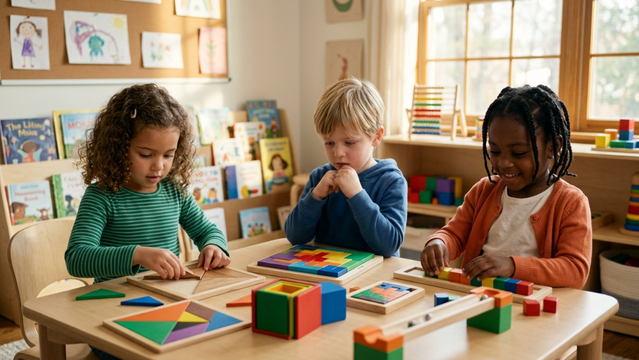
Watch a five-year-old working through a shape-sorting puzzle and you are seeing something that matters more than it appears to. The child is not just learning which shapes fit which holes. The child is developing a habit of mind: the practice of looking at a problem, identifying its constraints, and reasoning toward a solution rather than guessing or giving up.
That habit, established early and reinforced through years of age-appropriate challenge, shapes the way a person approaches difficult problems for the rest of their life. Educational psychologists have been documenting this for decades. The connection between early puzzle play and later academic and professional capability is one of the more robust findings in developmental research, and it has significant practical implications for parents and teachers who want to give children the best possible foundation.
What Happens in the Developing Brain
Children’s brains are not simply smaller versions of adult brains. They are developing structures with different capabilities and different forms of plasticity at different ages. Between roughly ages five and twelve, the prefrontal cortex, which is the region responsible for planning, reasoning, and self-regulation, undergoes particularly significant development. This is an unusually sensitive window for establishing reasoning habits.
Logic games engage exactly the neural systems that are developing most actively during this period. When a child works through a simple deduction puzzle or figures out how to fit a set of shapes into a frame, they are strengthening the prefrontal neural pathways that support analytical thinking. Research published in developmental psychology journals consistently shows that children who engage regularly with structured problem-solving activities develop stronger executive function: the set of cognitive skills that includes planning, focus, impulse control, and mental flexibility.
These are not just academic skills. They are the skills that determine how a person handles frustration, how they approach unfamiliar challenges, and how effectively they manage their own thinking across every domain of life.
Age-Appropriate Entry Points
The logic games world scales beautifully across ages, and finding the right entry point matters enormously. A puzzle that is too easy produces boredom. One that is too hard produces frustration and discouragement. The goal is the zone in between: challenging enough to require real effort, but solvable with persistence.
For children aged four to six, simple shape-sorting games, basic sequencing activities, and age-appropriate riddles are ideal starting points. These introduce the habit of problem-solving without requiring literacy or numerical skills, and they are genuinely enjoyable at this age. The goal is not to teach the specific content but to establish the disposition: problems are interesting, effort produces solutions, sticking with something hard is rewarding.
Children aged seven to ten are ready for beginner Sudoku on smaller grids, simple logic grid puzzles with clear visual cues, and spatial challenges like tangrams. At this age, the ability to follow multi-step reasoning is developing rapidly, and well-designed puzzles provide exactly the right kind of structured challenge to support that development.
Older children and teenagers can engage with the full range of logic game formats, including number puzzles at higher difficulty levels, standard deduction grids, strategy games, and digital puzzle experiences. Many teenagers discover that logic gaming connects naturally to interests in coding, mathematics, and competitive gaming, and the transition from casual play to serious engagement with these fields is often smoothed by a foundation in logical thinking developed through games.
What Parents and Teachers Should Know
The research on early puzzle play produces a few findings that are particularly worth knowing for anyone involved in a child’s development.
First, the habit matters more than the specific game. Children who develop the practice of working through structured problems regularly, regardless of which particular games they use, show stronger reasoning skills than children who are introduced to logic games occasionally without building a consistent habit. Even short daily puzzle sessions of ten or fifteen minutes produce measurable effects over months.
Second, the social context of puzzle play matters. Children who solve puzzles with engaged adults, or who discuss their reasoning aloud while working through a problem, show stronger development of metacognitive skills: the ability to think about their own thinking. Asking a child to explain why they made a particular move in a logic game does more for their reasoning development than simply letting them play silently.
Third, difficulty progression is essential. A child who only ever solves puzzles they find easy is not developing reasoning skills in any meaningful way. The challenge has to be genuine, which means finding puzzles that require real effort and, sometimes, failure and recovery.
For parents looking for a trusted platform that organizes logic games by age and difficulty level, SpillLogikk offers a curated selection of games well-suited to different developmental stages, making it easier to find the right challenge without wading through irrelevant content.
The Long-Term Picture
Children who grow up playing logic games regularly tend to develop a particular relationship with difficult problems. They approach them as interesting rather than threatening. They have learned from experience that hard problems yield to patient, systematic effort, and that the satisfaction of reaching a correct conclusion through your own reasoning is genuinely rewarding.
That relationship with difficulty is one of the most valuable things a person can bring to any challenging situation, whether it is a demanding academic program, a complex professional problem, or the ordinary hard decisions that adult life presents. And it is built, incrementally and reliably, through the simple practice of sitting down with a good puzzle and working it out.
The games are fun. That is reason enough to play them. But the thinking skills they build are the real gift, and they keep delivering value long after the puzzle is finished.