
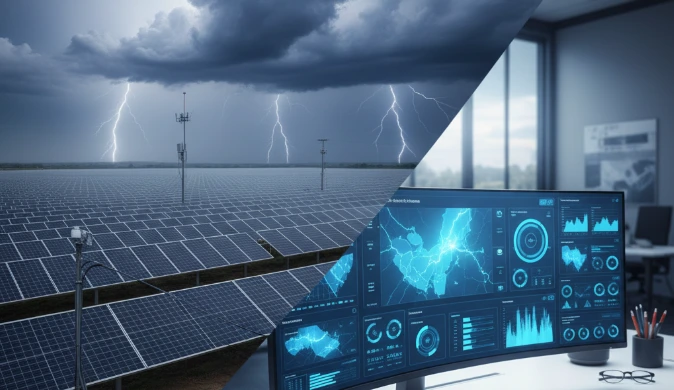
Utility scale solar organisations invest in vast tracts of land covered with conductive structures, long cable corridors, tall trackers and intricate grounding networks. Lightning enters this environment with little restraint, and its behaviour shapes asset security more than many developers admit. A single strike can fracture modules, scar inverters, or trigger protection trips that leave generation idle for hours. A disciplined approach to lightning risk assessment gives project teams a path to anticipate exposure before harm settles in.
Understanding the nature of exposure
Solar arrays form broad metallic grids that alter local electrical conditions. Their size invites wide collection zones where upward leaders may form. Each segment of a site behaves differently. A tracker row on a hill crest invites a different strike path than one in a shallow plain. A cable trench with long loops of DC conductors may collect induced surges that creep toward vulnerable electronics. Such patterns shape the foundation of any credible lightning risk assessment.
Most teams start by quantifying the striking probability. National meteorological datasets, historical ground flash density and surface features guide this stage. Raw numbers alone tell little. The real challenge lies in interpreting how site geometry directs secondary effects such as step voltages or magnetic coupling along long strings.
Methods used by engineering teams
Developers rely on a mixture of codified standards and practical engineering models. IEC 62305 remains the principal reference for structured calculation. It outlines a method that weighs physical dimensions, environmental factors and protection levels suited for large energy assets. Risk components are tallied section by section, producing a numerical expression of site exposure.
In practice, the method benefits from supplementing hand calculations with digital tools. A platform such as LRA Plus from Skytree Scientific helps teams handle complex site partitions, apply structured inputs and generate reports aligned with IEC 62305 guidance. Analysts often subdivide a solar facility into clusters of modules, inverter stations, control cabins and grid interfaces. Each cluster receives its own strike probability and loss scenario. This granular approach helps catch areas where energy concentration or conductor routing may raise risk unexpectedly.
Influence of electrical architecture
The electrical spine of a solar facility shapes lightning behaviour. Long DC strings running toward a central inverter station act like antennas that absorb electromagnetic fields from nearby strikes. Such fields may force currents along unintended paths. Surge protection devices handle part of the burden, yet their placement and coordination determine actual resilience. A surge device located too far from an inverter may slow clamping action, leaving sensitive components exposed.
Engineers analyse these patterns with models that approximate induced currents along the DC and AC networks. Sophisticated simulations are common in large programmes, though many teams rely on structured assessment tools instead, focusing on conductor lengths, bonding quality and the interaction of grounding grids.
Grounding and equipotential planning
Grounding forms the silent backbone of a solar site’s defence. A poor grid conducts lightning energy unevenly. Some areas rise in potential faster than others, which draws current through unintended paths. A thorough lightning risk assessment studies soil resistivity, grid layout, bonding between module frames, mounting structures and inverter stations.
Field surveys often reveal inconsistencies in grounding continuity across tracker rows. A small gap in bonding between structural components may appear trivial, yet lightning current will seek the lowest impedance path, turning that gap into a point of distress. Assessors trace these potential weaknesses and assign corrective measures tied to protection levels defined by IEC 62305.
Environmental shaping factors
Topography influences strike attraction. Elevated ridges draw leaders from passing storm fronts. Forest clearance near the facility might change air flow and storm movement. Proximity to taller structures, transmission towers or nearby hills also reshapes exposure. Lightning prefers abrupt changes in height, and solar installations often sit in open plains, offering large surfaces as initiation points. Analysts map these surroundings and introduce corrective coefficients within their modelling.
Methods for reporting and action planning
Risk assessment without structured reporting yields little progress. Technical staff, planners and insurers require clarity. Tools such as LRA Plus present findings in formal reports suited for engineering reviews. These reports outline calculated probabilities, loss scenarios, and recommended protection levels. Project teams then translate these conclusions into actions like:
- Revising grounding design for uniform impedance
- Strengthening surge protection coordination
- Adjusting array segmentation to improve bonding continuity
- Positioning key control equipment in zones with reduced exposure
Solar growth and the need for sharper assessment
Gigawatt scale developments across Europe, India and the Middle East place fresh pressure on project teams to refine lightning resilience. As arrays sprawl across wider terrains, risk grows in complexity. Traditional rule based protection struggles to capture subtle site behaviours. Structured lightning risk assessment offers clarity by tying physical design to measurable indicators.
Skytree Scientific positions LRA Plus as a methodical companion for engineering teams managing varied terrain, evolving layouts and extensive electrical designs. Its approach focuses on systematic inputs, clear calculations and dependable compliance guidance, assisting analysts who need consistent reasoning across large portfolios.
A closing perspective
Utility scale solar depends on durable electrical integrity. Lightning tests that integrity relentlessly during storm seasons. A rigorous assessment method helps engineers confront that reality with insight rather than guesswork. Careful modelling, informed interpretation of standards and structured tools build a defensive posture that suits the scale of modern energy assets.