

By Legal-Fintech News Desk
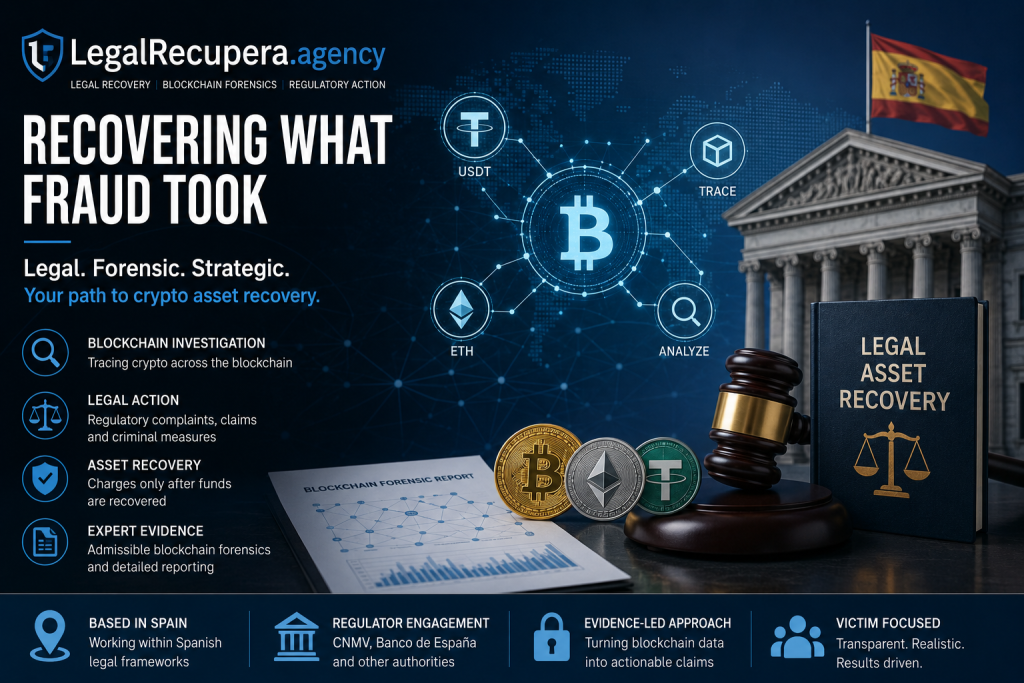
As cryptocurrency fraud becomes more sophisticated, victims are increasingly turning to hybrid legal-fintech recovery services that combine legal strategy, blockchain forensics and regulatory complaints. One such firm, LegalRecupera.agency, presents itself as a Spain-based legal recovery practice focused on helping individuals recover funds lost through fraudulent brokers, crypto platforms, online casinos and trading-advice schemes.
According to the firm’s website, Legal Recupera says it works on cases involving Forex, CFDs, cryptocurrencies and online gambling, offering an initial case review and stating that it charges only after funds are recovered. Its crypto recovery service specifically refers to tracing USDT, Bitcoin and other cryptocurrencies through blockchain transaction analysis.
Crypto fraud enters a more forensic phase
The growth of digital assets has created new opportunities for investors, but also for fraud networks that exploit cross-border payments, wallet pseudonymity and social-engineering tactics. Recent industry data shows that stolen crypto and scams remain major threats: Chainalysis reported that stolen funds rose by about 21% year over year to $2.2 billion in 2024, with private-key compromises accounting for the largest share of stolen crypto.
Law-enforcement data points in the same direction. The FBI’s 2024 Internet Crime Report recorded $16.6 billion in reported cybercrime losses, noting that cryptocurrency is used to cheat investors, launder proceeds and facilitate illicit schemes.
Against that backdrop, asset recovery is no longer simply a matter of sending demand letters. In crypto-related matters, recovery efforts often begin with transaction reconstruction: identifying wallet addresses, mapping fund flows, following assets across blockchains, detecting transfers to exchanges and preserving evidence for regulators, banks, courts or law enforcement.
LegalRecupera’s stated model: legal review, blockchain tracing and regulatory action
LegalRecupera.agency describes a four-step process: free case analysis, engagement letter, formal claim and return of funds. In the claim phase, the firm says it may contact banking entities, submit complaints to the CNMV, and where necessary provide forensic expert evidence.
For cryptocurrency cases, the firm says it adds blockchain expert analysis using tools such as Chainalysis and TRM Labs, and references the admissibility of such evidence under Spanish civil procedure rules. It also says it may pursue parallel routes including card chargebacks, regulator complaints and criminal-law measures where there is a Spanish jurisdictional link.
This legal-fintech structure reflects a broader trend in fraud recovery: victims need both legal standing and technical evidence. Blockchain analytics can show where funds moved, but lawyers are typically needed to convert those findings into actionable claims, exchange-disclosure requests, freezing measures, criminal complaints or regulatory filings.
How victims are supported
In practical terms, firms operating in this space typically assist victims in five ways:
First, they assess viability. Not every crypto loss is recoverable. Key factors include how recently the transfer occurred, whether funds reached a regulated exchange, whether payment was made by card or bank transfer, whether the victim retained wallet addresses and whether the scam has a connection to a usable jurisdiction.
Second, they preserve evidence. Victims are usually asked to provide bank statements, transaction hashes, wallet addresses, platform screenshots, contracts, emails, WhatsApp or Telegram messages and any identity documents supplied to the fraudulent platform. Legal Recupera’s FAQ similarly lists bank extracts, conversations and contracts or platform terms as documents useful for the initial review.
Third, they trace assets. Blockchain tracing can identify whether funds moved to mixers, bridges, exchanges, stablecoin issuers or other wallet clusters. This does not guarantee recovery, but it can create an evidence trail that supports complaints and urgent preservation requests.
Fourth, they coordinate legal claims. In Spain-linked cases, this may involve complaints to financial regulators, banking claims, criminal fraud complaints or civil measures. Legal Recupera’s site references complaints before the CNMV, Banco de España conduct channels and possible criminal action under Spanish fraud provisions where appropriate.
Finally, they manage expectations. Legitimate recovery work should avoid promises of guaranteed recovery. Crypto funds can move quickly, cross borders and be converted through multiple platforms. The strongest recovery prospects usually arise when assets can be traced to a compliant exchange, regulated payment channel or identifiable counterparty.
Operating within legal and regulatory frameworks
Crypto asset recovery sits within a tightly regulated environment. Recovery firms must handle personal data, evidence, financial claims and possible criminal allegations carefully. They also need to avoid becoming indistinguishable from the fraudulent “recovery scam” market, where victims are targeted a second time by actors promising guaranteed fund returns for upfront fees.
The relevant regulatory context includes anti-money-laundering rules, virtual asset service provider obligations and international standards on payment transparency. FATF updated its Recommendation 16 framework in 2025, including Travel Rule-related requirements intended to improve payment transparency and help detect financial crime in cross-border transfers.
For a Spain-based recovery firm, the legal framework may also involve Spanish consumer law, banking regulation, criminal fraud provisions, civil evidence rules and regulatory complaint mechanisms. Legal Recupera states that it works where there is a Spanish jurisdictional connection, such as a Spanish bank, Spanish company or euro payment through SEPA.
Why blockchain forensics matters
A common misconception is that crypto is anonymous and therefore impossible to trace. In reality, many blockchains are public ledgers. Investigators can often follow transactions from the victim’s wallet to intermediary wallets, exchanges or conversion points. The challenge is not always tracing; it is turning the trace into a legally enforceable recovery pathway.
That is why the combination of forensic reports, legal filings and regulator engagement has become central to modern crypto recovery. Blockchain evidence can support court applications, exchange notices and law-enforcement referrals, but it must be documented in a way that meets evidentiary standards.
The bigger picture
LegalRecupera.agency reflects a wider shift in financial-fraud response: the line between law firm, forensic investigator and fintech compliance specialist is narrowing. Victims of crypto scams need more than sympathy and more than a wallet-address report. They need a coordinated recovery strategy that is legally grounded, technically credible and realistic about the limits of asset recovery.
As crypto fraud continues to evolve, firms that can combine blockchain analytics with regulatory literacy and victim-focused legal support are likely to play a growing role in the post-scam recovery ecosystem. For victims, the key is to act quickly, preserve evidence and work only with professionals who are transparent about fees, jurisdiction, recovery risks and the absence of guaranteed outcomes.