
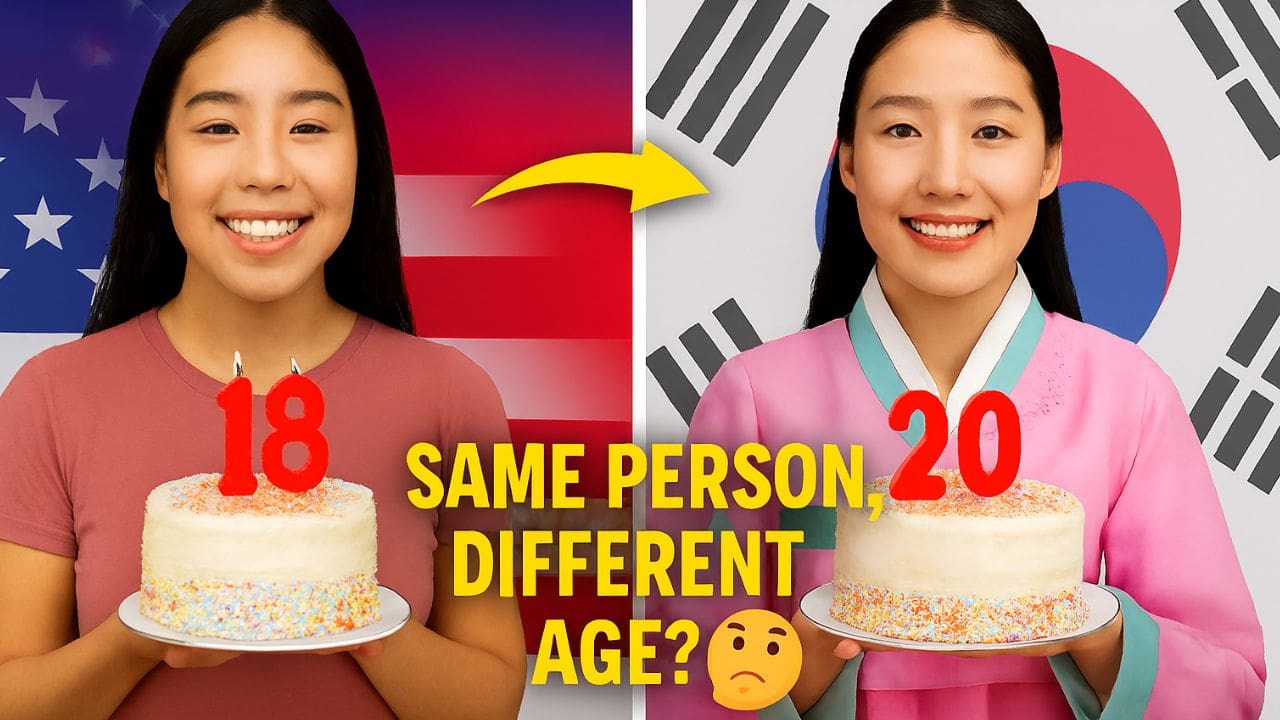
Have you ever met someone from Korea who said they were 20 years old, but their birthday showed they were only 18? That’s not a mistake – Koreans actually count age differently than most of the world!
In Korea, people are 1 or even 2 years older than their “international age” (the age most countries use). This confuses a lot of people, especially when Korean friends celebrate their birthday but don’t get “older.”
Why does this happen? Korea uses a special age-counting system that’s totally different from what you’re probably used to. Let’s break it down in the simplest way possible.
By the end of this article, you’ll understand:
- Why Koreans are born “1 year old”
- How Korean age actually works
- The difference between Korean age and Western age
- How to calculate both ages easily
What is Western Age? (International Age)
Let’s start with what you probably already know – Western age or international age.
Here’s how it works:
When you’re born: You are 0 years old
On your first birthday: You turn 1 year old
Every year after that: You add one more year on your birthday
Simple example:
- Born: January 15, 2010 → Age = 0
- January 15, 2011 → Turn 1 year old
- January 15, 2024 → Turn 14 years old
- Today (January 23, 2026) → You are 16 years old
This system is used in the United States, Europe, most of Asia, and almost everywhere else in the world. Your age goes up only on your birthday, not before.
Most people use an international age calculator to find their exact age in years, months, days, and even seconds. These calculators count from your birth date to today’s date and show you precisely how old you are right now.
What is Korean Age?
Korean age is completely different. In Korea, age isn’t just about how many birthdays you’ve had – it’s about which year you were born and what year it is now.
Here are the two BIG differences:
Rule #1: You’re Born at Age 1
In Korea, when a baby is born, they are immediately 1 year old (not zero).
Why? Koreans count the time you spent in your mother’s womb (about 9 months) as part of your first year of life. So the moment you’re born, you’ve already lived almost a year!
Example:
- Baby born on December 25, 2025
- Western age: 0 years old
- Korean age: 1 year old (already!)
Rule #2: Everyone Gets Older on New Year’s Day
This is the really confusing part! In Korea, everyone in the country gets one year older on January 1st – not on their birthday.
It doesn’t matter if your birthday is in January or December. When New Year’s Day comes, you add one more year.
Example:
- Baby born December 25, 2025
- Korean age on birth day: 1 year old
- Korean age on January 1, 2026 (just 7 days later!): 2 years old
- Western age: Still 0 years old
See how this baby is “2 years old” in Korea but hasn’t even had a first birthday yet? That’s why Koreans can be 2 years older than their international age!
Korean Age vs Western Age: Side-by-Side Examples
Let’s look at some real examples so you can see exactly how different these systems are.
Example 1: Born in January
Birthday: January 5, 2010
| Date | Western Age | Korean Age | Difference |
|---|---|---|---|
| January 5, 2010 (birth) | 0 | 1 | +1 year |
| January 1, 2011 | 0 (not birthday yet) | 2 | +2 years |
| January 5, 2011 (1st birthday) | 1 | 2 | +1 year |
| January 1, 2026 | 15 (not birthday yet) | 17 | +2 years |
| January 5, 2026 | 16 | 17 | +1 year |
| Today (Jan 23, 2026) | 16 | 17 | +1 year |
Notice: People born in January usually have only a 1-year difference because their birthday comes right after New Year’s Day.
Example 2: Born in December
Birthday: December 20, 2010
| Date | Western Age | Korean Age | Difference |
|---|---|---|---|
| December 20, 2010 (birth) | 0 | 1 | +1 year |
| January 1, 2011 (12 days later!) | 0 | 2 | +2 years |
| December 20, 2011 (1st birthday) | 1 | 2 | +1 year |
| January 1, 2026 | 15 | 16 | +1 year |
| Today (Jan 23, 2026) | 15 | 16 | +1 year |
Notice: People born in December have a 2-year difference for most of the year (from birth until their birthday), then it becomes 1 year.
Example 3: Born This Month
Birthday: January 10, 2026
| Date | Western Age | Korean Age | Difference |
|---|---|---|---|
| January 10, 2026 (birth) | 0 | 1 | +1 year |
| Today (Jan 23, 2026) | 0 (13 days old) | 1 | +1 year |
| January 1, 2027 | 0 (not birthday yet) | 2 | +2 years |
This baby is only 13 days old but is already “1 year old” in Korea!
Why Do Koreans Count Age This Way?
You might be thinking: “This seems so complicated! Why do they do this?”
Great question! There are a few reasons:
Historical Reasons
Korea’s age system comes from ancient Asian traditions, especially from China. In old times:
- People didn’t always know exact birth dates
- They counted by the year you were born, not the specific day
- The lunar calendar (moon-based calendar) was used, making birthdays less important
- Respect for elders was super important, so age groups mattered more than individual ages
Cultural Reasons
Age is very important in Korean culture because it affects:
- How you talk to people (formal vs casual language)
- Who is older/younger in friend groups
- Social hierarchy and respect
- School grades and military service
When everyone ages together on January 1st, it makes it easier to know who’s in your “age group.” You don’t have to remember everyone’s birthday – just their birth year.
Social Bonding
In Korea, people born in the same year are called “동갑” (dong-gap) or “same age.” These people often become close friends because they’re considered equals. The Korean age system makes it super easy to find your “same year” friends.
Real-Life Confusion: Stories from Korean Age
The Korean age system causes funny and confusing situations all the time!
Story 1: The “Young” College Student
Sarah moved to Korea for college. At orientation, she told people she was 19 years old (her Western age).
Her Korean classmates said, “Oh, you’re younger than us!”
But when they found out her birth year (2006), they said, “Wait, you’re actually 21 years old! You’re the same age as us!”
Sarah was confused until someone explained Korean age to her.
Story 2: The Birthday That Changes Nothing
Tom celebrated his 18th birthday in Korea with Korean friends. He was excited to say “I’m 18 now!”
His friends laughed and said, “You were already 19 in Korean age! Your birthday doesn’t change your Korean age.”
Tom learned that in Korea, birthdays are celebrated, but they don’t actually make you “older” in Korean age – only New Year’s Day does that.
Story 3: The 2-Year-Old Baby
A baby was born on December 28, 2024.
- On birth: 1 year old (Korean age)
- January 1, 2025 (4 days later): 2 years old (Korean age)
- Actual age: 4 days old!
The parents joked that their baby “aged 2 years in 4 days!”
How to Calculate Korean Age (Simple Method)
Want to know your Korean age? Here’s the easiest way to calculate it:
Method 1: If Your Birthday Hasn’t Happened Yet This Year
Korean Age = (Current Year – Birth Year) + 1
Example:
- Today: January 23, 2026
- Birth year: 2010
- Birthday: March 15
- Birthday hasn’t happened yet this year
Calculation:
- (2026 – 2010) + 1 = 16 + 1 = 17 years old (Korean age)
- Western age right now: 15 years old
- Difference: 2 years
Method 2: If Your Birthday Already Happened This Year
Korean Age = (Current Year – Birth Year) + 1
(It’s the same formula! Korean age doesn’t change on your birthday)
Example:
- Today: January 23, 2026
- Birth year: 2010
- Birthday: January 5
- Birthday already happened this year
Calculation:
- (2026 – 2010) + 1 = 16 + 1 = 17 years old (Korean age)
- Western age right now: 16 years old
- Difference: 1 year
Quick Trick
Here’s an even faster way to estimate:
- Take the current year
- Subtract your birth year
- Add 1
That’s your Korean age! It doesn’t matter what month it is or if your birthday passed.
Example:
- Born in 2008
- Current year: 2026
- 2026 – 2008 = 18
- 18 + 1 = 19 years old (Korean age)
Using Calculators to Find Your Ages
Doing the math in your head can be tricky, especially when you want to know your exact age in months, days, or even seconds!
For International Age (Western Age)
To find your exact Western age with all the details, you can use an international age calculator. These tools are super helpful because they show:
- Your exact age in years, months, and days
- How old you are in hours, minutes, and seconds (yes, really!)
- Live countdown to your next birthday
- When you hit cool milestones like “10,000 days old” or “1 billion seconds old”
- Your age in different formats all at once
Why this is useful:
- You can see your age change in real-time (the seconds keep counting!)
- Perfect for tracking special milestones
- Great for science projects or just for fun
- Shows you exactly how much time until your next birthday
For example, instead of just knowing you’re “16 years old,” you can find out you’re exactly “16 years, 2 months, 8 days, 14 hours, 23 minutes, and 47 seconds old!” The calculator keeps updating every second, which is pretty cool to watch.
For Korean Age
If you want to quickly find your Korean age without doing the math yourself, there’s a Korean age calculator that does it instantly.
Just enter your birth year, and it tells you:
- Your current Korean age
- Your Western age for comparison
- The difference between the two
This is especially helpful if:
- You’re talking to Korean friends and want to know your “Korean age”
- You’re confused about age differences
- You want to check if you calculated it correctly
- You’re planning to visit or move to Korea
Pro tip: Keep both calculators bookmarked! You’ll need to know both ages if you’re communicating with people from different countries.
Big Change in Korea (2023)
Here’s something super important to know:
In June 2023, South Korea officially started using international age for most legal and official purposes!
What changed:
- Official documents now use Western age
- Legal age limits (like drinking age, voting) use international age
- Schools and workplaces started switching to international age
What stayed the same:
- Many Koreans still use Korean age in everyday conversations
- Cultural traditions still follow Korean age
- Older generations especially still prefer Korean age
- Social relationships and friend groups still often use Korean age
Why did they change it?
The Korean government realized the dual age system was causing:
- Confusion in international communication
- Legal problems (different ages for different laws)
- Administrative headaches in schools and hospitals
- Difficulties for foreigners living in Korea
Now Korea is slowly moving toward using international age like most of the world, but the traditional Korean age system is still part of Korean culture and conversation.
Korean Age vs Western Age: Quick Comparison Chart
| Feature | Western Age | Korean Age |
|---|---|---|
| Age at birth | 0 years old | 1 year old |
| When you get older | On your birthday | January 1st every year |
| Based on | Exact birth date | Birth year |
| Difference from birth year | Usually 1-2 years younger | Usually 1-2 years older |
| Used in | Most countries | Korea (traditionally) |
| Official use in Korea (2026) | Yes (legal documents) | No (casual conversation only) |
| Calculation | Current date – birth date | (Current year – birth year) + 1 |
Common Questions People Ask
Q: Can I be 3 years older in Korean age?
A: No, the maximum difference is 2 years, and that only happens for a short time if you’re born late in the year (like December) and your birthday hasn’t come yet.
Q: Do Koreans celebrate birthdays?
A: Yes! Koreans definitely celebrate birthdays with cake, gifts, and parties – just like in Western countries. But the birthday doesn’t change their Korean age, which confuses some people.
Q: Which age should I use when talking to Koreans?
A: It depends! For official things (government forms, job applications), use international age. For casual conversation with Korean friends, they might ask your Korean age to figure out if you’re older or younger. When in doubt, just ask which age they mean!
Q: Do other countries use Korean age?
A: Not really. Korea was one of the last countries to use this system. Some other Asian countries had similar systems in the past (like China and Vietnam), but they switched to international age long ago.
Q: If I’m born on January 1st, am I still 2 years older?
A: No! If you’re born on January 1st, you’re only 1 year older in Korean age because your birth day and the day everyone ages are the same day.
Why Understanding Both Ages Matters
Knowing the difference between Korean age and Western age is important if you:
1. Have Korean friends
- They might mention their Korean age in conversation
- You won’t be confused when they say different ages
- You can figure out if you’re in the same “age group”
2. Watch Korean shows or K-pop
- Korean celebrities often mention their Korean age
- Ages in Korean dramas use Korean age
- Fan ages in K-pop fandoms can be confusing without understanding this
3. Plan to visit or study in Korea
- You’ll need to know both ages
- Official forms use international age now
- Social situations might use Korean age
4. Are just curious about different cultures
- It’s fascinating how different cultures count time!
- Shows how culture affects everyday things like age
- Helps you appreciate diversity in the world
Conclusion
So now you know the big secret: Koreans aren’t really older – they just count age differently!
Remember the key points:
✅ Western age starts at 0 and increases on your birthday
✅ Korean age starts at 1 and increases every January 1st
✅ The difference is usually 1 or 2 years
✅ Korea now uses international age for official purposes (since 2023)
✅ But many Koreans still use Korean age in daily life
✅ You can easily calculate both ages using simple formulas or online calculators
Understanding these two age systems helps you communicate better with Korean friends, enjoy Korean media without confusion, and appreciate how culture shapes something as simple as counting your age.
Next time a Korean friend tells you their age, you’ll know exactly what they mean – and you can impress them by knowing both your Western age and your Korean age!
Want to find out both your ages right now? Try using an age calculator to see your exact international age with real-time updates, or check out a Korean age calculator to instantly know how old you’d be in Korea. It’s pretty fun to see the difference!