
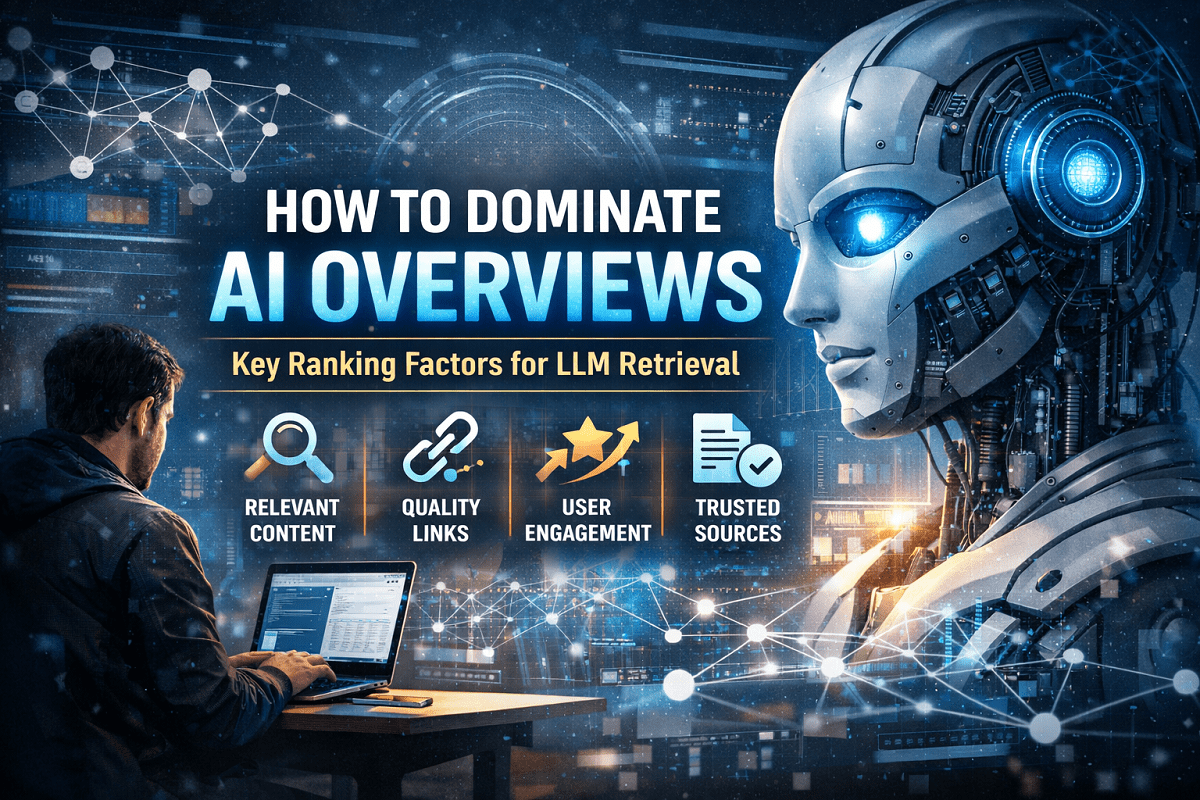
Search traffic is plummeting. Users no longer click through pages of blue links. They want instant, synthesized answers directly from AI.
If you rely purely on traditional search metrics, your visibility is already decaying. Your competitors are securing citations in ChatGPT and Google Gemini, while your content is ignored.
The solution is Generative Engine Optimization (GEO). As an AI Search Specialist at Khalid SEO, I help brands worldwide adapt to this shift. Here is the blueprint to ensure AI models retrieve, trust, and cite your content.
you can also read the original and detaild blog here: Key Ranking Factors for LLM Retrieval
The Shift from Search to Synthesis
Search engines are transitioning into answer engines. OpenAI and Google Gemini do not rank pages. They synthesize data.
Users now expect complete answers without leaving the chat interface. This fundamentally changes how we structure information online. To survive, your content must be optimized for Retrieval-Augmented Generation (RAG) systems, not just traditional web crawlers.
Traditional SEO vs. Generative Engine Optimization (GEO)
Old habits will sink your new strategy. You must understand the difference between ranking for clicks and optimizing for AI synthesis.
| Feature | Traditional SEO | Generative Engine Optimization (GEO) |
| Primary Goal | Drive clicks to a specific webpage. | Secure citations within AI-generated answers. |
| Core Metric | Search volume and keyword density. | Semantic proximity and entity trust. |
| User Action | Scrolling and evaluating multiple sources. | Reading a single, zero-click synthesized output. |
| Success Signal | High organic traffic and backlinks. | High citation velocity across LLM platforms. |
The Core Ranking Factors for LLM Retrieval
To capture Position Zero and dominate AI Overviews, you must feed the machine exactly what it wants. LLMs prioritize four primary ranking factors:
- Topical Authority: Deep, interconnected entity coverage within your niche.
- Information Gain: Unique data that breaks away from repetitive web consensus.
- Factual Consensus: Consistent brand mentions and verifiable off-page trust signals.
- Machine Readability: Strict formatting that allows rapid unstructured data parsing.
Information Gain & Factual Consensus
LLMs aggressively filter out repetitive content to mitigate hallucinations. If your article just repeats what is already ranking, an AI model will ignore it.
You must provide high Information Gain. This means introducing proprietary data, unique frameworks, or verified expert opinions. Combine this with factual consensus. When multiple trusted sources agree on your unique data, LLMs confidently cite you.
Entity-Level Trust and E-E-A-T
Keywords are out. Entities are in. LLMs map relationships using the Knowledge Graph.
Your brand must be recognized as a factual entity. This requires strong E-E-A-T signals. Digital PR and consistent brand mentions across authoritative platforms train the models to trust your expertise.
Structuring Machine-Readable Content for RAG
If an LLM cannot parse your data, it will not cite you. You must structure content for machines first.
I strongly recommend the BLUF (Bottom Line Up Front) method. Answer the user’s core intent immediately. Use clean semantic HTML, logical heading hierarchies, and robust Schema.org markup. Make extraction effortless for the algorithm.
Assess Your AI Search Visibility Readiness
Do you know if your current content is visible to AI models? Most brands are entirely blind to their LLM blind spots.
Conclusion: Securing Your Brand’s Share of AI Voice
The window to establish your brand in AI training data is closing. The models are learning who to trust right now.
If you continue to rely on outdated keyword tactics, you will lose your share of voice. It is time to audit your entity authority and restructure your data. If you are ready to implement a high-yield GEO strategy, I can help you build the technical foundation.
Frequently Asked Questions (AEO Optimized)
What are the most important ranking factors for Generative Engine Optimization (GEO)?
The top GEO ranking factors are topical authority, structured factual clarity, cross-source consensus, and high Information Gain. You must provide unique, machine-readable insights rather than repeating standard web consensus. AI models prioritize content that easily integrates into their context window. By focusing on entity depth rather than keyword frequency, you ensure your data is highly retrievable.
How does an LLM decide which websites to cite in an AI response?
LLMs select citations based on semantic relevance and source authority. They prioritize content with clear heading hierarchies, bulleted lists, valid Schema.org markup, and verifiable E-E-A-T signals.
Pages that directly and concisely answer the underlying intent are cited most frequently. If your formatting is messy, the RAG system will bypass your page for a cleaner source.
What is the difference between traditional SEO and LLM Optimization?
Traditional SEO ranks individual pages for specific keywords to drive clicks. LLM Optimization establishes entity-level trust and structures data so AI models extract, synthesize, and cite your brand directly.
This is the shift toward zero-click search. You are no longer trying to win a click; you are trying to be the source of truth within a conversational interface.
How can I make my website content more machine-readable for AI search?
To improve machine readability, utilize the BLUF (Bottom Line Up Front) method. Place direct, 40-50 word answers immediately after H2 questions using strict HTML lists and tables.
You must also deploy precise JSON-LD structured data. The easier you make it for unstructured data parsers to categorize your information, the higher your citation velocity will be.
Why is Information Gain critical for ranking in Google AI Overviews?
Information Gain measures the unique value a document adds to a topic. Because AI models train on massive datasets, they ignore redundant content. Adding proprietary data increases your citable value.
If you only summarize what top-ranking pages already say, you offer zero Information Gain. First-hand experience and original frameworks force the LLM to pull from your specific context.
Published by Khalid SEO — LLMO Strategy & AI Search Optimization
