
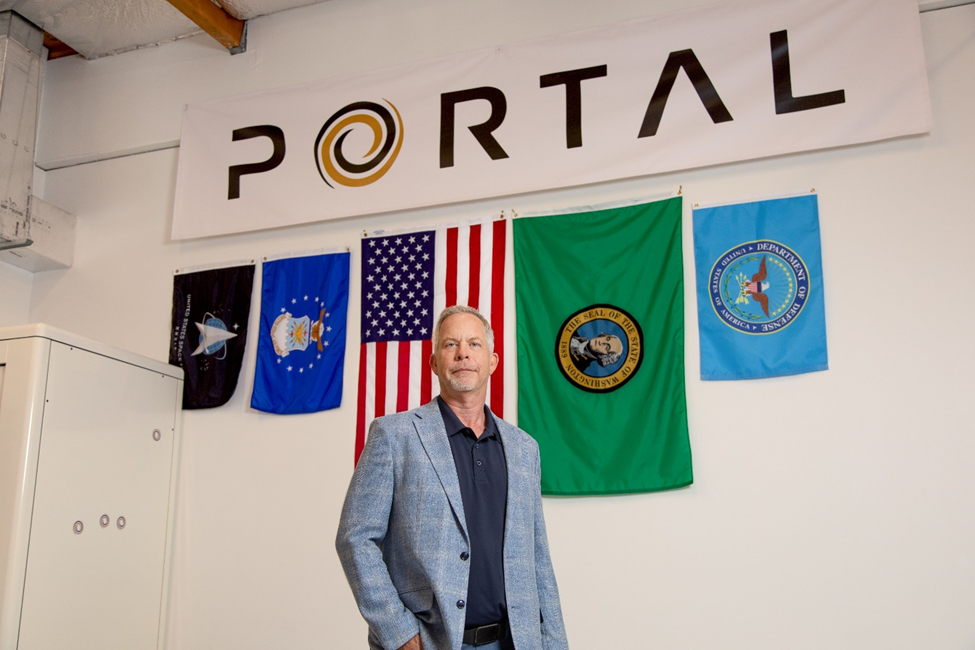
ALT: Jeff Thornburg stands inside Portal Space Systems’ Bothell, Washington facility in front of a wall displaying the U.S. Space Force flag, Department of Defense flag, U.S. flag, Washington state flag, U.S. Air Force flag, and a Portal Space Systems banner.
The private space industry has grown dramatically in the past decade with the advent of new tech and the emergence of several satellite mobility and orbital operation startups. New tech has also helped the industry advance in terms of satellite and orbital advancements. Today, several private companies are taking the industry by storm with the development of spacecraft that are more agile and flexible in terms of orbit changes and rendezvous. For several people in the space industry, the advancement of the sector is not just about the tech; it’s also about effective project management and the ability to attract government and commercial funding for ideas.
Portal Space Systems is an American private aerospace company founded in 2021 with headquarters in Bothell, Washington. Jeff Thornburg, Ian Vorbach, and Prashaanth Ravindran established the company. Its mission focuses on developing maneuverable spacecraft capable of rapid orbital repositioning, a concept known as orbital mobility. Portal’s technology aims to serve multiple sectors, including defense programs requiring on-demand satellite operations, civil missions such as space domain awareness, and commercial services that benefit from responsive satellite deployment.
The company remained in stealth mode during its early years, focusing on technology development and internal testing. Portal emerged publicly in April 2024, announcing its objective to improve orbital mobility while reducing the cost and complexity of repositioning satellites. Initial funding included approximately $3 million from the U.S. Department of Defense. This investment supported early development of propulsion systems and spacecraft prototypes.
The identity of the company, Portal Space Systems, is built on the concept of solar thermal propulsion. This is a propulsion system that uses the sunlight to heat a propellant, typically ammonia, instead of the traditional chemical propulsion system. Large mirrors concentrate the sun’s rays to heat the propellant in a heat exchanger. The heat exchanger is 3D-printed. The heated gas is then expelled through a nozzle. The system is said to be able to achieve a high delta-v and still achieve the thrust required for rapid orbital maneuvers. The system is a middle ground between the chemical and electrical propulsion systems. It is ideal for a spacecraft that needs to be mobile and flexible in the different orbits it will cover, including LEO, MEO, and GEO.
Funding and strategic support have played a critical role in the growth and development of the company. In 2025, the company raised about $17.5 million in seed funding from a syndicate of investors, including AlleyCorp. In the same year, the company received a $45 million Strategic Funding Increase from the U.S. Space Force. The company also received a $350,000 grant from the State of Washington to increase the company’s manufacturing capacity. The funding will likely be used to increase the size of the company’s development facilities and increase the workforce. The funding and support from the government and private sector have been cited in the media as critical in the development of the company’s propulsion and orbital mobility technologies.
Portal’s spacecraft platforms include the Supernova and Starburst systems. The Supernova spacecraft is a trans-orbital spacecraft designed for high-range agility and smooth transitions between low orbit, medium orbit, and geosynchronous orbit. It’s intended for use in missions that require rapid repositioning and high precision in orbit. Then there’s Starburst, launched in late 2025, and it is designed as an ESPA-class spacecraft bus that’s optimized for rapid retasking within fixed orbital planes. The two spacecraft are based upon several similar subsystems, such as reaction control and other necessary systems and are intended for use in proliferated space architectures that include large numbers of small and agile spacecraft that provide greater resiliency and operational flexibility.
Portal has secured a launch contract for its first orbital demonstration vehicle, Mini-Nova 1, which will be launched in Q1 2026 via a Momentus Vigoride Orbital Transfer Vehicle. Portal Space Systems will be testing their solar thermal propulsion system in space and will be followed by their first free-flying satellite, Starburst-1, which will be launched in late 2026 via a SpaceX Falcon 9 rocket and a SpaceX Transporter-18 mission. Other sources indicate that this satellite is to carry payloads from other organizations, including TRL11 and Zenno Astronautics, which underscores their collaborative approach to technology development.
The company has a development facility of 8,000 square feet in Bothell, Washington, which is to be expanded to a 50,000-square-foot manufacturing facility. They have indicated their intention to increase their manufacturing capability to allow them to launch several satellites per month to meet government and commercial needs. Independent sources point to their use of additive manufacturing and rapid prototyping as key contributors to their ability to meet their needs on time, as well as their ability to develop complex propulsion systems. This is seen as a growing necessity in today’s commercial aerospace landscape.
Jeff Thornburg’s leadership in Portal Space Systems, in partnership with co-founders Ian Vorbach and Prashaanth Ravindran, reflects the fusion of aerospace engineering with program management and strategic investment. From its establishment in 2021, the firm’s progression from stealth mode development to public acknowledgment, as well as the support from the government and the private sector, reflects the progression of the private space industry in the development of spacecraft mobility, propulsion systems, and the wider sphere of orbital technology.
