

Key takeaways
- IoT monitoring shifts home services from breakdown response to planned maintenance.
- It helps homeowners avoid surprises and helps providers sell and retain plans.
- The highest-impact use cases are HVAC, water heaters, leak detection, and remote triage.
- The value must show in KPIs: callbacks, truck rolls, first-time fix, renewals, CSAT.
- ROI is strongest when you count full costs and tie gains to fewer revisits + better scheduling.
- Start with a 30–60–90 day pilot, prove numbers, then scale.
Introduction
Every home service business knows this pattern. A customer calls only after a breakdown. Then you rush a tech, repeat the visit, and lose margin on callbacks.
IoT equipment monitoring flips that flow. It uses connected sensors and smart devices to capture real-time signals from household systems and appliances. As a result, teams can spot abnormal behavior early, trigger alerts, and plan service before failure.
In practice, IoT monitoring is not just “devices sending data.” It is a disciplined way to track device health, connectivity, and operating metrics continuously. Because the platform watches uptime, signal drops, and performance thresholds, it can flag anomalies, reduce blind spots, and support predictive maintenance.
Homeowner Value for Service Providers
For homeowners, IoT equipment monitoring is simple: it helps you avoid surprises. Instead of finding out there’s a problem after a breakdown, sensors can detect early warning signs like leaks, unusual vibration, overheating, or power surges. Because of that, you can act early and often avoid emergency repairs.
It also helps with energy and cost control. Smart thermostats and lighting can adapt to usage patterns and reduce waste. In many cases, smart thermostats are associated with ~10–15% savings on heating and cooling, while smart lighting can reduce electricity use ~7–27%, depending on habits and setup.
Safety is another clear win. Monitoring can trigger real-time alerts for smoke, gas, water leaks, or suspicious activity. So even when you’re away, you can check status, lock doors, and share temporary access with a service provider from your phone.
Why this matters for service providers: when customers understand these outcomes, fewer breakdowns, lower bills, and faster response they’re more likely to opt into monitoring-backed maintenance plans and stick with them.
For providers, the homeowner value becomes measurable only when IoT Development connects device telemetry to dashboards, alert logic, and work-order triggers through stable integrations.
Applications of IoT equipment monitoring in home services
1) Predictive maintenance for HVAC, water heaters, and major appliances
Sensors track operating signals like temperature, vibration, runtime cycles, and energy draw. When readings drift from a normal range, the system flags early wear or abnormal behavior.
What it enables for providers:
- Schedule maintenance before a breakdown
- Reduce emergency dispatch volume
- Bundle repairs with planned visits instead of repeat trips
Example triggers:
- HVAC short-cycling patterns
- Abnormal compressor vibration
- Water heater temperature instability or heating delays
2) Energy monitoring and optimization
IoT devices can measure real-time electricity, gas, and water usage. That data helps identify waste, overconsumption, and equipment that is working harder than it should.
Common home applications that also create service opportunities:
- Smart thermostats adjust heating/cooling using occupancy and weather signals
- Smart lighting reduces usage automatically in empty rooms
- Smart plugs expose high-draw appliances and allow scheduling
For service teams: energy anomalies often point to maintenance issues. So you can position monitoring as both savings and early fault detection.
3) Leak detection and water damage prevention
Leak sensors near plumbing fixtures, water heaters, and sump pumps detect moisture or abnormal flow and send instant alerts. This is one of the fastest “value moments” for homeowners because it prevents property damage.
For service teams: it reduces catastrophic calls while creating predictable, planned service work.
4) Safety and security monitoring
Equipment monitoring often overlaps with home safety systems, especially when it’s connected to one app and alerting layer.
Typical safety signals include:
- Smoke and fire alerts
- Carbon monoxide detection
- Electrical panel anomalies (surges, overheating warnings where supported)
- Indoor air quality signals (CO₂, humidity, particulates)
For service teams: you can build monitoring packages around “protect the home” outcomes, not just appliance performance.
5) Remote control and automation through a single app
Homeowners increasingly expect to control devices through a mobile app or voice assistants. For providers, the bigger win is workflow: remote checks reduce unnecessary visits.
Examples:
- Remote thermostat adjustment after support approval
- Door access controls for scheduled service windows
- Automated routines that reduce energy waste
For service teams: remote visibility shortens triage time and improves dispatch decisions.
6) Appliance monitoring for “status + alerts”
Smart appliances can send basic status updates such as cycle completion, fault codes, and abnormal behavior.
Examples:
- Laundry cycle completion notifications
- Fridge temperature deviations
- Oven preheat status and fault alerts
For service teams: fault notifications can be routed into service workflows, which reduces “guesswork visits” and supports better first-time fix rates.
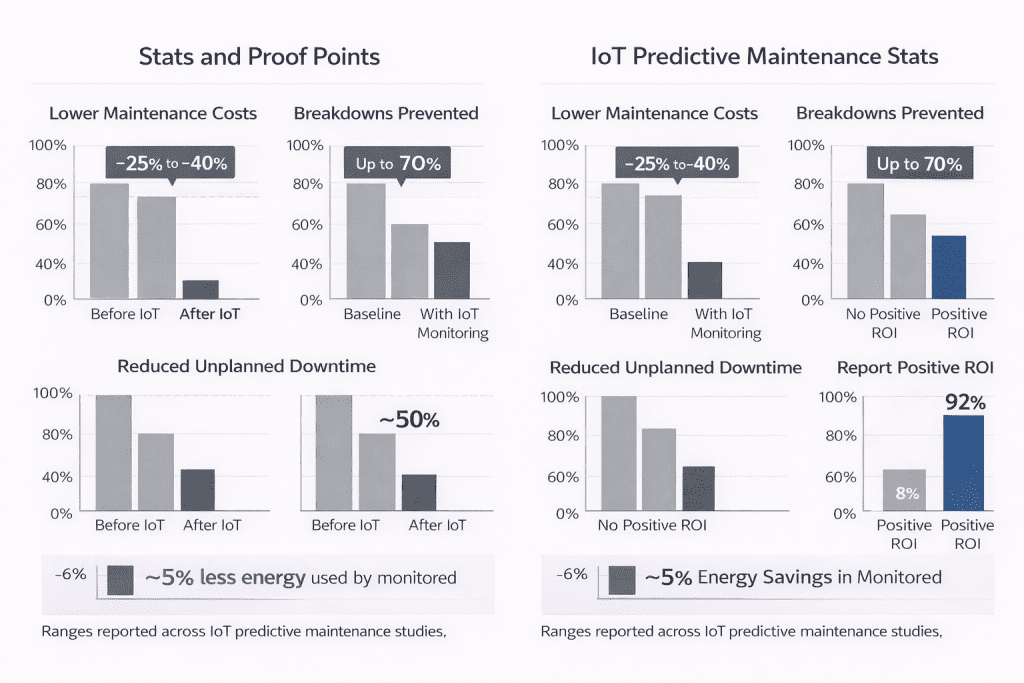
Stats and Proof Points
How IoT equipment monitoring works in home services
IoT equipment monitoring follows a simple chain: measure → transmit → analyze → act. In home services, the goal is not collecting more data. Instead, it is to detect issues early and trigger the right service action.
1) Sensing and data collection
Sensors sit inside equipment or attach externally and capture operating signals from HVAC units, water heaters, plumbing lines, appliances, and panels where supported. The most useful signals are temperature, vibration, energy draw, flow/moisture, and fault codes. These signals act like health markers. When they drift, the system flags risk before a breakdown.
2) Connectivity and transmission
Data moves through Wi-Fi, Bluetooth, or cellular to a hub or cloud platform. Connectivity is critical because monitoring fails silently when devices drop offline. Good setups track online/offline status and raise a connectivity alert when a device stops reporting.
3) Processing and analysis
The platform compares current readings against baselines and safe ranges. Detection is usually:
- Threshold rules (fast and predictable)
- Anomaly detection (flags patterns that differ from normal behavior)
The output is a severity grade, not raw charts.
4) Alerts and service actions
Alerts go to a homeowner app and a provider dashboard. Useful alerts include what changed, severity, and next action: monitor, run a remote check, schedule service, or dispatch urgent help.
Provider Workflow: From Device Signals to Dispatched jobs
To make monitoring useful in the field, most providers run a simple operating model:
Benefits as KPIs
IoT monitoring only matters if it moves numbers you already track. So, instead of listing “benefits,” tie monitoring to KPIs that prove operational and revenue impact in home services.
| KPI to track | What monitoring improves | How to measure it |
| Callback rate | Earlier detection + better diagnosis reduces repeat visits | % jobs needing a revisit within 7–14 days |
| Truck rolls per 100 jobs | Remote triage avoids unnecessary dispatch | Dispatch logs (onsite visits / 100 jobs) |
| First-time fix rate | Fault codes + pre-identified parts increase one-visit resolution | % jobs closed in a single visit |
| Breakdowns per asset / MTBF | Proactive maintenance extends time between failures | Failures per asset per quarter |
| SLA response time | Severity-based routing speeds up the right response | Alert → customer contact / onsite time |
| Plan attach + renewal rate | Monitoring makes maintenance plans easier to justify and retain | Attach % at sale + renewal % monthly |
| CSAT/NPS | Fewer surprises and faster fixes lift satisfaction | Post-job surveys + review velocity |
Pilot tip: pick 3 KPIs, set a baseline for 30 days, then track weekly. That keeps the program measurable and prevents “cool tech” drift.
ROI model + example
ROI works best when you treat it as cash in vs cash out over time. In other words, you hit break-even when your cumulative cash flow pays back the initial spend.
Step 1: List the full investment (don’t miss “hidden” costs)
Your IoT budget is not only sensors and software. It also includes setup effort, process updates, training, and adoption work.
Total Cost of Investment (TCI)
- Hardware: sensors, gateways, install kits
- Platform + analytics: subscription, dashboards, alerts, integrations
- Implementation: onboarding, rules setup, field rollout
- Ongoing ops: connectivity, support, updates
- Transition costs: process changes, skills, change management
Step 2: Quantify returns tied to your KPIs
Focus on numbers you can defend:
- Fewer emergency call-outs (lower overtime + lower chaos cost)
- Higher first-time fix rate (less rework, fewer repeat visits)
- Fewer truck rolls from remote triage
- Higher plan renewals (monitoring as a paid add-on)
Step 3: Calculate ROI
ROI (%) = (Net Gain − Total Cost) ÷ Total Cost × 100
Practical note: real ROI is usually a range, not one “perfect” number, because assumptions change.
Example: HVAC service company (12 months)
| Item | Amount (USD) |
| Total IoT cost (TCI) | $2.50M |
| Savings: fewer emergency dispatches + overtime | $1.20M |
| Savings: better scheduling + remote diagnosis | $0.80M |
| Reduced repeat visits (higher first-time fix rate) | $1.00M |
| Avoided major failures / warranty losses | $1.30M |
| Total gain | $4.30M |
Net gain = $4.30M − $2.50M = $1.80M
ROI = $1.80M ÷ $2.50M × 100 = 72%
Expert opinions
Kishan Srivastava (CEO, SDLC CORP)
Leads SDLC CORP’s delivery and growth strategy across connected digital solutions and service platforms.
“Home services usually run on urgency. A breakdown happens, the customer panics, and the business scrambles. Monitoring changes that rhythm. It gives the homeowner a sense of control and it gives the provider a calmer, planned way to deliver service. Over time, that consistency becomes your real differentiator. People don’t remember the cheapest quote. They remember the company that helped them avoid the problem in the first place.”
Shashank Jaiswal (CTO, SDLC CORP)
Engineering-led, focused on IoT architecture, telemetry pipelines, alert orchestration, and integration reliability.
“IoT monitoring works only when the plumbing is right: device identity, stable connectivity, and strict alert rules. Start with a small signal set that maps to service actions, leak events, overheat conditions, short cycling, abnormal current draw. Then design severity levels and escalation paths so dispatch isn’t guessing. Finally, integrate alerts into the tools the team already lives in, otherwise you just create another dashboard that nobody checks.”
Trends + Future actions
IoT monitoring in home services is moving from “alerts” to decision support. In the next 12–24 months, the winners will be providers who turn device data into cleaner triage, tighter scheduling, and predictable service revenue.
Trends shaping monitoring in home services
- AI-assisted predictive maintenance: models learn normal behavior and flag drift earlier, so teams schedule work before failure.
- Edge processing: more logic runs on the device or gateway, so critical alerts trigger faster, even with weak connectivity.
- Interoperability first: standards and common protocols reduce vendor lock-in and make mixed-device homes easier to support.
- Security and privacy by default: stronger authentication, encryption, and firmware hygiene become non-negotiable.
- Monitoring packaged as a service: providers bundle monitoring into maintenance plans with clear response rules and SLAs.
Future actions for service providers
- Start with one trade + one asset type, then expand after you hit KPI targets.
- Build a severity ladder (low/medium/high) and assign owners, so alerts don’t bounce between dispatch and techs.
- Train techs on signal interpretation (runtime drift, short cycling, leak events) and keep playbooks simple.
- Treat security as operations: patch cycles, device onboarding rules, and clear customer consent language.
Conclusion + pilot steps
IoT Development makes sense in home services when it turns equipment behavior into planned worknot more alerts. The strongest outcomes come from reducing repeat visits, improving scheduling accuracy, and building a monitoring-backed plan customers keep renewing.
What to take away
- Move from “breakdown-first” work to signal-led service.
- Use monitoring to raise one-visit resolution and cut avoidable dispatch.
- Treat data as operations: measure, adjust, and lock what works.
- Scale only after the numbers prove the model.
30–60–90 day pilot
30 days: pick one asset + 3 KPIs, install, and set simple alert rules.
60 days: tune noise, standardize triage, and track outcomes per alert.
90 days: compare against baseline, calculate payback, then expand or productize as a paid monitoring plan.