
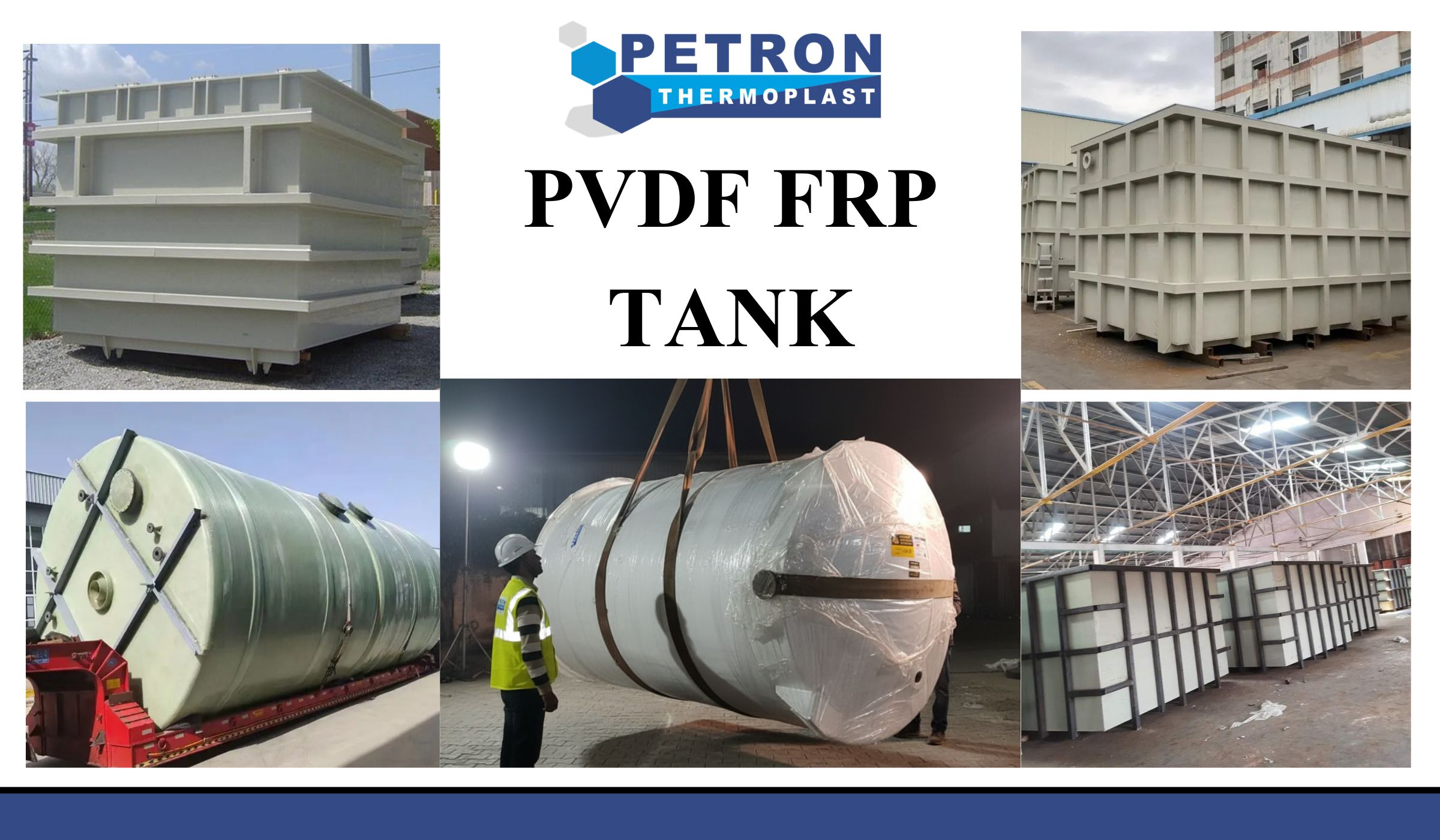
Industrial chemical processing environments require advanced storage systems capable of handling aggressive chemicals, elevated temperatures, and demanding operating conditions. Conventional storage tanks often fail when exposed to corrosive chemicals combined with high thermal stress, resulting in structural degradation, leakage risks, and operational downtime. To address these challenges, industries increasingly rely on PVDF FRP tank engineered for exceptional chemical resistance and excellent thermal stability.
Industrial PVDF FRP tanks are widely used in chemical processing plants, pharmaceutical facilities, semiconductor industries, water treatment systems, electroplating plants, and high-purity industrial applications. Their advanced dual laminate construction combines the superior chemical resistance of PVDF with the structural strength of FRP, creating a highly durable storage solution for demanding industrial environments.
Understanding PVDF FRP Tanks
A PVDF FRP tank is a dual laminate industrial storage tank manufactured using:
- PVDF (Polyvinylidene Fluoride) inner liner
- FRP (Fiber Reinforced Plastic) structural outer layer
The PVDF liner provides excellent resistance against aggressive chemicals and high temperatures, while the FRP outer shell delivers superior mechanical strength and structural stability.
This combination creates a storage system capable of handling:
- Corrosive chemicals
- High-purity fluids
- Elevated temperature applications
- Aggressive process conditions
PVDF FRP tanks are commonly used for:
- Chemical storage
- Acid containment
- Process fluid management
- High-temperature chemical handling
- Industrial wastewater treatment
Importance of Thermal Stability in Industrial Storage Tanks
Industrial storage tanks operating under elevated temperatures require excellent thermal stability to maintain structural integrity and operational reliability.
Poor thermal resistance may lead to:
- Material deformation
- Structural weakening
- Chemical leakage
- Reduced service life
- Process failure
- Increased maintenance costs
Industrial applications involving heated chemicals or fluctuating process temperatures demand storage systems capable of maintaining consistent performance under thermal stress.
Excellent thermal stability helps:
- Improve operational safety
- Maintain chemical compatibility
- Extend tank lifespan
- Reduce downtime
- Improve process efficiency
PVDF FRP tanks are specifically engineered to perform reliably in these demanding conditions.
Why PVDF Material Provides Excellent Thermal Stability?
PVDF is one of the most advanced thermoplastic materials used in industrial chemical storage systems.
High Temperature Resistance
PVDF offers excellent thermal resistance and can safely operate under elevated temperatures without losing mechanical or chemical performance.
This makes PVDF suitable for:
- Hot chemical storage
- Heated process fluids
- Thermal chemical applications
- Industrial process systems
Its ability to maintain dimensional stability under heat improves long-term operational reliability.
Superior Chemical Resistance at Elevated Temperatures
Many conventional materials lose chemical resistance when exposed to high temperatures. PVDF maintains exceptional chemical compatibility even under thermally aggressive conditions.
PVDF can safely handle:
- Strong acids
- Alkalis
- Solvents
- Chlorinated chemicals
- Corrosive industrial fluids
This combination of thermal and chemical stability makes PVDF highly suitable for demanding industrial applications.
Low Permeability
PVDF provides excellent barrier protection against chemical permeation and vapor transmission, helping maintain safe containment even under elevated temperatures.
UV and Weather Resistance
PVDF materials also provide excellent resistance against:
- UV radiation
- Outdoor exposure
- Environmental degradation
- Atmospheric corrosion
This improves long-term performance for outdoor industrial installations.
Role of FRP in PVDF FRP Tanks
While PVDF provides chemical and thermal protection, the FRP outer structure delivers mechanical strength and load-bearing capability.
High Structural Strength
FRP reinforcement allows the tank to withstand:
- Mechanical stress
- Fluid pressure
- Wind loads
- Structural loading
- Industrial operating conditions
Lightweight Construction
FRP structures are significantly lighter than metal tanks, simplifying transportation and installation.
Lightweight construction reduces:
- Foundation requirements
- Installation costs
- Structural loading
- Maintenance complexity
Corrosion-Free Performance
FRP materials do not rust or corrode under industrial environmental exposure, improving the operational lifespan of the tank.
Key Features of Industrial PVDF FRP Tanks
Industrial PVDF FRP tanks are designed with advanced features to support safe and reliable industrial operations.
Dual Laminate Construction
The dual laminate design combines:
- PVDF chemical barrier protection
- FRP structural reinforcement
This provides superior durability and performance in corrosive and high-temperature applications.
Leak-Proof Design
Leak prevention is essential in industrial chemical storage systems. PVDF FRP tanks are manufactured using precision fabrication techniques that ensure secure joints and reliable sealing performance.
Leak-proof construction helps:
- Prevent chemical loss
- Improve workplace safety
- Protect industrial infrastructure
- Reduce environmental risks
Excellent Thermal Stability
PVDF FRP tanks maintain structural integrity and chemical resistance under elevated operating temperatures.
High Mechanical Durability
Industrial process systems often involve continuous operational stress. PVDF FRP tanks provide:
- Impact resistance
- Pressure handling capability
- Structural stability
- Long-term reliability
Low Maintenance Requirements
Corrosion-free materials significantly reduce maintenance requirements and improve operational efficiency.
Applications of PVDF FRP Tanks
Industrial PVDF FRP tanks are widely used across multiple industries requiring thermal and chemical resistance.
Chemical Processing Industries
Chemical plants use PVDF FRP tanks for:
- Acid storage
- Solvent handling
- Process chemical containment
- Corrosive fluid management
Semiconductor Industries
Semiconductor manufacturing requires ultra-clean and chemically resistant storage systems for high-purity process chemicals.
Pharmaceutical Industries
Pharmaceutical facilities use PVDF FRP tanks for:
- High-purity chemical storage
- Process fluid handling
- Specialized chemical systems
Electroplating Industries
Electroplating operations involve aggressive chemicals and elevated temperatures that require advanced corrosion-resistant storage solutions.
Water and Wastewater Treatment Plants
PVDF FRP tanks are used for:
- Chemical dosing systems
- Corrosive fluid storage
- Industrial wastewater handling
Advantages of PVDF FRP Tanks Over Conventional Storage Tanks
Industries increasingly replace conventional storage systems with PVDF FRP tanks due to their superior performance characteristics.
| Feature | PVDF FRP Tank | Conventional Metal Tank |
| Thermal Stability | Excellent | Moderate |
| Chemical Resistance | Superior | Limited |
| Corrosion Resistance | Excellent | Poor |
| Structural Strength | High | High |
| Maintenance | Low | High |
| Service Life | Long | Moderate |
| Weight | Lightweight | Heavy |
Factors to Consider When Selecting a PVDF FRP Tank
Proper tank selection is important for achieving safe and reliable industrial performance.
Operating Temperature
Select a tank designed for the required operating temperature range.
Chemical Compatibility
Verify compatibility between the PVDF liner and the stored chemical.
Storage Capacity
Tank size should match operational and process requirements.
Installation Environment
Indoor and outdoor installations may require additional UV protection and reinforcement features.
Structural Design Requirements
Industrial applications may require:
- Reinforced support structures
- Pressure-rated designs
- Specialized nozzles and fittings
- Custom fabrication solutions
Installation and Maintenance Benefits
Industrial PVDF FRP tanks provide several operational advantages.
Easy Installation
The lightweight structure simplifies handling and installation procedures.
Reduced Maintenance Costs
Corrosion-free construction minimizes:
- Repair frequency
- Replacement costs
- Inspection requirements
- Operational downtime
Long Operational Life
PVDF FRP tanks are designed for extended industrial service under demanding thermal and chemical conditions.
Environmental and Economic Benefits
Modern industries focus heavily on sustainable and cost-efficient infrastructure solutions. PVDF FRP tanks support these objectives through:
- Long service life
- Reduced maintenance waste
- Leak prevention
- Lower lifecycle costs
- Improved operational efficiency
Their durable construction also reduces the environmental impact associated with frequent equipment replacement.
Why Industries Prefer PVDF FRP Tanks?
Industrial facilities handling corrosive and high-temperature chemicals require advanced storage systems capable of maintaining long-term reliability.
PVDF FRP tanks provide:
- Excellent thermal stability
- Superior chemical resistance
- Corrosion-free performance
- High mechanical strength
- Leak-proof containment
- Long operational life
These benefits make them highly suitable for modern industrial storage applications.
Conclusion
Industrial PVDF FRP tanks with excellent thermal stability provide reliable and durable solutions for storing aggressive chemicals under elevated temperature conditions. Their advanced dual laminate construction combines the superior chemical resistance of PVDF with the structural strength of FRP, ensuring safe and efficient industrial operation.
From chemical processing plants to semiconductor facilities and pharmaceutical industries, PVDF FRP tanks deliver dependable long-term performance while reducing maintenance costs and improving process safety. Their ability to withstand thermal stress, corrosive chemicals, and demanding industrial conditions makes them one of the most effective storage solutions for modern industrial infrastructure.
Selecting high-quality PVDF FRP tanks from a trusted manufacturer like Petron Thermoplast helps industries achieve safe chemical containment, improved operational reliability, and long-term process efficiency.