
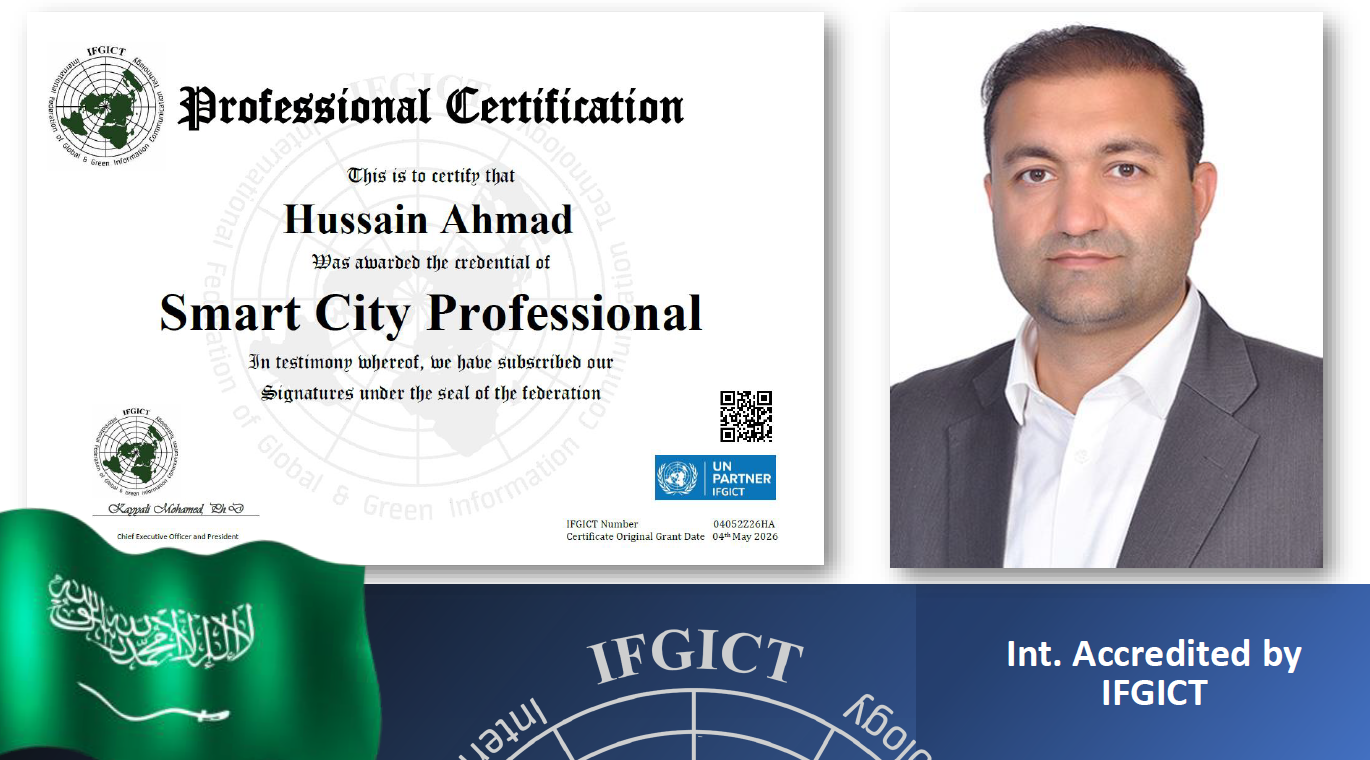
The global landscape of infrastructure is currently undergoing a radical shift, moving away from static brick-and-mortar developments toward dynamic, data-driven ecosystems. At the heart of this transformation are the specialized engineering professionals who can synchronize the complexities of telecommunications, data storage, and urban planning into a single, high-availability framework. Hussain Ahmad, a seasoned engineering professional with more than eighteen years of experience, has recently reached a significant milestone in his career. He has been officially recognized as a Smart City Professional (SCP) by the International Federation of Global and Green ICT (IFGICT). This certification serves as a testament to his mastery of complex high-tech environments and his ability to deliver large-scale projects that meet the most rigorous international standards.
The International Federation of Global and Green ICT is a world-renowned body dedicated to setting the standards for a sustainable and efficient digital future. By awarding Hussain Ahmad the Smart City Professional certification, the federation acknowledges his capacity to lead the next generation of urban innovation. In an era where the concept of a city is being redefined by its connectivity and resource efficiency, Hussain’s unique blend of expertise in mission-critical systems and governance positions him as a definitive authority in the global effort to build smarter, safer, and more resilient urban centers.
The Foundation of an Eighteen-Year Engineering Legacy
Hussain Ahmad’s professional journey is characterized by nearly two decades of deep involvement in some of the most challenging technical environments in the industry. His career has been defined by a focus on “high-availability”—a technical term that describes systems designed to remain operational for exceptionally long periods with minimal downtime. In the world of high-tech engineering, high availability is not just a preference; it is a mechanical necessity for systems that support human safety, global commerce, and essential public services. Hussain’s ability to deliver these projects consistently highlights a career built on technical precision and a refusal to compromise on quality.
Throughout his eighteen-year trajectory, Hussain has navigated the diverse perspectives of the engineering lifecycle. He has held pivotal roles across the entire spectrum of the industry, acting as a contractor, vendor, and a leader within Project Management Consultancy (PMCM) and Project Management Office (PMO) environments. This 360-degree view of the project lifecycle has given him a rare advantage. He understands the boots-on-the-ground challenges of the contractor, the technical constraints of the vendor, and the high-level strategic requirements of the client. This multifaceted experience allows him to translate abstract client requirements into practical, implementable solutions that survive the rigors of the construction and integration phases.
Master of Mission-Critical ICT and Data Center Infrastructure
One of the pillars of Hussain Ahmad’s expertise is his work within the realm of data centers and Information and Communication Technology (ICT) infrastructure. Data centers are often described as the “engines” of the modern world, housing the vast amounts of information that power our digital lives. Designing and delivering these facilities requires an intimate knowledge of thermal management, redundant power systems, and physical security. Hussain has spent years ensuring that these critical nodes of the digital economy are built to survive any contingency.
His work in mission-critical telecom systems further emphasizes his commitment to reliability. Whether it is ensuring that a wireless network remains functional during a peak load or designing the fiber-optic backbone of a major industrial facility, Hussain approaches every task with a focus on long-term stability. This focus on mission-criticality is precisely why he is a perfect fit for the IFGICT certification. The federation prioritizes systems that are not only advanced but are also sustainable and robust enough to handle the pressures of global connectivity.
Bridging the Gap with Smart City Architecture and IoT
The transition from a standard engineering professional to a certified Smart City Professional involves a profound shift in thinking. It requires an architect to see the city as a living organism rather than a collection of separate utilities. Hussain Ahmad’s work in Smart City architecture focuses on the convergence of various high-tech systems, including the Internet of Things (IoT) and advanced wireless communications. By integrating sensors into the fabric of urban infrastructure, he enables cities to monitor everything from traffic patterns and energy consumption to public safety and environmental quality in real-time.
This level of integration is what defines the “Smart” in Smart City. However, the true challenge lies in making these systems communicate flawlessly with one another. Hussain’s background in ICT and wireless systems provides the foundational knowledge necessary to build these communication protocols. He understands that for a smart city to be effective, it must be secure and scalable. As urban populations continue to grow, the architectures he designs must be capable of expanding without requiring a complete overhaul of the existing digital infrastructure.
Governance Design Management and Delivery Oversight
Beyond the technical designs and the hardware of sensors and servers, Hussain Ahmad excels in the vital disciplines of governance and design management. In large-scale, high-availability projects, the risk of failure is often found in the “gaps” between different teams or phases of the project. Hussain’s experience in PMO and PMCM roles has made him an expert in delivery oversight, ensuring that every multidisciplinary team is aligned with the project’s ultimate goals. He acts as the bridge between the technical specialist and the executive stakeholder, providing the governance necessary to keep complex projects on track and within budget.
His capabilities in design management involve a rigorous process of integration and testing. In Hussain’s world, no system is considered “delivered” until it has been proven to meet international standards through exhaustive validation. This lifecycle approach—moving from initial concept through to testing, handover, and operation—ensures that the client receives a solution that is not only functional but is also easy to maintain and upgrade. His leadership style is collaborative yet direct, focusing on the practical results that come from well-managed multidisciplinary teams.
A Commitment to Global and Green ICT Standards
The relationship between Hussain Ahmad and the IFGICT is founded on a shared commitment to the “Global and Green” mission of the federation. As an engineering professional, Hussain recognizes that the technology of the future must be environmentally responsible. High-tech environments and data centers are notorious for their energy consumption, and part of the challenge of a Smart City Professional is to find ways to mitigate this impact. By incorporating Green ICT principles into his designs, Hussain helps organizations reduce their digital carbon footprint while simultaneously improving their operational efficiency.
The IFGICT certification also highlights Hussain’s alignment with global standards. In an increasingly interconnected world, engineering protocols must be interoperable across different regions and technologies. Hussain’s mastery of these international benchmarks ensures that the projects he leads are world-class. His certification distinguishes him as a leader who is not only technically proficient but also ethically grounded and committed to the sustainable growth of the global technology sector.
Shaping the Future of Intelligent Urban Systems
Hussain Ahmad’s achievement as a Smart City Professional Certified degree holder is a well-deserved recognition of a career spent at the cutting edge of engineering. His ability to handle the full lifecycle delivery of mission-critical systems makes him an invaluable asset to any city or organization looking to navigate the complexities of the digital age. He represents a new breed of engineering leader—one who is as comfortable with a high-level governance meeting as he is on a technical handover at a construction site.
As he continues to lead large-scale projects and mentor the next generation of engineers, Hussain’s influence will undoubtedly be felt in the resilient and intelligent cities he helps to build. His legacy is found in the reliability of the networks he designs and the efficiency of the urban systems he architects. Through his partnership with the International Federation of Global and Green ICT, Hussain Ahmad is not just building infrastructure; he is architecting the future of human connectivity, ensuring that the cities of tomorrow are as smart, green, and secure as the technology that powers them.