
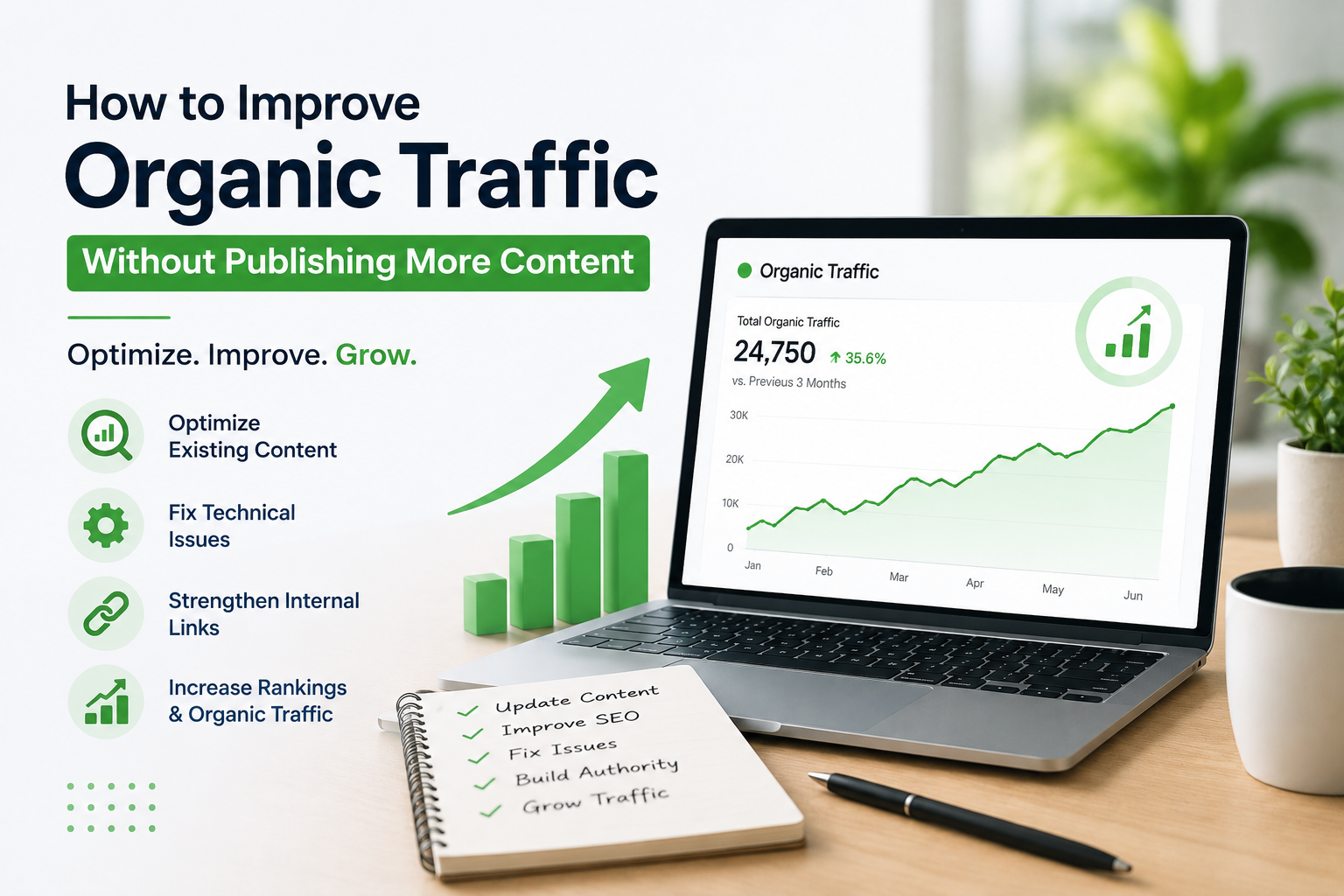
Many businesses assume that the only way to increase website traffic is by constantly publishing new blog posts. While content creation remains an important part of SEO, it’s not always the answer.
In fact, many websites already have enough content to generate significantly more organic traffic. The real challenge is that existing pages are often underperforming due to technical issues, outdated information, poor optimization, or a lack of authority.
Before investing time and resources into creating more content, it may be worth evaluating how effectively your current content is working.
In this article, we’ll explore practical ways to improve organic traffic without publishing more content and how small optimizations can lead to significant SEO gains.
Why More Content Isn’t Always the Solution
Content marketing has become one of the most common SEO strategies, but many websites fall into the trap of publishing new articles while neglecting older pages.
Over time, websites accumulate:
- Outdated blog posts
- Thin content
- Broken internal links
- Unoptimized metadata
- Keyword cannibalization issues
- Declining rankings on previously successful pages
As a result, businesses often create more content when the better solution is improving what already exists.
Google’s goal is to provide the most relevant and useful results to users. Enhancing existing content can often deliver faster and more sustainable results than continually publishing new pages.
Start With a Website Review
Before making changes, it’s important to understand what is holding your website back.
Many websites already have enough content to rank better. The first step is conducting a SEO audit to identify underperforming pages, content gaps, technical issues, and backlink opportunities.
An audit helps uncover:
- Pages that have lost rankings
- Technical errors affecting visibility
- Indexing and crawlability problems
- Internal linking opportunities
- Content that requires updating
- Weak backlink profiles
Rather than guessing what’s wrong, a structured review provides a clear roadmap for improvement.
Update Existing Content
One of the easiest ways to improve organic traffic is by refreshing existing content.
Search engines favor content that remains relevant and accurate. Pages that were published several years ago may contain outdated information, statistics, screenshots, or recommendations.
When updating content, consider:
Refreshing Statistics
Replace outdated figures with current industry data.
Improving Readability
Break up long paragraphs, improve formatting, and use clear headings.
Expanding Key Sections
Address common questions and provide additional context where needed.
Updating Examples
Replace old case studies or references with newer examples.
Content updates often help pages regain rankings without requiring entirely new articles.
Optimize Title Tags and Meta Descriptions
Title tags and meta descriptions play a significant role in click-through rates.
Even if a page ranks well, poor metadata can limit traffic potential.
Review existing pages and ensure:
- Primary keywords appear naturally in titles
- Titles encourage clicks
- Meta descriptions accurately summarize content
- Duplicate titles are removed
A simple title optimization can improve visibility and attract more clicks from search results.
Strengthen Internal Linking
Internal links are often overlooked but can have a significant impact on SEO performance.
Search engines use internal links to understand relationships between pages and distribute authority throughout a website.
Benefits of strong internal linking include:
- Improved crawlability
- Better user navigation
- Increased page authority
- Higher engagement metrics
Review your content and identify opportunities to connect related pages naturally.
For example, if you have content discussing traffic growth, technical SEO, keyword research, or content optimization, linking between relevant resources can help strengthen topical relevance.
Improve Page Speed and User Experience
User experience has become increasingly important for SEO.
Visitors expect websites to load quickly and function smoothly across all devices.
Common issues that negatively affect user experience include:
- Slow page speed
- Poor mobile usability
- Intrusive pop-ups
- Layout shifts
- Broken navigation
Google’s Core Web Vitals provide useful insights into real-world user experience.
Improving page speed not only helps rankings but can also increase engagement and conversions.
Fix Keyword Cannibalization
Keyword cannibalization occurs when multiple pages target the same search query.
Instead of helping rankings, these pages compete against each other.
Signs of keyword cannibalization include:
- Multiple pages ranking for the same keyword
- Fluctuating rankings
- Declining visibility
To resolve this issue:
- Consolidate similar content
- Redirect weaker pages where appropriate
- Strengthen the primary page
- Clarify keyword targeting
This helps search engines understand which page should rank for a specific topic.
Improve Existing Backlinks and Authority
Many websites focus on content but overlook authority-building efforts.
Even high-quality content may struggle to rank if competing websites have stronger backlink profiles.
Backlinks remain an important ranking signal because they help search engines evaluate trust and authority.
A backlink review can help identify:
- Lost backlinks
- Broken referring links
- Competitor link opportunities
- Unlinked brand mentions
After technical and content improvements are complete, many businesses focus on strategic authority-building methods such as guest posting, digital PR, and editorial outreach to strengthen their online presence.
The goal isn’t simply acquiring more links but earning relevant, high-quality links that support long-term growth.
Improve Content That Already Receives Traffic
Not all content requires major updates.
Sometimes the biggest opportunities come from pages already generating traffic.
Review pages that rank between positions 5 and 20 in search results.
These pages often require only minor improvements to achieve significant ranking gains.
Consider:
- Expanding content depth
- Adding supporting sections
- Improving internal links
- Updating metadata
- Improving user experience
Moving a page from position 8 to position 3 can often generate more traffic than publishing multiple new articles.
Monitor Search Performance Regularly
SEO is not a one-time activity.
Search behavior changes, competitors publish new content, and search engines update their algorithms regularly.
Monitoring performance helps identify new opportunities before rankings decline.
Key metrics to track include:
- Organic traffic
- Keyword rankings
- Click-through rates
- Indexing status
- Page speed
- Backlink growth
Regular reviews help ensure that existing content continues to perform effectively over time.
Final Thoughts
Publishing new content will always play an important role in SEO, but it isn’t the only way to grow organic traffic.
Many websites already have valuable content assets that are underperforming due to technical issues, outdated information, weak internal linking, or insufficient authority.
By focusing on content optimization, technical improvements, user experience, and backlink opportunities, businesses can often increase website traffic without creating additional content.
Before investing in another round of content production, take a closer look at what you already have. The biggest SEO opportunities are often hiding in plain sight.