

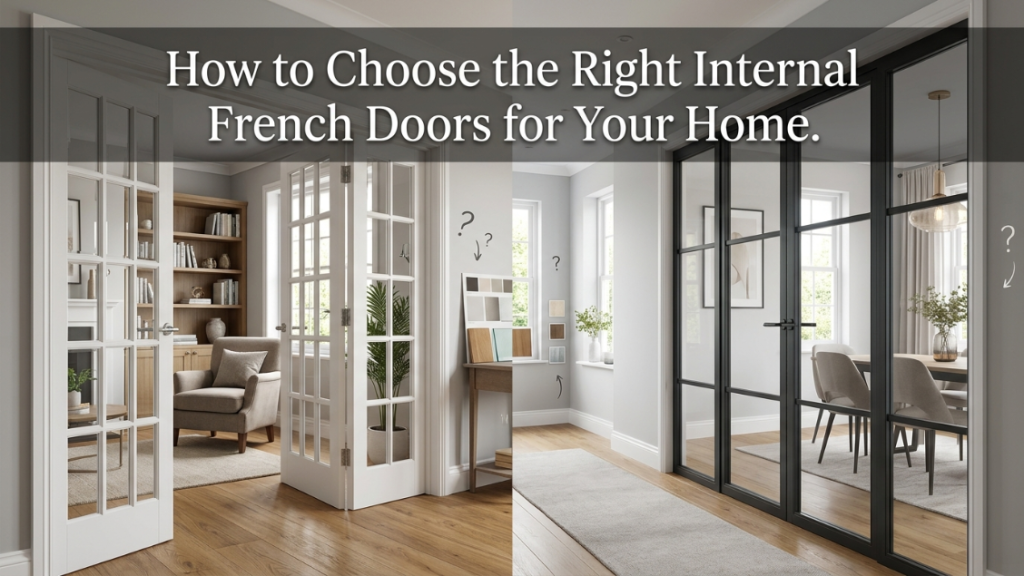
How to Choose the Right Internal French Doors with Glass
Glazed internal doors are one of those decisions that feel straightforward until you actually start researching them. Then you realise there are about fifteen different variables to consider, glass type, frame material, profile width, finish colour, glazing bar pattern, hardware, and suddenly what seemed like a simple upgrade becomes a fairly involved process. The good news is that once you understand what each choice actually does, it becomes a lot easier to navigate. This guide is aimed at homeowners who want honest, practical advice rather than a glossy rundown of options with no real guidance on what to pick.
One thing upfront: the quality of the frame material underpins everything else. You can make excellent decisions on every other variable and still end up disappointed if the frame itself isn’t right for your home. We’ll come to that.
Start With the Glass, Because It’s More Complex Than You Think
Most people assume the glass choice is simple. Clear or frosted, basically. But the range available for internal french doors with glass is considerably broader than that, and each option does something meaningfully different in a real home.
Clear Glass
Clear glass wins out in the impact on light and visual continuity. When putting in doors between your kitchen diner and living room or between an extension to the rear and the original house, you will allow the light to flow easily and keep the two areas visually connected no matter what state the doors may be in. It is clean and architecturally simple, especially when housed within a thin steel frame.
The trade-off with being upfront is obvious. In rooms where keeping things tidy is a daily challenge (and in a family environment, that describes just about every room), there is no hiding anything from view at any point. It can be inspiring for some; terrifying for others.
Reeded Glass
This has become the most talked about glazing option in the last few years, and the enthusiasm is deserved. Reeded glass has a ribbed vertical texture that diffuses the view without meaningfully reducing the light. You get brightness, you get a softened sense of privacy, and you get a material that has genuine visual character of its own. The way it catches and refracts light throughout the day is something flat glass simply can’t replicate.
It works in almost every interior context. Contemporary spaces, period properties, transitional renovations , reeded glass suits them all because its appeal is rooted in texture and quality rather than trend. If you’re unsure which glazing to choose, reeded is almost always a safe bet and frequently the best one.
Frosted and Satin Glass
Solid privacy with good light diffusion. Frosted glass is the traditional choice for spaces where you want brightness without any visual transparency at all. It suits more classic interior schemes and period properties particularly well. It doesn’t have the same visual depth as reeded, but it does its job very effectively and it’s been doing it for long enough that it’s clearly not going anywhere.
Smoked and Tinted Glass
Less common for internal applications, but worth knowing about. Smoked glass reduces light transmission more than the other options, which limits where it makes sense. In a basement conversion, a media room, or a space with a deliberately dark and dramatic aesthetic, it can look exceptional. Elsewhere, the light penalty is usually too high to justify it.
Frame Material: The Decision That Shapes Everything Else
This is the choice that matters most and the one that’s most worth getting right. The frame determines the profile width, which determines how much glass you actually get. It determines the maintenance burden over the door’s lifetime. And it has an enormous influence on the overall quality feel of the finished product.
Timber is warm and characterful and genuinely lovely in the right setting. It’s also a natural material that responds to its environment. In a British home with central heating running through winter and humid summers, timber frames move. They swell, they contract, and over time the precision of the fit degrades. Managing this is a recurring task rather than a one off job, and in a busy household that maintenance overhead adds up.
uPVC avoids the movement problem but the frames are necessarily bulky and the material ages in ways that aren’t particularly flattering. In a home where you’ve invested in the quality of the finishes, uPVC doors often look like a compromise, because they are one.
Steel is the material that resolves both problems simultaneously. Its dimensional stability means it holds its shape and its tolerances indefinitely, without the warping or swelling that timber is prone to. And because steel is so much stronger than either alternative, the frames can be dramatically slimmer. A well engineered steel profile can achieve full structural integrity at 30 to 40mm. Compare that to a timber frame that might need 70mm or more to do the same job, and the difference in glass area is substantial.
Black Steel Doors use only steel in their production process, not that there are no other materials, but that steel is the best choice for interior glazed doors. The fact that Black Steel Doors specialize in one material means that their knowledge of the craft is true and relevant.
Glazing Bars: Minimalist or Divided
The glazing bar pattern or the absence of one, has a bigger effect on the overall look of the doors than a lot of people expect when they’re choosing from a brochure.
Full height, uninterrupted panes give the cleanest and most contemporary result. There’s nothing between you and the glass. The doors feel light, minimal, and architectural. This suits open plan spaces, modern extensions, and any interior where restraint is part of the design language.
Grids or horizontal bars create definition and mass. In a traditional home, whether a Victorian terrace, Edwardian conversion, or Georgian townhouse, a divided light pattern might seem much more suited than a full pane. This is in keeping with the proportions of the existing windows and lends historical authenticity to the doors. If done well, it will seem as though the doors were always meant to be this way.
This decision is not only a matter of taste, but also proportion. In a very tall and narrow opening, the use of a single pane might be somewhat overpowering. The introduction of a simple horizontal bar that divides the door into two halves can restore the balance of proportions. Conversely, in a wide opening with a high ceiling, the use of a grid pattern can appear fussy where a clear pane would be elegant.
Getting the Sizing Right
This aspect often goes ignored, but it is perhaps one of the most frequent causes of dissatisfaction once the doors have been delivered and installed.
The standard sizes of 1980mm or 2040mm will fit in with the standard ceiling height of 2.4m. However, should you have higher ceilings, as is sometimes the case in Victorian or Edwardian houses where 2.7m or even 3m might be the norm, the standard size may come across as too small. Increasing the door size to 2.1m, 2.2m or even 2.3m will make quite a difference to the appearance of the door in the room.
Width is about the swing as much as the opening. Each leaf of a pair of french doors needs space to open, and in a tight room or a narrow hallway that swing radius can be awkward. It’s always worth physically measuring and taping out the swing before confirming the door width. More than one homeowner has recieved their doors and then realised they open into a wall or a piece of furniture.
For older properties with non standard openings, bespoke sizing is usually the most sensible route. Properties built before standardisation was a thing tend to have openings that don’t conform to modern dimensions, and forcing a standard size door into an awkward opening never looks right. Black Steel Doors offer bespoke sizing, which is genuinely useful when you’re working with a period home that has its own idiosyncratic proportions.
Hardware, Finish, and the Details That Tie It All Together
The finish color may seem like a minor choice until you understand that it’s one of the first things that everyone will notice about your doors. There is a good reason why the default is black, it’s bold, flexible and suitable for any interior setting, whether it’s a classic London terrace or a modern open-plan extension. However, dark greens, charcoals, and warm bronzes could be considered as well, depending on your overall interior design scheme. Checking out sample finishes under the real conditions of your interior is never a bad idea.
The hardware must match the door frame finish. Combining a black door frame with brushed steel handles is not a problem per se, but it must be a conscious choice and not a coincidence. Usually, choosing finishes from the same family is preferable.
Installation quality underpins everything. Steel doors are heavier than timber, and getting the frame perfectly level and plumb is non negotiable. A poorly installed pair of french doors will bind, stick, and feel wrong regardless of how good the product itself is. Use someone who’s done it before and knows what they’re doing.
If you’re at the stage of starting to look properly, the team at Black Steel Doors are genuinely helpful with the specification process. They know their product well, they’re straightforward to deal with, and they won’t push you towards something that doesn’t suit your home. Sometimes that kind of specific, focused knowledge is exactly what makes the whole process more managable.