

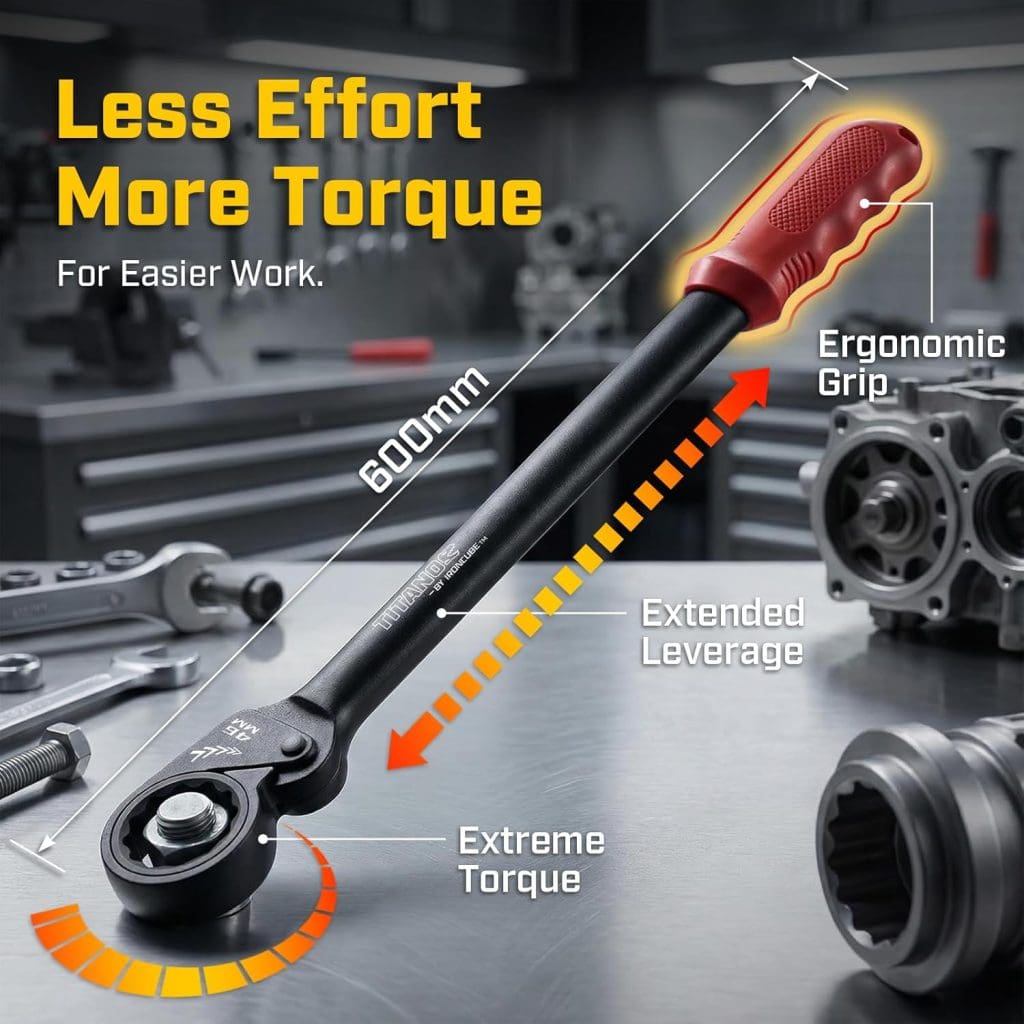
Anybody who has spent a Saturday afternoon wedged under a piece of heavy equipment knows the frustration of reaching for a wrench that’s too small, too clumsy, or flat-out wrong for the fastener staring back at you. A large ratcheting wrench set solves that problem by putting the full range of oversized metric and SAE sizes right on your tool cart—ready to go when standard sets run out of steam.
Whether you maintain agricultural machinery, service commercial trucks, or run a busy fabrication shop, choosing the right set is about more than just picking the cheapest box on the shelf. Material quality, tooth count, handle length, and brand reputation all play into whether a set will still be earning its keep five years from now. In this guide we’ll walk through every factor that matters so you can make a confident, informed purchase.
Wrenches have been essential hand tools for centuries—the basic concept of a lever and jaw goes back to the 15th century, according to historical records on the wrench. But modern ratcheting designs are a different animal entirely, and when you scale them up to jumbo sizes the engineering decisions become even more consequential.
What Makes a Large Ratcheting Wrench Set Different from a Standard Set?
Standard ratcheting wrench sets typically top out around 19 mm or 3/4 inch. That’s fine for passenger cars, appliance repair, and light maintenance. But industrial fasteners regularly run to 32 mm, 36 mm, and beyond. A large ratcheting wrench set starts where those standard sets stop, covering the bigger end of the spectrum—usually from about 21 mm up to 50 mm on the metric side.
Aside from sheer size, there are engineering differences. The ratcheting mechanism inside a jumbo wrench must handle significantly higher torque loads without stripping. Gear teeth need to be cut from hardened alloy steel, and the housing itself has to resist flex under stress. Cheaper sets cut corners here, and the result is a broken pawl the first time you lean into a stubborn nut.
The physical weight is another factor. Large wrenches are heavy individually, so a full set can weigh fifteen to twenty-five pounds depending on how many pieces it includes. If you work on jobsites rather than in a stationary shop, that weight matters when you’re loading out a service truck every morning.
Key Factors When Choosing a Large Ratcheting Wrench Set
1. Size Range and Coverage
The first question to answer is simple: what fastener sizes do you actually encounter? If you work exclusively on heavy trucks, you might need metric wrenches from 24 mm through 46 mm. Farm equipment might demand SAE sizes up to 2 inches. Some jobs need both.
Check your most-used sizes and make sure the set covers them without forcing you to buy supplemental singles. A gap in the middle of the range—say, a set that jumps from 30 mm straight to 36 mm—will cost you time and money down the road. IRONCUBE’s extra-large heavy-duty ratcheting wrenches cover a broad metric range specifically because working professionals asked for it.
2. Material and Heat Treatment
Chrome vanadium (Cr-V) steel is the baseline for professional-grade wrenches. It provides good hardness without becoming brittle. Higher-end sets use chrome molybdenum (Cr-Mo) for even better fatigue resistance.
Heat treatment matters just as much as alloy choice. Drop-forged blanks that are through-hardened and tempered will outperform wrenches that are only surface-hardened. You can usually tell the difference by weight and by the satin or mirror finish—quality wrenches feel dense and uniformly finished.
If a manufacturer doesn’t mention the steel grade or heat-treatment process on its spec sheet, that’s a red flag. Reputable makers of jumbo ratchet wrenches for heavy-duty work will always publish their material specifications.
3. Ratchet Tooth Count and Arc Swing
The tooth count of the ratcheting mechanism determines the minimum arc swing—the smallest angle you can move the wrench before the ratchet engages the next tooth. A 72-tooth ratchet, for instance, requires only a 5-degree swing. That number is important in tight quarters where you can barely move the handle.
For large ratcheting wrenches, tooth count becomes a trade-off. More teeth means finer engagement, but each individual tooth is smaller and carries more load per unit area. Most quality large ratcheting wrench sets land between 72 and 120 teeth. Above 120, durability can suffer under heavy torque unless the manufacturer uses premium gear steel.
4. Handle Length and Leverage
Longer handles provide more leverage, which means less brute effort on your part. That sounds great until you try to swing a 20-inch wrench inside an engine bay with three inches of clearance. The best approach is to look for sets where handle length scales proportionally with head size.
Some manufacturers also offer extra-long ratcheting wrench sets as a separate product line. If your work routinely puts the fastener deep inside a machine frame, an extra-long option can save you from reaching for a crows-foot adapter or extension bar.
5. Surface Finish and Corrosion Resistance
Chrome plating is standard for corrosion protection and easy cleaning. Satin finishes resist glare under shop lights, which is a surprisingly practical benefit when you’re working overhead. Some sets offer a black oxide finish that reduces glare further but needs occasional oiling to stay rust-free.
Whatever finish you choose, make sure it extends fully into the box end and the ratchet housing. Cheap plating that flakes inside the mechanism will cause binding and premature wear.
Metric vs. SAE: Which System Does Your Large Ratcheting Wrench Set Need?
This depends entirely on the equipment you service. Japanese, Korean, and European machinery is almost universally metric. American-made heavy equipment and older domestic trucks often use SAE fasteners, though the industry has been shifting toward metric for decades.
If you serve a mixed fleet, a dual-system large ratcheting wrench set is the most efficient choice. Buying separate metric and SAE sets gives you deeper coverage per system but doubles the storage footprint. For most shops, a well-chosen metric set supplemented with a few SAE singles covers ninety percent of situations.
Comparison Table: What to Look For at a Glance
The table below summarizes the key specifications you should compare when evaluating any large ratcheting wrench set side by side.
| Feature | Budget Tier | Mid-Range | Professional |
| Material | Carbon steel | Chrome vanadium | Cr-V or Cr-Mo |
| Tooth Count | 36–45 | 72 | 72–120 |
| Arc Swing | 10°–15° | 5° | 3°–5° |
| Finish | Basic chrome | Satin chrome | Mirror or black oxide |
| Warranty | 90 days–1 year | Limited lifetime | Full lifetime |
| Price (per set) | $40–$80 | $100–$200 | $200–$500+ |
How Many Pieces Should Your Set Include?
Sets range from as few as five pieces to as many as sixteen or more. A five-piece set covering the most common large sizes—say 21 mm, 24 mm, 27 mm, 30 mm, and 32 mm—is a good entry point for a shop that only occasionally works with oversized fasteners.
For dedicated heavy-equipment mechanics, a ten-to-twelve piece set is the sweet spot. It gives you enough coverage to handle most jobs without needing to reach for an adjustable wrench as a backup. Check out this curated guide to choosing a large ratcheting wrench set for your shop for specific recommendations on piece count based on trade.
Whatever size set you pick, confirm that it ships in a storage case or roll-up pouch. Loose jumbo wrenches rolling around a drawer are a recipe for nicked chrome and lost pieces.
Specialty Wrenches Worth Adding to Your Kit
A large ratcheting wrench set covers the fundamentals, but certain jobs call for specialty tools. Friction wrenches, for example, grip round pipe and fittings that a standard box end can’t grab. IRONCUBE offers a 36 mm torque friction wrench and a 1–7/8 inch friction wrench designed for exactly this kind of work. There’s also a 1–1/2 inch heavy-duty ratcheting friction spanner for smaller pipe and hydraulic fittings.
Brake line wrenches are another common addition. A flare-nut design prevents rounding on soft brass fittings, which regular open-end wrenches are notorious for. You can read our detailed breakdown of the best ratcheting brake line wrenches if that’s a gap in your current toolkit.
And if your collection of hand tools extends beyond wrenches, our best screwdriver sets of 2026 guide is worth a look as well.
Common Mistakes When Buying a Large Ratcheting Wrench Set
After years of hearing feedback from mechanics and shop owners, a few buying mistakes come up over and over.
Buying on price alone. A forty-dollar set of jumbo wrenches sounds like a deal until the ratchet mechanism strips the third time you use it. The cost per wrench in a professional-grade set is higher, but the cost per year of ownership is almost always lower.
Ignoring the ratchet direction switch. On large wrenches the direction lever takes real force to flip, especially with gloves on. Test the switch before you commit—if it’s stiff or poorly positioned, you’ll fight it on every fastener.
Overlooking the open-end geometry. Many large ratcheting wrenches have a box end on one side and an open end on the other. That open end should have a 15-degree offset angle so it can work on flat surfaces. A zero-offset open end is nearly useless on heavy equipment.
Skipping warranty research. Professional use puts enormous stress on large wrenches. A lifetime warranty from a manufacturer who actually honors it is worth real money. Ask the vendor about their warranty and support process before purchasing.
Where to Buy Quality Large Ratcheting Wrench Sets
Industrial supply houses, specialty tool dealers, and reputable online retailers are your best options. Avoid generic marketplace listings with no brand attribution—there’s simply no way to verify the steel grade or quality control behind those products.
IRONCUBE’s full wrench catalog is available online with detailed specifications for every product. If you prefer Amazon, the IRONCUBE Jumbo Friction Ratcheting Wrench is available there with customer reviews and fast shipping. For contractors who need volume, our guide on finding quality wholesale jumbo wrench sets walks through the sourcing process step by step.
You can also explore our deep-dive articles on the best large ratchet wrenches and big ratchet wrenches for heavy equipment for side-by-side comparisons of the top options on the market today.
Maintaining Your Large Ratcheting Wrench Set for Long-Term Performance
Even the best wrenches need care. After heavy use, blow out the ratchet mechanism with compressed air and apply a drop of light machine oil to the gear teeth. This takes thirty seconds and prevents the gritty, sluggish action that builds up over time.
Wipe down the chrome finish with a rag after each shift, especially if you work in wet or corrosive environments. Store wrenches in a case or on a pegboard—never tossed loose in a drawer where they bang against each other.
If a ratchet mechanism starts to slip, don’t force it. A slipping pawl under high torque can round off a fastener or, worse, cause a sudden release that sends your knuckles into the nearest sharp edge. Replace the wrench or send it in for warranty service.
Frequently Asked Questions About Large Ratcheting Wrench Sets
What sizes are included in a typical large ratcheting wrench set?
Most sets cover metric sizes from 21 mm up to 32 mm or 36 mm, and SAE sizes from 13/16 inch up to 1–1/2 inch or 2 inches. A large ratcheting wrench set with ten or more pieces usually spans the full range needed for heavy-equipment maintenance and commercial truck repair.
Are large ratcheting wrenches strong enough for high-torque applications?
Professional-grade sets made from chrome vanadium or chrome molybdenum steel handle substantial torque. The critical factor is the ratchet mechanism—look for 72 teeth or more with hardened alloy gears. A well-built large ratcheting wrench set can manage the same torque levels as a conventional combination wrench of the same size.
How do I decide between a metric and an SAE large ratcheting wrench set?
Identify the equipment you service most often. European and Asian machinery uses metric fasteners almost exclusively, while some American-made heavy equipment still uses SAE. If you work on a mixed fleet, a metric-focused large ratcheting wrench set supplemented with a handful of SAE singles is the most practical approach.
Can I use a large ratcheting wrench set for automotive brake work?
Standard brake caliper bolts typically fall in the 14–19 mm range, which is below the starting size of most large sets. However, hub nuts and axle fasteners on trucks and SUVs do require larger sizes. For brake line fittings specifically, a flare-nut style wrench is a better choice—but having a large ratcheting wrench set on hand covers the bigger fasteners in the braking assembly.
How should I store a large ratcheting wrench set to prevent damage?
Use the manufacturer’s case, a padded tool roll, or a dedicated pegboard rack. Storing a large ratcheting wrench set loosely in a metal drawer causes chrome chips, dings, and misaligned ratchet mechanisms. Keep the set dry and apply a light oil to the ratchet heads every few months to maintain smooth action.
Is it worth paying more for a professional-grade large ratcheting wrench set?
In almost every case, yes. Professional sets use better steel, tighter manufacturing tolerances, and longer-lasting ratchet mechanisms. The upfront cost is higher, but a quality large ratcheting wrench set typically lasts a decade or more under daily professional use, while budget alternatives may need replacement within a year or two.
Final Summary
Choosing the right large ratcheting wrench set comes down to matching your actual work requirements—size range, material quality, tooth count, handle length, and budget—against what each set on the market offers. Don’t over-buy features you’ll never use, but don’t cut corners on the ratchet mechanism or the steel grade, either.
Start by auditing the fastener sizes you encounter most frequently. Narrow your choices to sets made from Cr-V or Cr-Mo steel with at least 72 ratchet teeth. Confirm the warranty terms, test the direction switch, and verify that the finish quality is consistent across every piece in the box. Do that, and the set you buy will pay for itself many times over in saved time and avoided frustration.
Browse the complete IRONCUBE large heavy-duty ratcheting wrench lineup or visit the full IRONCUBE tool catalog to find the right fit for your shop.