
So you’ve been pouring your heart into creating amazing content, and now you’re ready to monetize. But here’s the million-dollar question (well, hopefully at least a few hundred dollars): How much can you actually earn per 1000 visitors in your niche?
The answer might surprise you. Two blogs with identical traffic can have wildly different earnings—sometimes by a factor of 20 or more. A finance blogger earning $30 per 1000 pageviews while a lifestyle blogger makes just $3 from the same traffic isn’t unusual at all.
In this guide, we’ll break down exactly what you can expect to earn from ad revenue across 20+ different niches, what factors impact your earnings, and how you can maximize your revenue per thousand visitors. Whether you’re just starting out or looking to optimize an established blog, understanding these benchmarks is crucial for setting realistic income goals.
Let’s dive in!
What is Ad Revenue Per 1000 Visitors (RPM)?
Before we jump into the numbers, let’s clarify what we’re actually measuring. RPM stands for “Revenue Per Mille” (mille is Latin for thousand), and it represents how much money you earn for every 1000 pageviews on your website.
Here’s the simple formula:
RPM = (Total Earnings ÷ Total Pageviews) × 1000
For example, if you earned $500 from 50,000 pageviews, your RPM would be ($500 ÷ 50,000) × 1000 = $10.
Why RPM matters more than CPM: While CPM (Cost Per Mille) measures what advertisers pay per 1000 ad impressions, RPM accounts for all your earnings divided by total pageviews. Since one pageview can generate multiple ad impressions, RPM gives you a more accurate picture of your actual earning potential.
Image Suggestion: Simple infographic showing the RPM formula with visual elements—calculator icon, dollar signs, and a sample calculation using real numbers.
Average Ad Revenue by Niche: The Complete Breakdown
Not all niches are created equal when it comes to ad revenue. Advertisers in industries with high customer lifetime values are willing to pay significantly more to reach potential customers. Let’s break down the earning potential across different content categories.
High-Value Niches ($20-$40+ RPM)
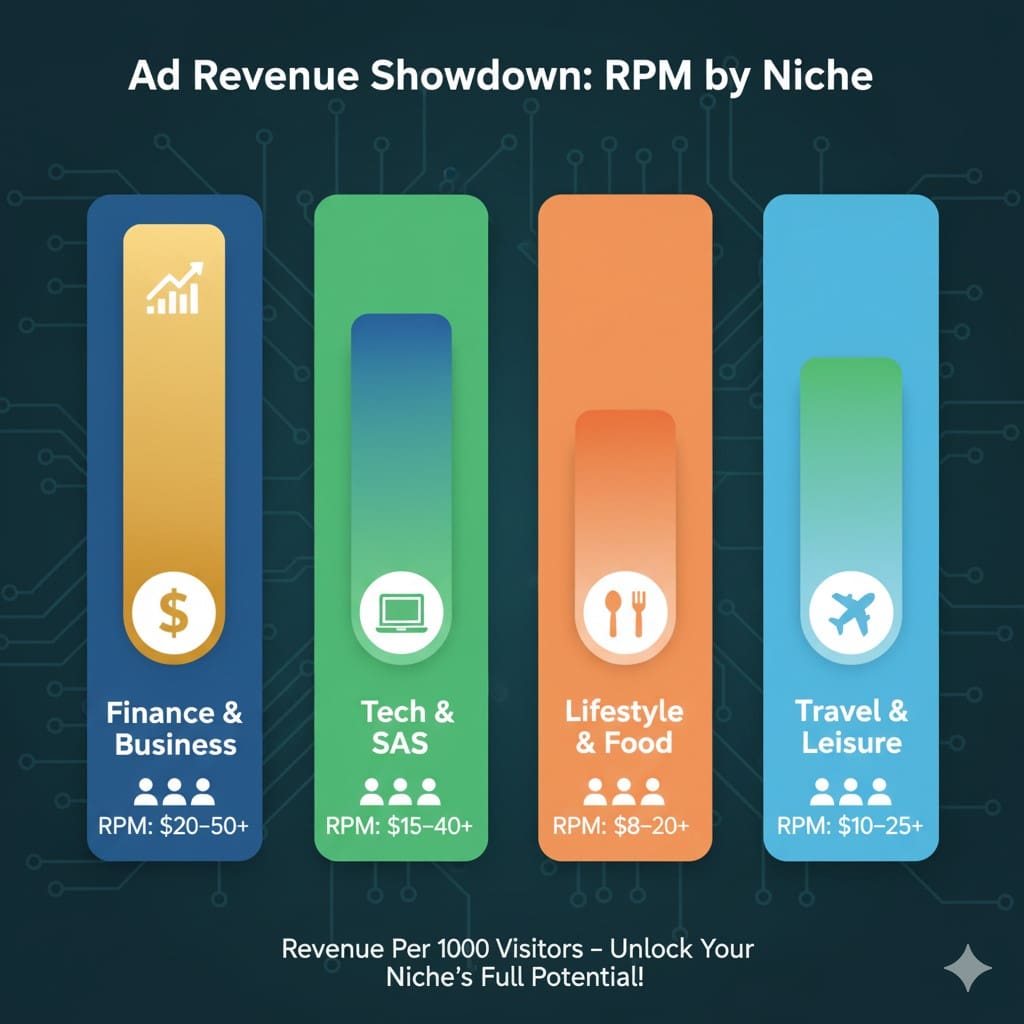
Finance & Personal Finance: $25-$40 RPM
If you’re writing about credit cards, investing, loans, or banking, congratulations—you’ve chosen one of the most lucrative niches for ad revenue. Financial advertisers have massive budgets because a single customer can be worth thousands of dollars to them over their lifetime.
Topics that perform especially well include credit card comparisons, mortgage calculators, investment strategies, and retirement planning. The key is attracting visitors who are actively looking to make financial decisions.
Insurance: $20-$35 RPM
Auto insurance, health insurance, life insurance—these topics command premium ad rates. Insurance companies compete fiercely for customers, and they’re willing to pay top dollar for quality traffic. Even a relatively small insurance blog with 50,000 monthly visitors can generate $3,000-$4,000 in monthly ad revenue.
Legal/Law: $18-$30 RPM
Legal services, especially personal injury, business law, and estate planning, attract high-paying advertisers. Law firms have substantial marketing budgets and understand the value of each potential client lead.
Business & B2B: $15-$28 RPM
Content targeting business owners and professionals—including SaaS tools, enterprise solutions, and business services—earns premium rates. B2B buyers make larger purchasing decisions, which translates to advertisers paying more for visibility.
Image Suggestion: Horizontal bar chart titled “Top High-Value Niches” showing the four categories above with their RPM ranges, color-coded in gold/premium colors with dollar sign icons.
Mid-Tier Niches ($8-$20 RPM)
Technology & Software: $10-$20 RPM
Tech content performs well, especially reviews of consumer electronics, software comparisons, and how-to guides. The wide range reflects the difference between general tech news (lower end) and specific product reviews with purchase intent (higher end).
Real Estate: $12-$22 RPM
Home buying, selling, and investing content attracts advertisers with healthy budgets. Real estate agents, mortgage lenders, and home service providers all compete for this audience.
Health & Wellness: $8-$18 RPM
Health-related content can be profitable, though it varies significantly by subtopic. Medical conditions, treatments, and wellness products tend toward the higher end, while general fitness content sits lower.
Home Improvement & DIY: $8-$15 RPM
Home renovation, decorating, and improvement projects attract advertisers selling tools, materials, and services. This niche has strong seasonal variations, with higher RPMs during spring and summer.
Marketing & SEO: $10-$18 RPM
Digital marketing, SEO tools, and business growth content targets professionals willing to invest in their businesses, resulting in solid ad rates.
Image Suggestion: Clean, modern table showing these mid-tier niches with columns for niche name, RPM range, competition level (Low/Medium/High), and a small icon representing each category.
Entry-Level Niches ($1-$8 RPM)
Entertainment & Celebrity News: $2-$5 RPM
While entertainment content can attract massive traffic, the RPM is typically low. The audience is browsing casually rather than looking to make purchases, which results in lower advertiser demand.
General Lifestyle: $2-$6 RPM
Broad lifestyle content without a specific focus generally earns on the lower end. However, you can improve this by focusing on monetizable subcategories within lifestyle.
Food & Recipes: $3-$8 RPM
Food blogs are popular but face lower RPMs unless they focus on premium cooking equipment, meal kit services, or specialized diets. Recipe content tends to have high engagement but lower commercial intent.
Fashion & Beauty: $4-$9 RPM
Fashion and beauty blogs can reach the higher end of this range when featuring product reviews and shopping guides. Affiliate marketing often supplements ad revenue well in this niche.
Travel: $5-$10 RPM
Travel content earns moderate RPMs, with luxury travel and destination guides performing better than budget travel tips. Geography matters too—content about expensive destinations typically earns more.
Gaming: $3-$7 RPM
Gaming content attracts passionate audiences but relatively lower ad rates. The younger demographic and focus on free-to-play games contribute to the lower earning potential.
Image Suggestion: Pyramid infographic with three tiers—high-value niches at the top (smallest section), mid-tier in the middle, and entry-level at the bottom (largest section), with representative icons for 2-3 niches in each tier.
What Actually Impacts Your Ad Revenue?
Understanding average RPMs by niche is just the starting point. Several crucial factors determine whether you’ll hit the high or low end of your niche’s range—or even exceed it.
Geographic Location of Your Traffic
This is huge, and it’s often overlooked by new bloggers. A visitor from the United States is typically worth 10-20 times more in ad revenue than a visitor from a developing country.
Tier 1 Countries (Highest RPM): United States, United Kingdom, Canada, Australia, Germany, Switzerland, Norway, and other wealthy Western nations.
Tier 2 Countries (Moderate RPM): Western Europe, Japan, Singapore, South Korea—still valuable but less competitive advertiser markets.
Tier 3 Countries (Lower RPM): India, Brazil, Philippines, Indonesia, and most developing nations—larger populations but much lower advertising rates.
If 80% of your traffic comes from India versus 80% from the United States, you might see a 15x difference in earnings even in the same niche. This is why targeting SEO keywords with strong search volume in Tier 1 countries is crucial for monetization.
Image Suggestion: World heat map showing RPM multipliers by region, with North America, Western Europe, and Australia in dark red (highest value), and gradient colors showing decreasing values across other regions.
Your Ad Network Makes a Massive Difference
Not all ad networks pay equally. Here’s what you can typically expect:
Google AdSense: The easiest to get approved for, but often the lowest paying. Great for beginners, but you’ll want to upgrade as your traffic grows.
Mediavine: Requires 50,000 monthly sessions. Most publishers see a 25-100% RPM increase compared to AdSense. Excellent support and optimization.
AdThrive: Requires 100,000 monthly pageviews. Premium network with some of the highest RPMs available, often 50-150% higher than AdSense.
Ezoic: Uses AI for ad optimization and has lower traffic requirements. Results vary but many publishers see 30-80% improvements.
The right network for your blog depends on your current traffic levels and niche. Tools available at adrevhub.com can help you calculate exactly how much you could earn with different ad networks based on your specific metrics.
Image Suggestion: Comparison chart showing 4-5 major ad networks with their minimum requirements, average RPM boost percentage vs. AdSense, and approval criteria in an easy-to-scan format.
Ad Placement and User Experience
Where you place your ads dramatically affects both your earnings and reader experience. The goal is maximizing revenue without creating a frustrating user experience that increases bounce rates.
High-performing placements include:
- Above the fold (visible without scrolling)
- Within content after the first few paragraphs
- Between sections of long-form content
- Sidebar ads on desktop
- Sticky footer ads on mobile
However, cramming too many ads into your content can backfire. High bounce rates and low engagement signal poor quality to both search engines and ad networks, ultimately reducing your RPM over time.
Image Suggestion: Website layout mockup with colored overlay showing “hot spots” (red/orange) for high-performing ad placements and “cold spots” (blue) for underperforming areas.
Content Quality Affects RPM More Than You Think
Google’s algorithm rewards engaging, valuable content with better rankings—and better rankings mean more qualified traffic. But engagement also directly impacts your ad revenue.
Visitors who read multiple pages generate more ad impressions. If your average pageviews per session is 1.5, but you increase it to 3.0 through better internal linking and compelling content, you’ve potentially doubled your ad revenue with the same traffic.
Key engagement metrics that influence RPM:
- Average pageviews per session
- Time on site
- Bounce rate
- Scroll depth
Creating comprehensive guides, adding related content links, and keeping visitors engaged all contribute to higher earnings per visitor.
How to Calculate Your Earning Potential
Let’s get practical. Here’s how to estimate what you could realistically earn based on your niche and traffic goals.
The Formula: (Monthly Pageviews ÷ 1000) × Your Niche’s Average RPM = Estimated Monthly Revenue
Real Examples:
Example 1: Finance Blog
- 50,000 monthly visitors
- 2.0 pageviews per session = 100,000 pageviews
- RPM: $30
- Calculation: (100,000 ÷ 1,000) × $30 = $3,000/month
Example 2: Tech Review Site
- 100,000 monthly visitors
- 2.5 pageviews per session = 250,000 pageviews
- RPM: $15
- Calculation: (250,000 ÷ 1,000) × $15 = $3,750/month
Example 3: Lifestyle Blog
- 200,000 monthly visitors
- 2.0 pageviews per session = 400,000 pageviews
- RPM: $5
- Calculation: (400,000 ÷ 1,000) × $5 = $2,000/month
Notice how the finance blog with one-fourth the traffic of the lifestyle blog earns 50% more? That’s the power of niche selection.
Image Suggestion: Interactive calculator-style graphic showing input fields (traffic, niche RPM, pages per session) and output (projected earnings), with three example calculations displayed.
Strategies to Increase Your Ad Revenue
No matter what niche you’re in, you can take steps to boost your RPM:
1. Target High-Value Keywords: Focus on search terms with commercial intent. “Best credit cards for travel rewards” will earn more than “how credit cards work.”
2. Improve Your Traffic Sources: Organic search traffic from the US converts better than social media traffic from mixed geographies. Invest in SEO targeting Tier 1 countries.
3. Optimize Ad Placements: Test different ad positions and formats. Most ad networks offer optimization tools—use them.
4. Increase Pages Per Session: Better internal linking, related post suggestions, and series content keep visitors engaged longer.
5. Upgrade Your Ad Network: Once you hit the traffic thresholds, switching to premium networks can double your RPM overnight.
6. Focus on Content Depth: Longer, comprehensive articles generally perform better for both SEO and ad revenue because they provide more ad opportunities while maintaining good user experience.
7. Monitor Seasonal Trends: RPMs typically spike in Q4 (October-December) as advertisers increase spending for the holidays. Plan your content calendar accordingly.
Common Mistakes That Kill Your RPM
Avoid these pitfalls that can significantly reduce your earnings:
Over-optimization: Stuffing too many ads into your content creates a poor user experience, increasing bounce rates and actually lowering overall revenue.
Ignoring Mobile: With 60-70% of traffic coming from mobile devices for most blogs, a poor mobile ad experience leaves money on the table.
Wrong Network for Your Traffic Level: Staying with AdSense when you qualify for Mediavine or AdThrive can cost you thousands in lost revenue annually.
Low-Quality Traffic: Buying traffic or relying on clickbait might increase visitor numbers but tanks your RPM because the traffic isn’t engaged or qualified.
Policy Violations: Accidentally violating ad network policies can get your account suspended, eliminating all ad revenue until resolved.
The Reality Check: Setting Realistic Expectations
Here’s some honest perspective: Most bloggers need 12-24 months of consistent effort before reaching $1,000+/month in ad revenue. Building organic traffic takes time, especially in competitive niches.
However, understanding these benchmarks helps you:
- Set realistic income goals based on your niche and growth trajectory
- Calculate how much traffic you need to replace your income
- Decide whether to focus on higher RPM niches or go with your passion
- Determine when ad revenue alone becomes viable versus needing additional income streams
Remember, ad revenue is just one monetization method. Most successful bloggers combine display ads with affiliate marketing, sponsored content, digital products, and services to create multiple income streams.
The tools and calculators at adrevhub.com can help you model different scenarios, set realistic targets, and track your progress toward your monetization goals.
Frequently Asked Questions
What is a good RPM for a new blog?
For a new blog, an RPM between $5-$10 is considered solid, depending on your niche. If you’re in high-value niches like finance or insurance, you might see $15-$25 RPM even with newer content. Entry-level niches typically start around $2-$5 RPM. As your content improves, your SEO strengthens, and you attract more qualified traffic, expect your RPM to increase by 50-100% or more within your first year. Don’t get discouraged by lower initial numbers—focus on creating quality content and building authority.
How much can I realistically earn with 50,000 monthly visitors?
With 50,000 monthly visitors, your earnings vary dramatically by niche. Assuming an average of 2 pageviews per session (100,000 total pageviews), you can expect: Finance blogs: $2,500-$4,000/month ($25-$40 RPM), Tech blogs: $1,000-$2,000/month ($10-$20 RPM), and Lifestyle blogs: $400-$800/month ($4-$8 RPM). Your actual results depend on traffic geography, ad network choice, content quality, and user engagement. Use ad revenue calculators like those on adrevhub.com to get personalized estimates based on your specific situation.
Should I choose my niche based solely on RPM potential?
While RPM potential matters, it shouldn’t be your only consideration. High-RPM niches like finance and legal are extremely competitive and require specialized knowledge to build authority. You’ll create better, more consistent content in a niche you’re genuinely interested in. The sweet spot is finding overlap between your interests, expertise, and monetization potential. A passionate creator in a $5 RPM niche reaching 500,000 monthly visitors will significantly outperform someone struggling to produce content in a $30 RPM niche with only 10,000 visitors.
When should I switch from AdSense to premium ad networks?
Consider upgrading to premium networks when you consistently hit 50,000+ monthly sessions (Mediavine’s minimum) or 100,000+ monthly pageviews (AdThrive’s requirement). However, traffic volume alone isn’t enough—you need quality content, good engagement metrics (low bounce rate, high pages per session), and predominantly Tier 1 country traffic. Premium networks typically boost RPM by 40-200% compared to AdSense, but they maintain strict quality standards. Monitor your metrics and apply when you meet the requirements to maximize your revenue jump.
Why is my RPM lower than the averages you listed?
Several factors can cause below-average RPM: (1) High percentage of traffic from Tier 2/3 countries rather than the US/UK/Canada, (2) Using only Google AdSense instead of premium networks, (3) Poor ad placement reducing viewability, (4) High bounce rates limiting total ad impressions, (5) Mobile optimization issues, (6) Seasonal dips (January-February typically see lower ad spending), or (7) Low-quality or bot traffic. Review your Google Analytics for geographic and engagement data, test different ad placements, and consider upgrading your ad network once you meet their requirements. Small optimizations can often boost RPM by 20-50%.
Conclusion: Your Path to Monetization Success
Understanding average ad revenue per 1000 visitors by niche empowers you to set realistic goals and make strategic decisions about your blog’s direction. Whether you’re earning $5 RPM or $30 RPM, there are always opportunities to optimize and grow.
The key takeaways:
- Niche selection creates 20-40x earning differences for identical traffic
- Geographic traffic sources dramatically impact revenue
- Premium ad networks can double your earnings overnight
- User engagement and content quality directly affect RPM
- Patience and consistency are crucial—sustainable income takes time
Start by calculating your current or target RPM using the formulas we’ve covered. Then focus on the optimization strategies that will have the biggest impact for your specific situation. Every improvement compounds over time.
Ready to dive deeper into maximizing your blog’s revenue potential? Visit adrevhub.com for advanced calculators, detailed comparisons of ad networks, and actionable strategies to boost your earnings. Your monetization journey starts with understanding the numbers—and now you’ve got the complete picture.
What’s your niche, and what RPM are you targeting? The possibilities are exciting, and with the right strategy, your blogging income goals are within reach.
