

The B2B buying landscape has changed in ways that few sales and marketing teams have fully absorbed. Buying committees are larger, sales cycles are longer, and skepticism toward vendor claims has reached levels that would have seemed alarming a decade ago. Procurement teams arrive at first calls already armed with peer reviews, analyst notes, podcast clips, and LinkedIn opinions about the companies they are evaluating. In this environment, credibility is no longer a soft reputational asset. It has become a direct revenue lever.
What industry observers are calling the “B2B trust gap” describes the widening distance between what companies say about themselves and what buyers actually believe. Closing that gap, and understanding how to build brand trust when traditional signals are losing power, is quickly becoming one of the defining commercial challenges of the decade.
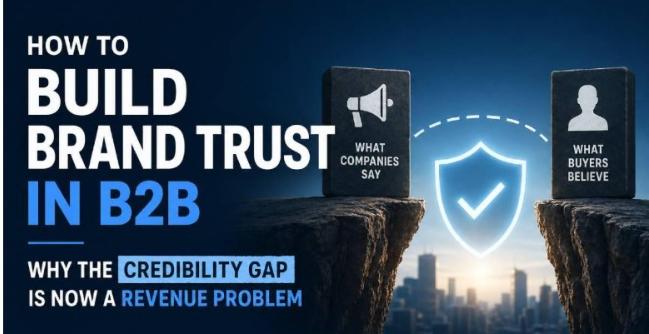
The Anatomy of the Trust Gap
The erosion of B2B trust did not happen overnight. It is the cumulative result of several converging pressures. Content saturation has flooded every channel buyers once relied on, from email to LinkedIn to industry publications. AI-generated material has multiplied that noise, making it harder for genuine expertise to stand out. Cold outreach response rates have collapsed, and case studies have started to feel interchangeable, written to a template rather than a truth.
Research from the Edelman Trust Barometer and Gartner’s B2B buyer studies consistently shows that buyers now consult ten or more sources before they ever engage a sales representative. They cross-reference vendor claims against third-party reviews, analyst commentary, and the personal networks of people they already trust. In this context, learning how to build trust with customers is no longer a marketing afterthought. It is a strategic priority that touches product, sales, customer success, and leadership communication all at once.
Why Credibility Now Directly Impacts Revenue
The connection between credibility and revenue used to be assumed but rarely measured. That has changed. Companies tracking the right metrics are finding that credibility correlates directly with pipeline velocity, win rates, average deal size, and customer lifetime value. Deals close faster when buyers arrive at the table already convinced. Win rates climb when third-party validation does the heavy lifting before the first demo. Expansion revenue grows when existing customers feel confident enough in a vendor’s reputation to recommend it internally.
Procurement teams have caught up to this reality. Vendor evaluation scorecards increasingly weight analyst coverage, earned media presence, and customer advocacy alongside product capability and price. Understanding how to build business credibility is no longer a vanity exercise reserved for founders chasing speaking slots. It is a measurable input into commercial performance, and finance teams are starting to treat it that way.
The Role of Earned Media and Strategic Communications
The function once known simply as public relations has been quietly reinvented. Modern PR services have moved beyond press releases and media lists into integrated credibility-building operations that touch thought leadership, executive visibility, podcast appearances, analyst relations, and customer storytelling. The deliverable is no longer a clipping book. It has a measurable influence on the buying decision.
Agencies that have adapted to this shift, including firms such as Savon PR, have positioned themselves around outcome-driven narrative work rather than logo placement. Vertical specialization has become a particularly strong signal of credibility, which is why the rise of focused practices such as a fintech PR agency model illustrates where the broader industry is heading. Buyers in regulated and technical industries respond to communicators who understand their world, not generalists translating from a press release template. The firms that win in this environment are the ones treating earned attention as a revenue function, not a brand exercise.
AI’s Double-Edged Role in the Trust Equation
Artificial intelligence is simultaneously the cause of the trust gap and one of the most promising tools for closing it. On one side, synthetic content, deepfakes, and automated outreach have flooded inboxes and feeds with material that looks human but carries none of the accountability. Buyers have grown adept at spotting it, and their default posture has shifted toward suspicion. On the other side, AI now powers sentiment analysis, narrative tracking, message testing, and media monitoring at a scale and speed that was impossible five years ago.
This has given rise to a new category, the AI PR firm, which blends human strategists with AI-driven research and content optimization. The strongest practitioners in this space treat automation as a way to surface insight faster, not as a substitute for the human judgment that earned media still requires. The broader story of how AI is disrupting the PR industry is, in many ways, the story of credibility being rebuilt from the ground up for a market that no longer trusts polished surfaces.
Practical Frameworks for Building Trust at Scale
Closing the trust gap is less about clever campaigns and more about repeatable systems. Companies that consistently outperform on credibility tend to share a small set of habits: message consistency across every channel and executive, transparency about both wins and limitations, sustained third-party validation through analysts and earned media, structured customer advocacy programs, and visible thought leadership from leaders who have something genuinely informed to say. None of these are quick fixes, and none of them work in isolation. Together, they compound into a reputation that buyers encounter long before sales does.
Conclusion
The B2B trust gap is not a communications problem that marketing can solve alone. It is a revenue problem that requires alignment between marketing, sales, product, and leadership. Companies that recognize this and invest accordingly will find that credibility is becoming the most durable competitive moat available in a market where features can be copied, pricing can be matched, and attention can be bought, but trust still has to be earned.