
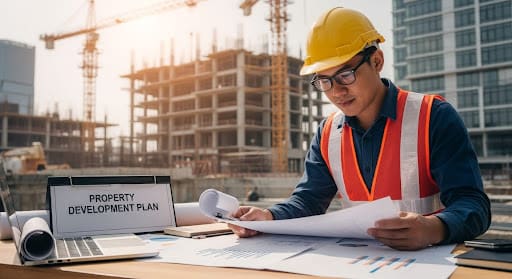
By definition, a property developer is a person who purchases land or outdated buildings, upgrades them, and then sells or leases them to make a profit. It’s a business that involves ingenuity, finance, and project management. Besides that, the profits can be quite sizable; however, the risks are also present, and to be successful, one needs to possess the right amount of knowledge, make effective plans, and remain determined.
Understanding the Role of a Property Developer
Property development cannot be viewed as merely the purchase of land or property construction. Among other things, the duties assigned to a developer include not only finding real estate investment opportunities and obtaining financing, but also managing the design and construction operations, and even making sure that the product offered in the end will be bought by the buyers or leased by the tenants.
In simple terms, developers play the role of bridges between the ideas and the final real estate projects. Working closely with architects, city planners, contractors, financiers, and marketers, they try to make sure that projects turn out to be profitable. In the United States, this process could be challenging due to zoning laws, market conditions, and the like regulatory requirements.
Step 1: Get Educated About Real Estate and Development
A successful property developer doesn’t need to have a degree, but most of them have one. They work as real estate agents, are involved in construction management, architecture, or finance. Firstly, one must acquire the knowledge of how the deals are structured, the way the market behaves, and how the construction is executed.
One of the key aspects is construction cost estimating. It is the principal part of financial planning that supports any project. This will enable you to anticipate the cost of labor, materials, permits, and unexpected contingencies. Projects without precise cost estimation have the possibility of going beyond the budget, facilitating lower profitability.
Taking courses in housing development, the management of construction, or even short certifications from institutions such as the Urban Land Institute or local universities can assist you in taking your first steps.
Step 2: Understand the U.S. Real Estate Market
Before investing any money, you have to understand the local markets. Every city in the U.S. has its own characteristics: demand, property values, rental yields, and potential future growth.
For example:
- Cities like Austin and Nashville are very attractive to investors because of the tech and entertainment sectors.
- The markets of New York and San Francisco, which are already established, provide the potential of high returns, but at the same time, they have higher entry costs.
- The emerging suburbs may be the place where you can enter at a low price point, but they are also the riskiest.
The research is accompanied by the study of comparable sales, the examination of rental yields, and the monitoring of zoning updates or developments in infrastructure (such as new highways or transit lines).
Step 3: Choose a Niche in Property Development
Property development is a fashion trend of the moment that doesn’t work equally well for everyone. Developers usually focus on one of the following areas:
| Niche | Description | Typical Profit Potential |
| Residential Housing | Single-family homes, apartments, condos | Moderate but steady |
| Commercial Spaces | Office buildings, retail centers | High but market-sensitive |
| Industrial Projects | Warehouses, logistics hubs | Growing with e-commerce |
| Mixed-Use Projects | Combination of residential + retail/office | High, complex to execute |
Picking your niche depends on the amount of money you are willing to spend, the demand for the product in the market, and your personal interests.
Step 4: Build a Strong Professional Network
Property development is not a journey that you can go alone. You will need partners who are reliable: real estate agents who will locate the opportunities, lenders who will finance the projects, contractors who will carry out the construction, architects who will design, and legal experts who will help you with contracts.
Working with these professionals not only gives you a way in but also provides you with insider knowledge. You can broaden your network by attending real estate expos, going to events organized by the local chamber of commerce, and joining clubs such as the National Association of Home Builders.
Step 5: Explore Financing Options
The biggest problem for the developers of tomorrow is obtaining funds for the project. Large-scale projects require a lot of money to be put down first; however, there are still some ways to get the ball rolling:
| Financing Option | Details | Best For |
| Bank Loans | Traditional mortgages or construction loans | Mid-size projects |
| Private Investors | Equity partners who share profits | Large or high-risk projects |
| Joint Ventures | Partnering with landowners or developers | Beginners with less capital |
| Crowdfunding | Pooling smaller investments online | Smaller, creative projects |
Understanding financing is not only about finance procurement—it is also about controlling one’s debt the right way and making sure that the money invested will gather interest.
Step 6: Start Small and Learn by Doing
A lot of first-time developers choose to start small with a single-family home or a duplex renovation. In this way, you can get to know the ropes-budgeting, timelines, and working with contractors-without the risk that the multi-million-dollar development will simply be too big for you.
Besides, small projects give you a chance to create a portfolio, which can serve as a stepping stone to get you easier access to funds and investors for bigger projects in the future.
Step 7: Conduct Feasibility Studies
Before you get committed, always do a feasibility study. This, basically, is an in-depth examination to check whether a business idea will bring any profit after acquiring costs, construction, financing, marketing, and potential selling or rental income have been taken into account.
A feasibility study usually contains:
- Site analysis
- Test of zoning and legal compliance
- Cost estimate (using Cost Estimating tools)
- Market demand assessment
- Estimated ROI
The omission of this stage is among the most frequent causes of project failure.
Step 8: Secure Permits and Approvals
In the U.S., every city and county has zoning laws and building codes, which are very restrictive. Developers have to get building permits, environmental clearances, and sometimes, neighborhood approvals. Not only can holdups here be costly in terms of both time and money, but that is the reason why it is so important to have a good lawyer on your side.
Step 9: Manage Construction Effectively
After the project has passed from the planning stage to the actual work, attention is turned to construction management. In order to carry out the work, developers either work with a general contractor or directly manage the subcontractors. It is essential that time schedules, budgets, and the control of quality be kept properly.
The errors that may occur during this stage—late delivery, work of low quality, or lack of communication—have the capability to reduce the profit that a company can quickly get by a small margin. To keep track of the work progress and not fall behind the timeline, a lot of developers resort to using project management software.
Step 10: Market and Sell the Property
After the building phase, the subsequent step is marketing. Regardless of whether the project is for sale or for rent, you ought to have a solid plan. In the United States, online listings, staging homes, working with real estate agents, and providing incentives (like flexible payment plans) may assist a lot in sales speed and price.
Step 11: Prepare for Challenges
Regardless of your level of preparedness, property development is still a challenge. Some of the most common problems are:
- Increasing building costs due to rising prices of goods and services.
- Situations in which the approval of permits has caused delays.
- Changes in the demand for the market (e.g., offices that lost demand as a result of the telecommuting trend).
- Issues with the site that were not anticipated, such as soil contamination.
Experienced developers constantly make allowance for emergencies in the budgets and schedules for projects.
Essential Skills for Success
While the need for technical knowledge is voluminous, the developers’ attainment of which mostly depends on their personal skills:
- Financial Literacy: Comprehending incomes, loans, and dividends.
- Negotiating Abilities: Getting the best offer on land and agreeing on the terms of a construction contract.
- Project Management: Getting the best out of tending to the various facets of the project without losing control over the process.
- Networking: Gaining access to the deals and opportunities that are more favorable through having relationships with other people in the business.
- Risk Management: The process of identifying the problem, solving it at an early stage, and preventing it from getting larger.
Scaling Up Your Development Career
If you’ve managed to pull off smaller projects successfully, then you can grow your projects larger by becoming:
- Developing by taking advantage of the capital of other investors.
- Going into projects that are mixed-use or multi-unit.
- Creating your own real estate development company.
At this point, your name and past work will be your most valuable tools.
Conclusion
Property development in the U.S. is both hard and gratifying. It entails the use of financial discipline, understanding the market, and the ability to handle complicated projects from idea to finish. It is the safest way to start small, then learn extensively through Practicing Cost Estimating, and slowly move up.
On the other hand, property development might become the vehicle of immense changes not only in communities but also in the personal fortune and the long-term success of those who are willing to learn and persevere.
FAQs
1. Do I need a degree to become a property developer in the U.S.?
No, but degrees in real estate, finance, or construction management provide a strong foundation.
2. How much capital is required to start?
Small renovation projects may need $50,000–$150,000, while larger developments can require millions in financing.
3. What’s the average time for a development project?
Renovations may take 3–6 months, while large-scale developments can span 2–5 years.
4. Is property development risky?
Yes. Risks include cost overruns, delays, and market downturns. However, proper planning and feasibility studies reduce risks significantly.
5. What’s the difference between a property investor and a developer?
An investor funds real estate for returns, while a developer actively manages the creation and improvement of properties.