
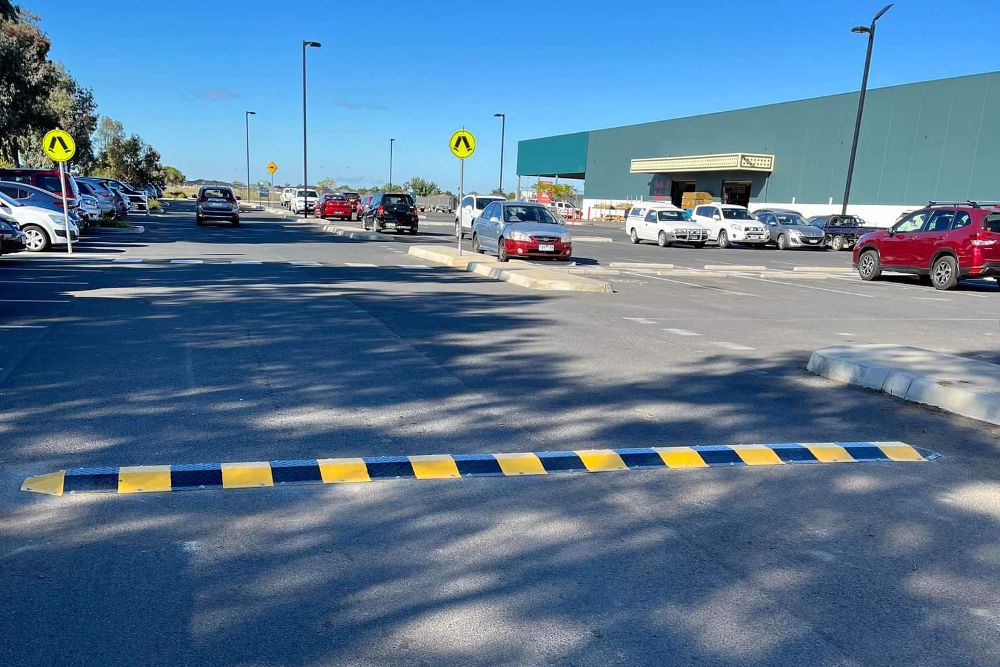
There’s a particular kind of chaos that shows up in places where people move, but not always in predictable ways.
Think school mornings. Cars arriving in waves. Parents rushing because they’re late again. Children stepping out of vehicles half awake, half excited, sometimes not looking where they’re going. Or a business park at 8:15am where everyone seems to arrive at once and nobody wants to be the first to slow down.
Estates are similar, just quieter about it. Less noise, same behaviours. Slightly faster turns. A bit of impatience at gates. The occasional “I know this road, I’ll be fine” mindset.
These are exactly the kinds of environments where traffic calming stops being optional and starts becoming structural.
That’s where solutions like the RoadQuip XpressBump system come into the conversation. Not because it’s flashy or complicated, but because it’s built for places where predictable speed control actually matters.
And that’s really the key word here: predictable.
Why These Environments Are More Risky Than They Look
On paper, schools, estates, and business parks don’t seem dangerous.
No high-speed traffic. No highways. No extreme driving conditions.
But risk doesn’t only come from speed. It often comes from behaviour.
At schools, for example, you get constant movement in short bursts. Cars stop, start, reverse, turn, and double-park. Children appear unexpectedly between vehicles. Drivers split attention between mirrors, gates, and pedestrians.
Estates introduce a different pattern. People get comfortable. Familiar roads create a false sense of safety. Someone who would never speed on a main road might casually drive too fast inside a gated community without even noticing it.
Business parks are somewhere in between. You’ve got logistics pressure, delivery schedules, and time-sensitive movement. That combination leads to impatience. And impatience tends to shorten reaction time.
The interesting thing is that none of these environments are inherently unsafe. They just rely heavily on human judgement. And human judgement, as it turns out, is not always consistent.
What Makes the XpressBump Different From Generic Speed Control
Most people think of speed bumps as a fairly standard product category. A raised section of road, a bit of paint, maybe some bolts.
But not all systems behave the same way under pressure.
The XpressBump system is designed as a modular traffic calming solution, which already puts it in a different category compared to traditional asphalt or permanently cast installations.
What that means in practice is flexibility. SafetyXpress mentioned to us that sections can be installed quickly, replaced individually, and adapted to different road layouts without major reconstruction.
That matters more than it sounds, especially in environments that evolve over time.
A school expands. An estate adds new phases. A business park changes tenant layouts. Suddenly fixed infrastructure becomes inconvenient.
Modular systems avoid that problem.
Schools: Where Predictable Speed Saves Real Lives
School zones are probably the most sensitive of the three environments.
And for good reason.
Children don’t behave like predictable traffic variables. They move unpredictably, they get distracted easily, and they don’t always process risk in the same way adults do.
According to the World Health Organization, road traffic injuries remain one of the leading causes of death for children globally, and low-speed environments are critical in reducing severity when incidents do occur.
That’s why physical traffic calming is used so widely around schools. Not just signage, but actual speed control that forces behavioural change.
XpressBump systems help here because they:
- Encourage earlier braking before school entrances
- Reduce rolling speed near pedestrian crossings
- Create predictable driver behaviour during peak hours
- Reinforce awareness without constant enforcement
You still get impatient drivers, of course. That never disappears completely. But the margin for error becomes smaller, and that’s really the point.
A simple but telling observation
Most near-misses around schools don’t happen at high speed. They happen at low-to-moderate speed when someone wasn’t expecting a child to step off a pavement or between parked cars.
Speed control doesn’t remove risk entirely. It just reduces the severity of consequences when human unpredictability shows up.
Estates: When Familiar Roads Become Too Comfortable
Estates are interesting because they often feel safe even when they aren’t fully controlled.
There’s a psychological shift that happens once drivers enter a gated community. The environment feels private, so the brain relaxes. That relaxation often translates into slightly higher speeds and less scanning for hazards.
It’s subtle. You don’t always notice it happening.
But residents do.
Complaints about “fast driving inside the estate” are one of the most common traffic management issues in residential developments.
This is where systems like XpressBump make a difference without turning the environment into something uncomfortable to live in.
Instead of aggressive road features that feel like punishment, you get structured speed control that blends into the environment but still forces compliance.
That balance matters in residential settings. Too harsh, and residents get frustrated. Too soft, and nothing changes.
Business Parks: Efficiency vs Safety Tension
Business parks introduce a different challenge altogether.
Here, speed isn’t just about convenience — it’s about operations.
Delivery vehicles are on schedules. Staff move between buildings. Visitors enter unfamiliar layouts. Forklifts and light vehicles may share internal roads.
There’s constant pressure to move quickly, but also a need to maintain safety in shared spaces.
This is where traffic calming often gets resistance from operations teams. Anything that slows movement is initially seen as friction.
But uncontrolled speed creates its own inefficiencies:
- Vehicle damage from sudden braking
- Delivery delays due to incidents
- Insurance claims from minor collisions
- Disruption to logistics flow
The interesting part is that structured speed control often improves overall efficiency in the long run because it reduces unpredictability.
And unpredictability is what slows operations more than anything else.
Real Case Study: Safer Urban Zones in the United Kingdom
A useful reference point comes from traffic-calming programmes implemented in the United Kingdom, where modular road safety systems have been widely introduced in school and residential zones.
Research from the Royal Society for the Prevention of Accidents has repeatedly shown that physical traffic calming measures significantly reduce vehicle speeds and improve pedestrian safety outcomes in mixed-use environments.
One of the key findings across multiple urban zones was not just accident reduction, but behavioural adaptation. Drivers began to anticipate speed changes earlier once consistent physical road features were introduced.
That anticipation effect is important. It means traffic calming doesn’t just slow people down — it trains behaviour over time.
Link: https://www.sciencedirect.com/science/article/pii/S2214140523000944
Installation Speed Matters More Than People Expect
One of the practical advantages of modular systems like XpressBump is how quickly they can be deployed.
In real-world environments, installation downtime often creates resistance. Schools can’t close roads for long periods. Business parks can’t interrupt logistics flow. Estates don’t want construction disruption at their entrances.
Fast installation means:
- Less operational interruption
- Reduced labour complexity
- Immediate safety improvement
- Minimal site closure time
That last point is often the deciding factor for property managers.
If something improves safety but disrupts daily operations for too long, it tends to get delayed. Systems that install quickly tend to get approved faster.
A Traffic Philosophy That Still Holds Up
Dutch traffic engineer Hans Monderman once said:
“If you treat people like children, they will behave like children.”
It’s a blunt way of describing a very real principle in road design.
Over-controlling environments can sometimes backfire. But removing structure entirely doesn’t work either.
The balance lies in subtle guidance — enough structure to shape behaviour, but not so much that the environment feels hostile.
XpressBump systems sit in that middle space. They don’t dominate the road visually, but they influence how people move through it.
Maintenance and Long-Term Practicality
Another overlooked factor is maintenance.
Many traffic calming systems start strong but degrade quickly under real use. In high-traffic environments, even small failures become visible fast.
Modular rubber systems generally offer advantages here:
- Individual sections can be replaced
- Repairs don’t require full removal
- Damage is localised rather than systemic
- Maintenance can be scheduled in phases
That’s especially important in business parks where uptime matters.
A broken traffic calming section isn’t just a safety issue — it can become an operational inconvenience.
Key Takeaways
- Schools, estates, and business parks all require predictable speed control due to mixed traffic behaviour
- The XpressBump system provides modular, adaptable traffic calming suited to changing environments
- Physical traffic calming is more effective than signage alone in reducing speed
- School zones benefit most from reduced vehicle speed near pedestrian activity areas
- Estates require balanced solutions that maintain safety without creating discomfort
- Business parks need traffic control that supports efficiency while reducing incident risk
- Installation speed and modular design reduce disruption during deployment
- Real-world studies show physical traffic calming improves both safety and driver behaviour over time
- Maintenance flexibility is a major long-term advantage in commercial environments
Frequently Asked Questions
1. What is the RoadQuip XpressBump used for?
It is a modular speed control system used to reduce vehicle speeds in areas such as schools, estates, parking areas, and business parks.
2. Why is speed control important in school zones?
Because children are unpredictable road users, and reducing vehicle speed significantly lowers the risk and severity of accidents.
3. Can XpressBump systems handle heavy traffic?
Yes, modular rubber systems are designed for repeated vehicle use in commercial and residential environments when properly installed.
4. Are speed bumps suitable for business parks?
Yes, but they need to be designed to balance safety with operational efficiency so they do not disrupt logistics flow unnecessarily.
5. Do these systems require a lot of maintenance?
No, maintenance is generally low and usually involves inspecting, tightening, or replacing individual sections if needed.
6. What makes modular speed bumps better than fixed ones?
They are easier to install, repair, and adapt when road layouts or traffic needs change over time.
Conclusion
Traffic calming in schools, estates, and business parks isn’t really about slowing vehicles for the sake of it. It’s about creating predictable environments where people, vehicles, and daily activity can coexist without constant risk.
The challenge is finding solutions that work in real conditions, not just on paper.
Systems like XpressBump are effective because they don’t overcomplicate that goal. They introduce structure where it matters, flexibility where it’s needed, and consistency where it counts most.
And in environments that depend on routine movement, that combination is often what makes the difference between controlled flow and constant uncertainty.