

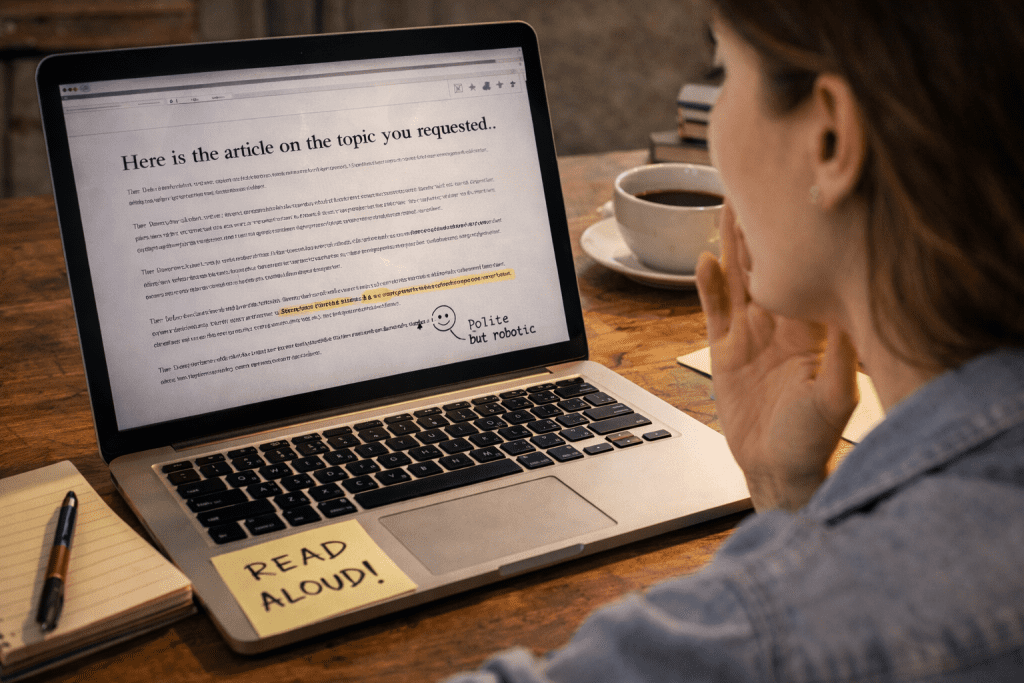
For a long time, I believed I was editing AI-generated content properly. I checked grammar, adjusted transitions, removed repetition, and improved clarity. On screen, everything looked fine. The sentences were clean. The structure made sense. Yet something still felt off after publishing. Articles performed inconsistently, and more importantly, they did not feel like something I would naturally say.
The real change in my editing process did not come from a new tool or a better prompt. It came from a simple habit I had underestimated for years: reading the content aloud. This shift was reinforced by discussions around humanized AI output, where experienced writers repeatedly pointed out that human tone is something you hear before you see.
This article explains how reading AI content aloud fundamentally changed the way I edit, why it exposes problems silent reading misses, and how it helps turn AI drafts into writing that feels genuinely human.
Why Silent Reading Hides AI Problems
When we read silently, our brains auto-correct. We skim. We fill gaps. We smooth awkward phrasing without realizing it. This works against us when editing AI content.
AI writing is often technically correct but rhythmically wrong. Sentences are balanced in a way that looks fine on the page but sounds unnatural when spoken. Silent reading hides that imbalance.
I realized this after publishing several articles that looked polished but felt lifeless. When I later read them aloud, the issues were immediately obvious. The pacing was off. Transitions felt forced. Some sentences were simply too polite to sound real.
AI Writes for the Eye, Not the Ear
AI models are trained primarily on written text. They optimize for readability on the page, not for speech. Humans, however, subconsciously judge writing as if it were spoken.
When writing sounds natural aloud, it usually reads naturally as well. When it sounds artificial, readers feel that disconnect even if they cannot articulate it.
Reading aloud bridges that gap. It exposes where AI has prioritized symmetry over flow and explanation over emphasis.
The First Time I Read an AI Draft Aloud
The first time I read a full AI-assisted article aloud, I was surprised by how uncomfortable it felt. Not because the content was wrong, but because it did not sound like a human thinking out loud.
There were too many transitions. Too many perfectly formed sentences in a row. Too little variation in tone. The article explained everything but committed to nothing.
That moment made it clear that visual editing alone was not enough. Sound mattered.
How Reading Aloud Changes Editing Decisions
When I edit silently, I focus on correctness. When I edit aloud, I focus on believability.
Reading aloud forces me to slow down. It highlights where a sentence drags, where an idea arrives too late, or where a paragraph says more than it needs to. These are not grammatical issues. They are human issues.
I began cutting entire sentences that looked fine but sounded unnatural. I shortened paragraphs that felt heavy when spoken. I rewrote transitions that sounded like filler.
Exposing AI-isms Through Sound
AI-isms are easier to hear than to see. Phrases like “it is important to note” or “this highlights the fact that” may look acceptable, but they sound stiff aloud.
When spoken, these phrases interrupt flow. They announce rather than communicate. Humans rarely speak this way unless they are reading from a script.
By reading aloud, I catch these patterns instantly and remove them without hesitation.
Why This Step Cannot Be Automated
Some tools claim to humanize text automatically. They can help at the surface level, but they cannot listen.
Listening is a human act. It involves intuition, context, and expectation. When something sounds wrong, a human editor knows it immediately. A tool does not.
This is why reading aloud remains one of the most effective editing techniques I use. It complements AI instead of competing with it.
Where Reading Aloud Fits in My Workflow
I only read content aloud after the draft is complete and human editing has already begun. I do not use it during drafting. I use it during refinement.
This approach aligns closely with Polishing AI drafts into human content, where the read-aloud phase is treated as a final quality check rather than a cosmetic step.
At this stage, the article already reflects my perspective. Reading aloud ensures it also reflects my voice.
How Reading Aloud Improves Rhythm and Flow
Rhythm is difficult to judge on a screen. When sentences are similar in length and structure, the eye may not notice. The ear always does.
Reading aloud reveals when writing becomes monotonous. It shows where variation is needed. Short sentences regain their power. Long sentences are trimmed or broken.
This process transforms the article from something that looks organized into something that feels alive.
Editing for Breath and Pause
Humans speak in breaths and pauses. AI writes in uninterrupted blocks of logic.
When I read aloud, I notice where I naturally pause. Those pauses often signal where paragraphs should break or where ideas need space.
I restructure content based on breathing patterns. This might sound subtle, but it dramatically improves readability.
Why Readers Respond Better to Read-Aloud Content
Readers do not consciously know that content has been read aloud. They simply feel that it flows.
Articles edited this way hold attention longer. Readers reach the end more often. Comments reference specific sentences rather than vague impressions.
These signals tell me that the writing feels human, not processed.
Fixing Over-Explanation
AI tends to explain everything thoroughly. Humans often imply.
Reading aloud makes over-explanation painfully obvious. Long explanations sound like lectures when spoken. Editing aloud helps me remove redundancy and trust the reader more.
Trust is a human signal. AI does not naturally provide it.
Tone Becomes Clearer When Spoken
Tone is easier to hear than to see. When I read an article aloud, I can tell immediately if it sounds too formal, too cautious, or too generic.
This allows me to adjust tone deliberately. I soften where needed. I become more direct where hesitation weakens the message.
These adjustments rarely emerge from silent editing alone.
Why Reading Aloud Protects Voice
Voice consistency is one of the biggest challenges in AI-assisted writing. AI can mimic style, but it cannot maintain voice across judgment calls.
Reading aloud acts as a voice filter. If something does not sound like me, it does not stay.
This keeps the article coherent and personal, even when AI was involved early in the process.
Common Mistakes When Skipping This Step
The most common mistake is assuming that clean writing is good writing. Another is trusting readability scores over intuition.
Articles that skip the read-aloud step often feel sterile. They communicate information but not thought.
Once I adopted this habit, skipping it felt irresponsible.
How This Habit Changed My Results
Since I started reading AI-assisted articles aloud, feedback has changed. Readers mention clarity, tone, and flow more often. Engagement feels steadier rather than unpredictable.
The content feels easier to stand behind because it sounds like something I would actually say.
Final Thoughts
Reading AI content aloud changed the way I edit because it shifted my focus from correctness to humanity. AI can help generate drafts, but it cannot listen to itself.
The ear catches what the eye misses. It exposes stiffness, over-explanation, and artificial rhythm instantly.
That is why conversations inside Humanize AI output repeatedly return to simple human practices rather than complex tools. The most effective techniques are often the oldest ones.
If there is one habit that consistently improves AI-assisted writing, it is this. Read it aloud. If it does not sound human, it is not finished yet.