
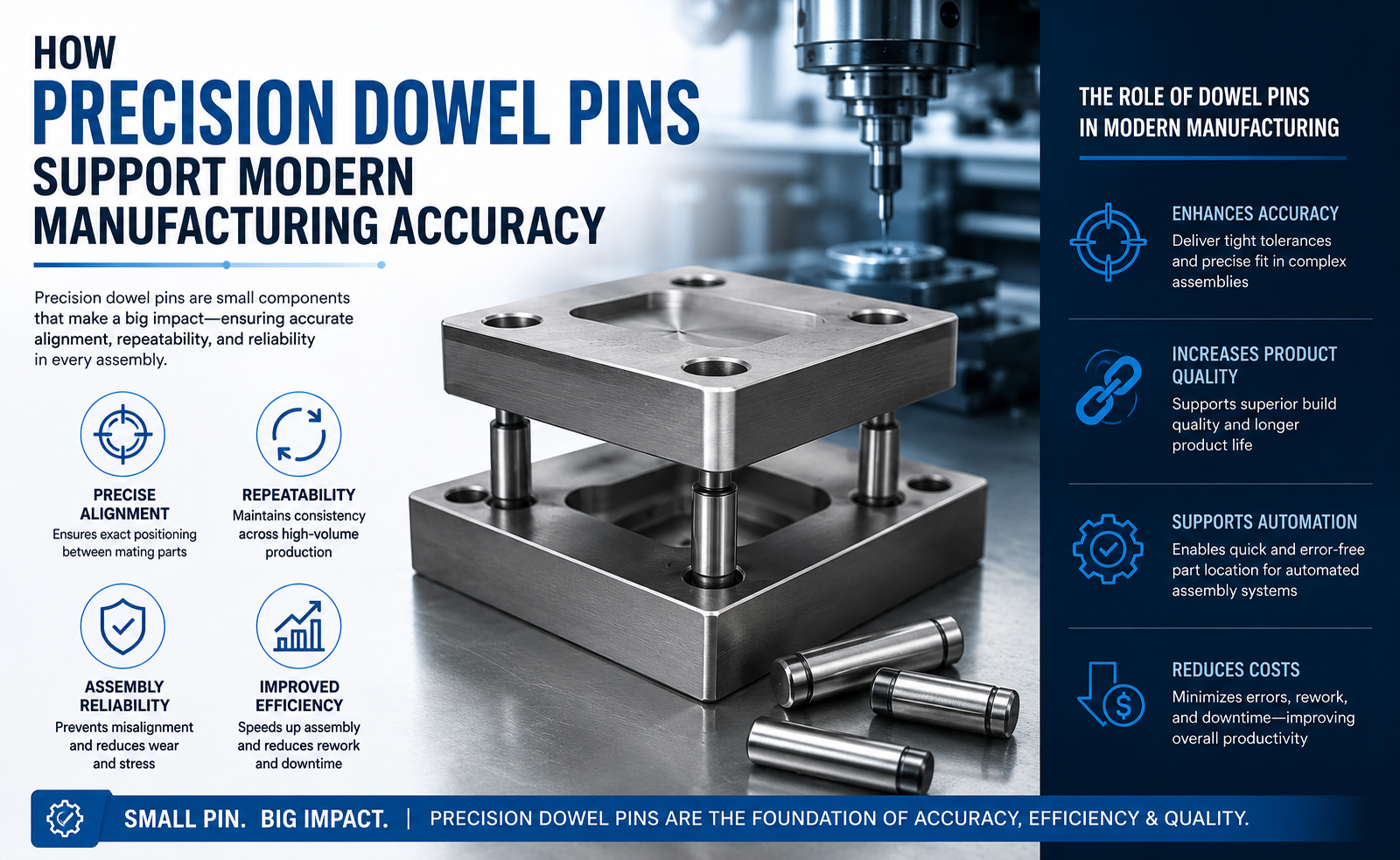
In modern manufacturing, precision is no longer optional. Whether producing automation equipment, automotive assemblies, medical devices, or industrial machinery, manufacturers are under increasing pressure to maintain tighter tolerances, improve assembly consistency, and reduce production downtime. As factories move toward higher levels of automation and lean manufacturing, even small alignment deviations can create major quality and performance problems.
One of the most overlooked yet critical components behind reliable mechanical alignment is the dowel pin.
Although simple in appearance, precision dowel pins play a major role in positioning, locating, and securing components in demanding industrial applications. From CNC machining fixtures to robotic assemblies and tooling systems, these components help manufacturers maintain repeatable accuracy across high-volume production environments.
Why Alignment Accuracy Matters in Modern Production
Manufacturing trends are changing rapidly. Companies are investing heavily in automation, CNC machining systems, robotics, and precision assembly equipment. As production speeds increase, the margin for dimensional error becomes smaller.
Poor alignment inside an assembly can lead to:
Premature wear of moving components
Inconsistent product quality
Increased vibration and noise
Difficult maintenance procedures
Production downtime
Reduced equipment lifespan
For industries such as aerospace, electronics, automotive, and industrial automation, maintaining repeatable positioning accuracy is essential. This is where precision dowel pins become indispensable.
Unlike standard fasteners, dowel pins are specifically designed to provide exact positioning between components. They ensure parts return to the same location repeatedly during assembly or maintenance operations.
The Growing Demand for Precision Machined Components
Manufacturers today are sourcing components that offer not only dimensional consistency but also material reliability and long-term durability. CNC machining technology has significantly improved the ability to produce highly accurate custom components with micron-level tolerances.
As industrial equipment becomes more complex, the demand for custom-machined locating and fastening components continues to grow. Precision dowel pins are now widely used in:
CNC fixtures and jigs
Injection molds
Robotic systems
Industrial automation equipment
Automotive assemblies
Medical equipment
Hydraulic systems
Aerospace tooling
Modern production facilities require components that can perform consistently under vibration, temperature changes, and repetitive mechanical loads.
High-quality precision pins manufactured through advanced CNC turning and grinding processes help manufacturers reduce tolerance stack-up issues while improving assembly repeatability.
Material Selection Is Critical
Choosing the correct material for dowel pins directly affects performance, wear resistance, and corrosion protection.
Among all material options, hardened steel remains one of the most widely used choices because of its excellent mechanical strength and dimensional stability.
Manufacturers that require long-term reliability in industrial environments often prefer precision-machined steel dowel pins for demanding assemblies where wear resistance and structural integrity are critical.
Depending on the application environment, manufacturers may also select stainless steel, alloy steel, brass, or engineering plastics. Heat treatment and surface finishing processes further enhance performance for specialized industrial applications.
Custom Manufacturing for Specialized Applications
Standard catalog components are not always suitable for modern engineering projects. Many OEM manufacturers now require custom dimensions, unique tolerances, specialized surface finishes, or non-standard geometries to meet exact assembly requirements.
This shift has increased demand for experienced machining suppliers capable of producing custom precision components with stable quality control systems.
Professional CNC machining manufacturers offering custom dowel pin manufacturing solutions can support OEM projects that require tight tolerances, specialized materials, and scalable production capabilities.
Advanced Swiss CNC machining technology is especially valuable for producing high-precision small components with exceptional concentricity and dimensional consistency.
The Role of CNC Machining in Precision Component Production
The evolution of CNC machining has transformed how precision hardware components are manufactured. Modern multi-axis CNC turning centers and Swiss-type lathes enable manufacturers to produce complex precision parts with superior repeatability.
Compared with traditional machining methods, CNC manufacturing offers several important advantages:
Higher dimensional accuracy
Better production consistency
Faster lead times
Improved surface finishes
Reduced human error
Scalability for mass production
For dowel pins and other precision locating components, maintaining tight diameter tolerances is especially important because even minor deviations can affect assembly alignment.
Manufacturers specializing in precision steel dowel pin production typically implement strict inspection processes including optical measurement systems, hardness testing, and precision grinding verification to ensure stable product quality.
Automation Is Increasing the Importance of Precision Hardware
Global manufacturing is rapidly shifting toward smart factories and automated production systems. Robotics, automated assembly lines, and precision motion systems require extremely accurate positioning components to function reliably.
As automation expands across industries, small mechanical components such as dowel pins become increasingly important for maintaining machine calibration and positioning accuracy.
Industrial engineers are now focusing more on long-term assembly stability rather than simply selecting low-cost hardware. Reliable precision components help reduce maintenance costs, improve production uptime, and increase operational efficiency.
This trend is driving greater interest in precision-machined locating solutions produced by experienced manufacturing partners with advanced CNC capabilities.
Quality Control Remains a Key Competitive Advantage
In precision manufacturing, consistent quality is often more important than production volume alone.
Reliable machining suppliers invest heavily in:
Precision inspection equipment
Material traceability systems
Process standardization
Skilled engineering teams
Advanced CNC technologies
Stable production management
For industrial buyers, selecting the right machining partner can significantly impact product reliability and long-term production stability.
Manufacturers searching for dependable alignment solutions increasingly prioritize suppliers with proven experience in precision dowel pin manufacturing, custom CNC machining, and industrial quality control systems.
Final Thoughts
As manufacturing technology continues evolving, precision components will play an even larger role in ensuring product reliability and production efficiency.
Dowel pins may appear simple, but their impact on assembly accuracy, mechanical stability, and long-term equipment performance is substantial. In industries where precision matters, investing in high-quality machined components helps manufacturers reduce risk while improving consistency across production processes.
With the continued growth of automation, robotics, and precision engineering, demand for accurately machined locating components will only continue increasing in the years ahead.
