
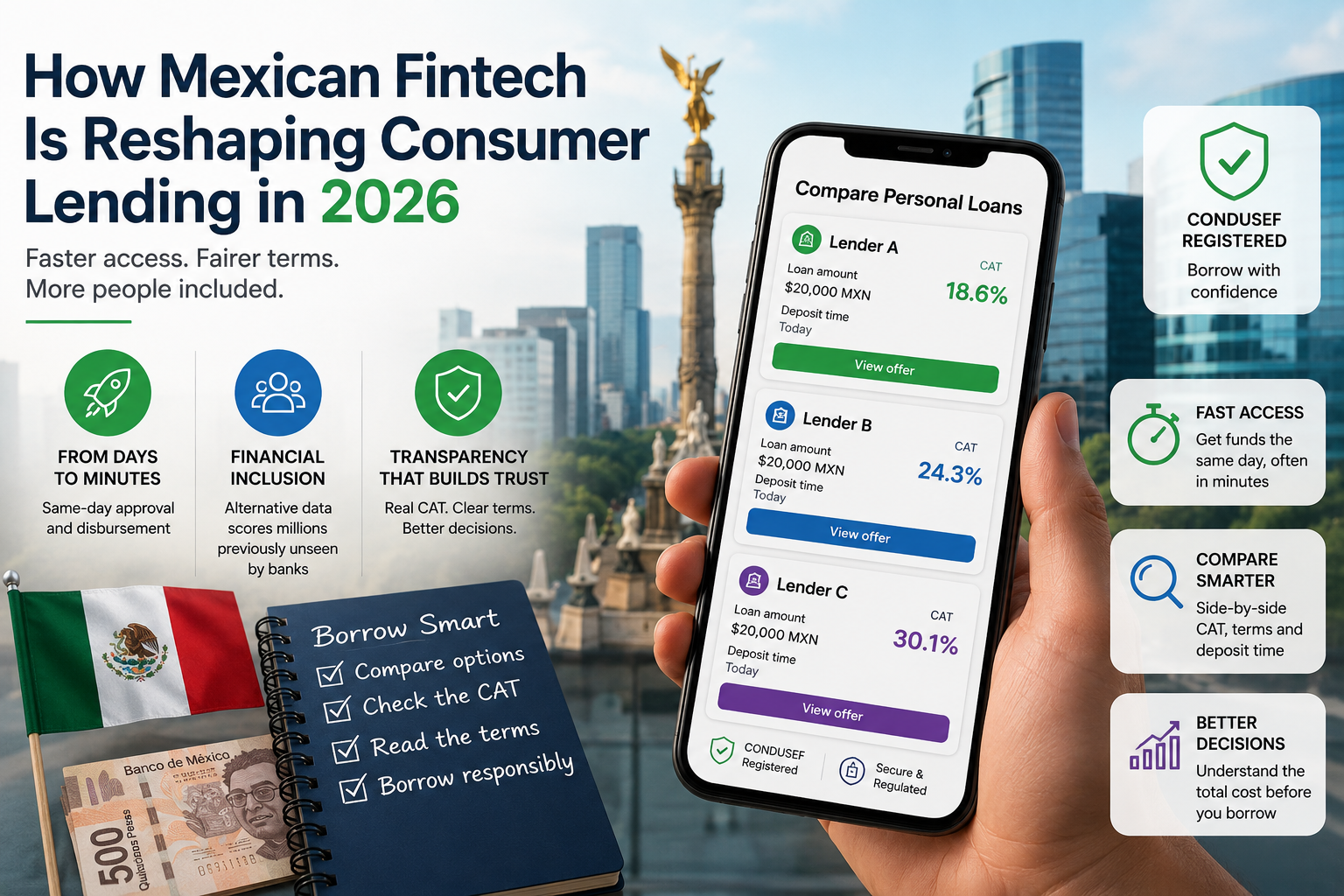
For decades, getting a small consumer loan in Mexico meant a branch visit, a thick stack of paperwork and a wait measured in days. In 2026 that experience is almost unrecognizable. A wave of financial-technology companies has moved the entire process onto the phone, and in doing so it has changed who gets access to credit, how fast, and on what terms.
From branches to smartphones
The headline change is speed. Where a traditional personal loan once required an in-person appointment, many digital lenders now approve and disburse funds the same day, sometimes within minutes. That convenience is not a gimmick; it reflects a different underlying model. Instead of relying solely on a thin credit-bureau file, fintech lenders read alternative signals — transaction history, device data, repayment behavior on smaller products — to estimate risk.
This matters in a country where a large share of adults have historically sat outside the formal banking system. By scoring people the old model simply could not see, digital lenders have pulled millions of first-time borrowers into the formal credit market. Financial inclusion, long a policy aspiration in Mexico, is finally moving because the unit economics now work.
The new competitive battleground: transparency
Speed alone, however, is no longer a differentiator — everyone is fast. The real competition in 2026 is over trust and clarity. Mexican consumers have learned, sometimes painfully, that a low advertised monthly payment can hide a punishing total cost. The metric that cuts through the noise is the CAT (Costo Anual Total), the all-in annual cost figure that bundles interest, commissions and fees into a single comparable number.
Lenders that lead with their real CAT, disclose their regulatory status and let borrowers see the full cost before they sign are winning the long game. Those that bury the numbers are increasingly called out, both by regulators such as CONDUSEF and by a more financially literate public.
Comparison as a consumer-protection tool
One of the quieter but more consequential developments is the rise of independent comparison platforms. By placing each lender’s CAT, loan amount, term and deposit time side by side, these tools turn an opaque market into something a borrower can actually evaluate. Mexican platform TurboCash is a clear example of the category: it lines up dozens of CONDUSEF-registered lenders so a user can weigh the honest cost of each option before applying, rather than chasing the first ad they see.
That shift — from marketing-driven choices to data-driven ones — is arguably the most important thing fintech has done for the Mexican consumer. It rebalances a relationship that used to favor whoever had the biggest advertising budget.
What comes next
Three trends are worth watching through the rest of 2026. First, embedded lending: credit offered at the moment of purchase inside e-commerce and ride-hailing apps. Second, tighter regulation, as authorities work to ensure that faster access does not translate into faster over-indebtedness. Third, the maturing of alternative credit scoring, which should keep widening access while — ideally — keeping default rates in check.
None of this removes the borrower’s responsibility to read the fine print. But the direction of travel is encouraging. A market that once rewarded confusion is starting to reward clarity, and the consumers who benefit most are precisely the ones the old system left behind.
The author writes on financial technology and consumer finance across Latin America