
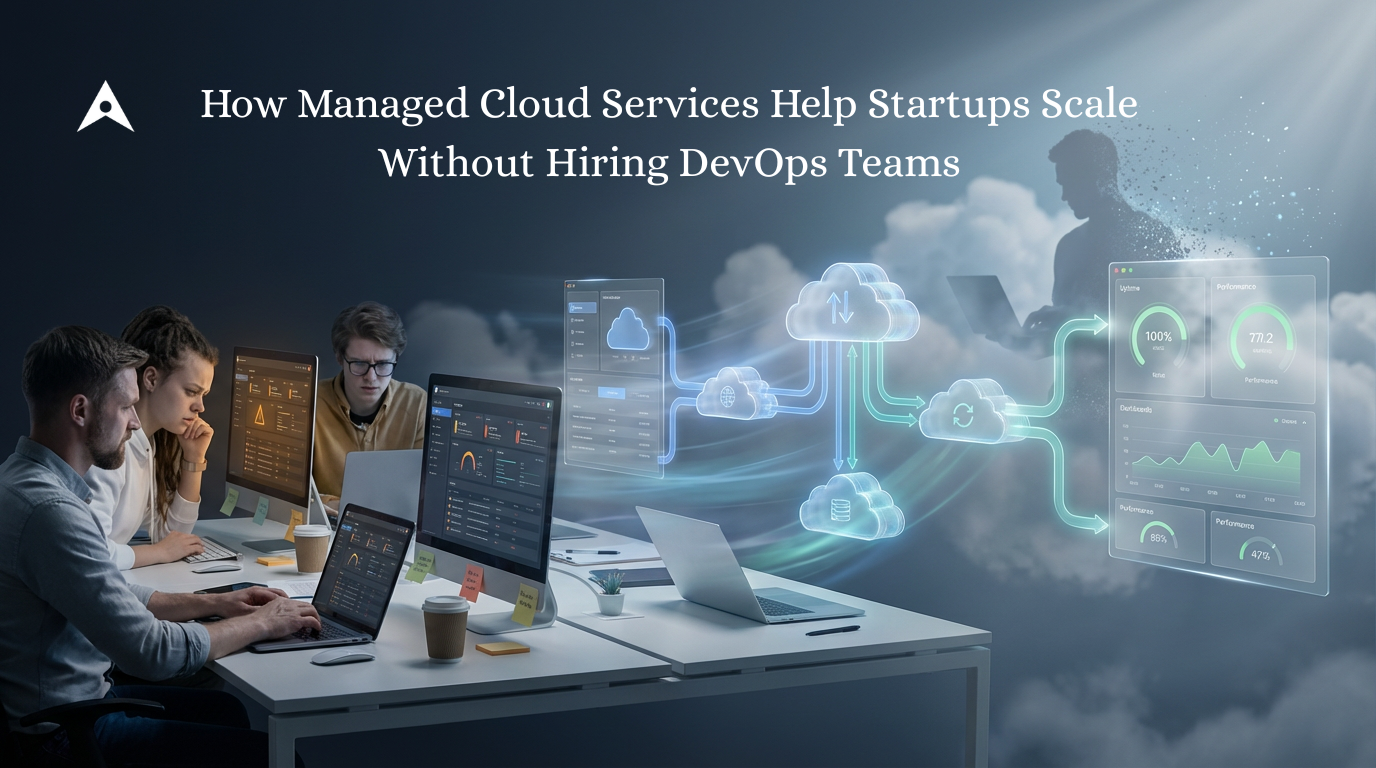
The dream of every startup founder is the “hockey stick” growth curve. You’ve spent months—maybe years—perfecting your Minimum Viable Product (MVP), and suddenly, it happens. Your user base doubles overnight. Then it triples. You get featured on a major tech portal or a viral social media thread, and the traffic starts pouring in.
But then, the nightmare begins.
The site starts lagging. Database queries that took milliseconds now take seconds. Your developers are frantically trying to patch server issues instead of shipping the new features your customers are screaming for. You realize you need a DevOps engineer, but you look at the market and see six-figure salaries and six-month hiring windows.
This is the “Infrastructure Wall,” and it breaks more startups than bad product-market fit ever will.
The good news? The era of needing a massive, in-house DevOps team to scale is over. Today, managed cloud services and devops consulting services are providing a blueprint for startups to scale with agility, security, and cost-efficiency without the overhead of a full-time operations department.
Why Scaling Infrastructure Is a Nightmare for Startups
Scaling a digital product is rarely as simple as “buying a bigger server.” In the early days, manual configurations and “quick fixes” are the norm. However, as you grow, these shortcuts turn into technical debt.
Unpredictable Demand
Startups don’t grow linearly. They grow in spikes. If your infrastructure isn’t designed to “elasticate” (expand and contract automatically), you’re either paying for idle servers during quiet hours or crashing during peak traffic.
The “Silo” Trap
Without dedicated infrastructure management, developers often end up wearing the “DevOps hat.” This leads to a dangerous bottleneck. Every hour a Senior Developer spends fixing a Jenkins pipeline or a broken S3 bucket is an hour they aren’t spent building the core product.
Security and Compliance
As you scale, you become a target. Startups often lack the monitoring tools to detect intrusions or the automated backups necessary to recover from a disaster. Furthermore, if you plan to move into Enterprise sales, you’ll need SOC2 or GDPR compliance—requirements that are nearly impossible to manage without expert infrastructure oversight.
The Real Cost of Hiring a DevOps Team
Many founders assume the solution is to hire a DevOps engineer. Let’s look at the math.
- Salary: In the current market, a mid-to-senior DevOps engineer or Site Reliability Engineer (SRE) commands a salary between $140,000 and $180,000 per year.
- The “Bus Factor”: You can’t just hire one. If your lone DevOps engineer goes on vacation or gets sick, and the system goes down, you’re stranded. A true 24/7 “on-call” rotation requires at least three people.
- Hiring Lead Time: It takes an average of 45 to 90 days to find and onboard a qualified DevOps professional. In startup time, three months is an eternity.
The Hidden Costs: Beyond the paycheck, there is the cost of inefficient cloud usage. Without expert optimization, startups often overspend on their cloud service providers by 30% to 50% due to misconfigured instances and orphaned resources.
What Are Managed Cloud Services? (Simple Explanation)
In plain English, managed cloud services are a partnership where you outsource the management of your cloud infrastructure to a team of dedicated experts.
Instead of you managing the virtual machines, databases, and networking of platforms like AWS, Azure, or Google Cloud, a managed service provider (MSP) or a DevOps consulting firm handles it for you.
What they typically handle:
- Infrastructure Setup: Provisioning environments using “Infrastructure as Code” (Terraform/CloudFormation).
- CI/CD Pipelines: Automating the process of moving code from a developer’s laptop to the production server.
- 24/7 Monitoring: Using tools like Datadog or New Relic to watch for errors before your users see them.
- Security: Implementing firewalls, encryption, and access controls.
- Cost Management: Regularly auditing your cloud bill to ensure you aren’t overpaying.
How Managed Cloud Services Enable Startup Scaling
By leveraging cloud infrastructure managed services, startups can bypass the growing pains of traditional infrastructure management.
1. Instant Infrastructure Readiness
With managed services, you don’t have to spend weeks building a production environment. Providers use pre-configured, battle-tested templates. This means you can go from “local development” to “enterprise-grade production” in days, not months.
2. Built-in Scalability
Managed services focus on “Auto-scaling.” They configure your system so that when traffic increases, the cloud provider automatically spins up more resources. When traffic drops, those resources vanish, saving you money. You scale up for the “spike” and scale down for the “savings.”
3. Faster Time-to-Market
When developers don’t have to worry about server configurations, their velocity increases. They can focus entirely on code. Managed services provide the “rails” that allow code to be deployed multiple times a day with zero downtime.
4. 24/7 Monitoring and Reliability
Startups can’t afford a reputation for being “unstable.” Managed partners provide “around-the-clock” eyes on your system. If a server fails at 3:00 AM, the managed service team handles it, often resolving the issue before your team even wakes up.
5. Cost Optimization from Day One
Cloud bills are notoriously complex. A managed partner understands the nuances of “Reserved Instances,” “Spot Instances,” and “Savings Plans.” They ensure you are using the most cost-effective resources offered by cloud service providers.
Managed Cloud vs. In-House DevOps: The Comparison
| Factor | Managed Cloud Services | In-House DevOps Team |
| Cost | Fixed, predictable monthly fee | High salaries + benefits + equity |
| Speed | Immediate setup and deployment | Months of hiring and onboarding |
| Expertise | Access to a team of specialists | Limited to the knowledge of the hire |
| Scalability | Built-in and automated | Needs manual planning and execution |
| Risk | Lower (Service Level Agreements) | Higher (single point of failure) |
The Startup Insight: For an early-stage company, speed is the only currency that matters. Managing an internal HR process for DevOps roles adds organizational complexity that distracts from the mission.
Real-World Scenario: The Scaling of “FinTechX”
Imagine a fintech startup, FinTechX, which just closed its Series A. They have 5,000 users and a small team of four developers.
Scenario A: The DIY Route The developers try to manage the AWS console themselves. They manually launch EC2 instances. One Friday, they get a shoutout from a major influencer. Traffic jumps to 50,000 users. The database locks up. The site stays down for six hours. They lose $20,000 in potential revenue and suffer a PR hit. They decide to hire a DevOps engineer, but the search takes four months.
Scenario B: The Managed Route FinTechX partners with a devops consulting services firm early on. The firm sets up a Kubernetes cluster with auto-scaling. When the traffic spike hits, the system automatically expands from three nodes to twenty. The users experience zero lag. The developers continue working on a new “crypto-wallet” feature. The monthly cost of the managed service is less than 1/4th the cost of a single senior engineer.
When Should Startups Consider Managed Cloud Services?
Not every startup needs managed services on day one, but you should look for these red flags:
- The MVP is Live: Once you have real users and real data, the “hobbyist” approach to servers is a liability.
- Frequent Downtime: If your site crashes more than once a month due to “server issues.”
- Developer Burnout: If your lead dev is spending 40% of their time on “ops” tasks.
- Audit Readiness: If you are chasing a big enterprise contract that requires security documentation.
Choosing the Right Managed Cloud Partner
When looking for a partner to handle your managed cloud services, don’t just look for the cheapest price. Look for:
- Startup DNA: Do they understand the need for speed and pivot-ready infrastructure?
- Multi-Cloud Expertise: Can they work across AWS, Azure, and Google Cloud?
- Security First: Do they provide automated backups and encryption as standard?
- Transparent Communication: You need a partner that integrates with your Slack or Teams, not one that hides behind a slow ticketing system.
Future Insight: DevOps Is Becoming a Utility
The tech industry is moving away from “building the machine” and toward “using the machine.” Just as we no longer run our own electricity generators, startups are realizing they shouldn’t have to build their own deployment machines.
In the next five years, the most successful startups will be the “leanest” ones. They will outsource everything that isn’t a core competency. By treating DevOps as a service rather than a department, companies can remain agile, keep their burn rate low, and focus entirely on the customer experience.
Conclusion
Scaling a startup is inherently risky, but your infrastructure shouldn’t be the reason you fail. You don’t need a massive in-house DevOps team to compete with the giants; you just need the right systems in place.
Managed cloud services offer a bridge between the scrappy MVP phase and the global scale phase. They provide the expertise, the tools, and the 24/7 peace of mind that founders need to sleep at night.
If you’re building a scalable product, it might be time to stop looking for a DevOps unicorn and start looking for a managed partner who can build the foundation for your growth. Your developers and your bottom line will thank you.