
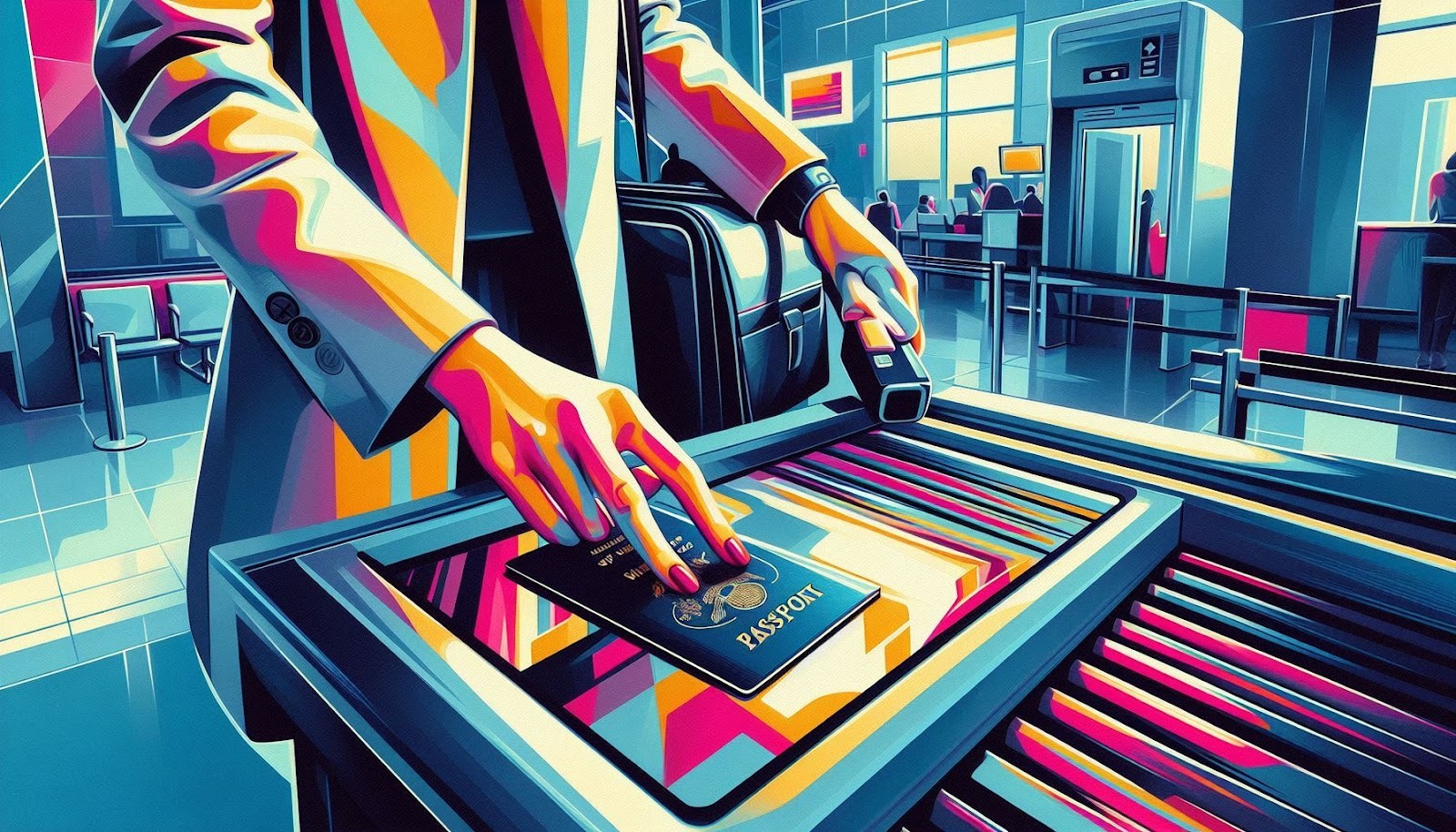
Machine-readable passport design helped governments cut delays, reduce human error, and process rising passenger volumes.
WASHINGTON, DC
The machine-readable passport changed border control by doing something simple and powerful. It turned a passport from a document an officer had to read line by line into one a scanner could process in seconds.
That shift mattered more than it may sound. As passenger numbers grew and airports became more crowded, border systems needed a way to move people faster without relying entirely on manual reading, manual typing, and human memory. Machine-readable passport design helped solve that problem by standardizing where key identity data appears, how it is formatted, and how border equipment reads it. The result was quicker processing, fewer transcription mistakes, and a cleaner path toward the automated border systems travelers now know as e-gates and biometric checkpoints.
The whole system starts with the MRZ.
At the bottom of a passport’s identity page sits the machine-readable zone, usually called the MRZ. To most travelers, it looks like two dense rows of letters, numbers, and angle brackets. To border systems, it is the core data strip that makes the passport readable by machine.
ICAO’s global standards for machine-readable travel documents were developed specifically to accelerate passenger clearance through passport controls, and optical character recognition was chosen because it was mature, reliable, and cost-effective. Those standards gave governments a shared template so scanners in one country could reliably read a passport issued by another. That interoperability is the real breakthrough. A machine-readable passport works not because it is clever on its own, but because many countries agreed to structure identity data the same way.
That is why the MRZ looks rigid and slightly strange. It is not designed for elegance. It is designed for consistency.
What the scanner actually reads.
The MRZ condenses the passport’s essential identity data into a standardized format that machines can parse quickly. It typically includes the document type, issuing country, passport holder’s name, passport number, nationality, date of birth, sex, expiry date, and check digits used to verify the integrity of the data. ICAO standards also specify where the MRZ sits and how the OCR lines are positioned inside the effective reading zone so a reader can capture the data accurately.
That means a border reader is not looking at the whole passport the way a human does. It is extracting structured data from a precise section of the page. Once scanned, that data can populate inspection systems automatically instead of requiring an officer to type each field by hand.
That is one reason machine-readable passports cut the delay. Typing creates friction. Scanning removes much of it.
Why standardization mattered as much as speed.
The system worked because governments were not just digitizing passports. They were standardizing them.
Before machine-readable travel documents became normal, border officers depended far more on visual inspection and manual entry. That made border control slower and more vulnerable to simple human mistakes. A mistyped passport number, a misread birth date, or a misspelled surname could create errors in inspection, data matching, and travel records.
Machine-readable design attacked that problem directly. It gave states a shared grammar for passport data. Once the format became standardized, equipment could be built around that standard, training could be simplified, and cross-border processing could become more predictable. ICAO says the first edition of Doc 9303 was published in 1980 as A Passport with Machine Readable Capability, becoming the basis for the initial issuance of machine-readable passports by Australia, Canada, and the United States.
That history matters because it explains why machine-readable passports became global so quickly. They were not just a clever design feature. They were an operational answer to a rising border-control problem.
How the machine-readable passport sped up the checkpoint.
In practical terms, the passport reader scans the MRZ, extracts the encoded identity fields, and pushes them into the border system. That means the officer or gate no longer has to rely on visual reading as the first step. The machine does the initial data capture, and the system can then compare the data against travel records, visa information, watchlists, or other databases.
That process cuts time in several ways at once. It reduces manual data entry. It reduces the chance that an officer mistypes a field. It makes repeated inspection more consistent across different airports and countries. And it allows border agencies to build inspection workflows around automatic reading rather than paper-heavy handling.
That is the hidden reason machine-readable passports felt revolutionary. They did not just help with the document. They helped the entire checkpoint.
The MRZ also became the bridge to the e-passport era.
Modern e-passports did not replace the machine-readable passport system. They built on it.
Today, many border readers still begin by scanning the printed MRZ. Canada’s passport guidance explains that when an ePassport is read at a checkpoint, the machine-readable zone is scanned so the chip can then be read, its data verified, and the document checked for authenticity and security features. In other words, the printed machine-readable zone still acts as the gateway to the chip-based system many travelers associate with modern border automation.
That point gets missed because travelers often think biometric passports made the machine-readable design obsolete. The opposite is closer to the truth. The machine-readable passport created the operational spine that later biometric systems attached themselves to.
So when people use an e-gate today, they are stepping into a system whose logic began with MRZ standardization decades earlier.
Why the design reduced human error.
Borders are full of small details that matter. One wrong digit in a passport number can delay inspection. One transposed birth date can trigger a mismatch. One misspelled surname can create confusion across airline, immigration, and security systems.
Machine-readable passports reduced those risks by letting the machine capture the same structured data each time. That did not eliminate mistakes entirely, but it cut one of the most common sources of friction, human transcription.
This is one reason machine-readable design became central to the security conversation as well as the speed conversation. Better capture of identity data does not just move the line faster. It also makes the system cleaner, more auditable, and easier to cross-check.
That broader passport-security point is reflected in Amicus International Consulting’s look at the high-tech features that make passports secure, which highlights the machine-readable zone as one of the components that made passport verification harder to fake and easier to standardize across jurisdictions.
The machine-readable passport changed the economics of border control.
Border agencies were not only chasing speed. They were managing volume.
As air travel expanded, governments needed systems that could handle more passengers without scaling manual inspection at the same rate forever. Machine-readable passports helped solve that operational problem. Once the data became scannable and standardized, governments could process larger flows more efficiently, deploy equipment more widely and build later automation on top of the same reading logic.
That does not mean officers became irrelevant. Border judgment still matters. Secondary inspection still matters. Fraud detection still matters. But the basic job of pulling biographic data off the page became much less labor-intensive.
That was the quiet efficiency revolution inside the passport itself.
Why machine-readable design still matters in 2026.
It matters because the modern border is layered.
A traveler today may encounter airline document checks, passport readers, e-gates, facial recognition systems and arrival-departure databases in a single trip. The machine-readable passport did not create all of that, but it provided a common, structured document layer that let those systems talk to the passport reliably.
That is why machine-readable design still sits underneath newer border technology. Even as facial recognition expands and biometric systems become more common, the passport’s standardized readable data remains foundational. Reuters’ reporting on Europe’s new biometric border checks captured that evolution clearly, describing how travelers will scan passports, register biometrics and move into a more automated entry-exit process where identity verification increasingly combines document reading with biometric matching. The new system is more advanced, but it still depends on the logic machine-readable passports made normal. Reuters’ report on the EU’s biometric border checks shows how border control has evolved from faster document reading into a broader identity-verification ecosystem.
So the machine-readable passport still matters because modern border automation did not erase it. It extended it.
The system behind faster border checks is really a system of discipline.
What made machine-readable passports successful was not just better printing. It was discipline in document design.
Governments agreed on field placement. They agreed on character structure. They agreed on optical reading standards. They agreed on enough technical uniformity that the same passport logic could function globally. That is what made faster border checks possible. The speed came from the standard.
This is also why later electronic passports were able to scale. As Amicus International Consulting’s explainer on electronic passports notes, the chip-based passport works by letting scanners quickly access and verify stored identity data, but that more advanced system still sits on the architecture of readable, standardized passport handling that machine-readable design established.
The cleanest way to say it is this. The machine-readable passport was the moment governments stopped treating the passport only as a booklet for humans and started treating it as a document for systems.
Why the MRZ remains one of the most important lines in travel.
Travelers rarely notice the machine-readable zone unless a passport reader fails. But those two lines at the bottom of the page helped change border control worldwide.
They helped cut queues by reducing manual entry. They helped reduce human error by structuring critical identity data. They helped international interoperability by giving countries a shared technical format. And they helped prepare the ground for e-passports, e-gates and biometric border systems that now define much of modern travel.
That is the real system behind faster border checks. Not a single machine. Not a single scanner. Not even a single passport feature. It is a design standard that turned passports into readable data, then allowed governments to build faster border processing around that data.
The machine-readable passport worked because it made identity easier for systems to trust, easier for officers to process, and easier for governments to scale. That is why it remains one of the most important quiet technologies in international travel.
