

Building a luxury home is one of the most exciting and most misunderstood parts of the real estate process. Buyers often assume a custom build follows the same rough timeline as a standard production home, only to discover that luxury construction operates on a completely different set of variables. Lot conditions, architectural complexity, custom finishes, and local permitting requirements all play a role in how long the process actually takes.
If you’re considering a custom build, working with a developer on a spec home, or simply trying to understand what “new construction” really involves, this guide breaks down the full timeline from empty lot to move-in day along with the factors that can speed things up or slow them down.
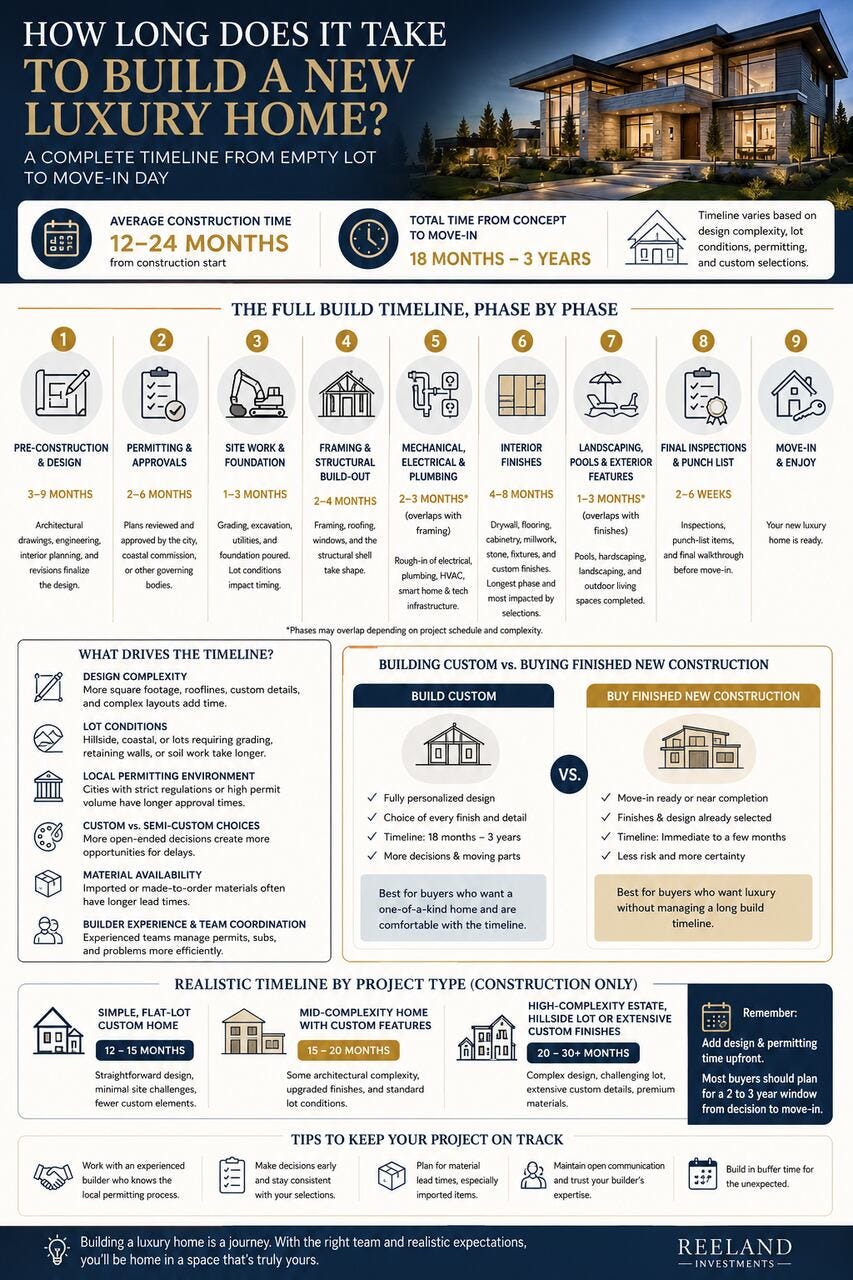
On average, a luxury home takes 12 to 24 months to build from the day construction officially begins. Add in design, permitting, and site preparation, and the full process from initial concept to final walkthrough often spans 18 months to 3 years.
That range is wide on purpose. A 3,500-square-foot modern home on a flat, previously developed lot with a straightforward design can move quickly. A 9,000-square-foot estate with a basement, pool, extensive custom millwork, and a hillside lot that will require geotechnical engineering will take considerably longer. The timeline is less about square footage alone and more about complexity, site conditions, and how many custom decisions are baked into the design.
Breaking Down the Timeline, Phase by Phase
Pre-Construction and Design
Before a single shovel hits the ground, there’s a design phase that shapes everything downstream. This includes architectural drawings, structural engineering, interior design planning, and for custom builds multiple rounds of revisions between the homeowner, architect, and builder.
For spec homes built by an experienced developer, this phase moves faster because the design is often finalized in-house before the property ever goes to market or before a buyer is involved. For fully custom homes, this stage can stretch longer as buyers weigh finishes, layouts, and structural choices.
Permitting and Approvals
This is the phase most buyers underestimate. Permitting timelines vary dramatically depending on the city, the complexity of the project, and whether the property sits in a coastal zone, hillside area, or historic district. Some municipalities process permits in a matter of weeks. Others, particularly in high-demand coastal and hillside markets, can take several months due to environmental review, coastal commission approval, or neighborhood design review boards.
Experienced builders who have already navigated a city’s permitting process and who maintain relationships with local planning departments tend to move through this stage more efficiently than first-time custom builders working with an unfamiliar team.
Site Work and Foundation
Once permits are approved, site work begins: grading, excavation, utility connections, and foundation pouring. Hillside lots, homes requiring extensive retaining walls, or properties needing soil remediation will take longer here. Flat, buildable lots move through this phase relatively quickly.
Framing and Structural Build-Out
This is when the home starts to take physical shape. Framing, roofing, and the structural shell are completed during this window. Larger homes, homes with unique rooflines, or those incorporating steel framing for large open spans will naturally take more time than a simpler structural design.
Mechanical, Electrical, and Plumbing
Once the structure is enclosed, the home is “roughed in” electrical wiring, plumbing lines, HVAC systems, and increasingly, smart home infrastructure are installed. Luxury homes often include more complex systems here: multi-zone HVAC, integrated audio/visual wiring, advanced security systems, and energy-efficient technology, all of which add time compared to a standard build.
Interior Finishes
This is typically the longest phase of a luxury build, and the one most affected by custom selections. Cabinetry, flooring, custom millwork, imported materials, designer lighting, and specialty finishes all require lead time and in many cases, these materials are made to order rather than pulled from stock. Supply chain delays for specialty imports (natural stone, custom hardware, high-end appliances) can meaningfully extend this phase.
Landscaping, Pools, and Exterior Features
Pools, outdoor kitchens, mature landscaping, and hardscaping are typically completed toward the end of the build, though excavation for pools sometimes begins earlier to run concurrently with interior work.
Final Inspections and Walkthrough
Before move-in, the home goes through final inspections, punch-list corrections, and a detailed walkthrough. Luxury builds often include a more thorough punch-list process given the number of custom details involved.
What Actually Drives the Timeline
Size and complexity of the design: More square footage, more rooflines, more structural complexity all of it adds time. A simple rectangular footprint builds faster than a home with multiple wings, courtyards, or non-standard geometry.
Lot conditions: Hillside lots, coastal lots, and lots requiring significant grading or soil work almost always extend the timeline compared to flat, previously improved sites.
Local permitting environment: This is one of the biggest variables and the one buyers have the least control over. Cities with coastal commission review, strict design guidelines, or high permit volume tend to move slower than areas with more streamlined approval processes.
Custom vs. semi-custom decisions: The more decisions left open finishes, layouts, fixtures the more opportunities there are for delays while selections are finalized. Builders who present a curated, pre-selected package of high-end finishes can often move faster than fully open-ended custom projects.
Material availability: Imported stone, specialty tile, and custom cabinetry often carry longer lead times than domestic, in-stock materials. This has become an increasingly important factor in overall build timelines in recent years.
Builder experience and team coordination: An experienced team that has completed similar projects in the same market will typically move through each phase more predictably than a first-time custom build with a newly assembled team of subcontractors.
Buying a Finished New Construction Home vs. Building Custom

Not every buyer wants to go through the full design-and-build process. For buyers who want a luxury home without managing an 18-24 month build, purchasing from an existing inventory of new construction homes for sale is often the more practical path. In this scenario, an experienced developer has already handled the design, permitting, and construction the buyer simply steps in near the end of the process or after completion, with far more certainty around timing and finishes.
This is one of the biggest advantages of buying from a developer who builds on spec: the guesswork, the permitting delays, and the material sourcing have already been managed, and the buyer is purchasing a finished, move-in-ready product built to a high standard.
Timing the Build Around an Existing Sale

For homeowners who need to coordinate their current home sale with a new build, timing becomes especially important. If you’re planning to move into a custom home once construction wraps, you’ll want to think carefully about when to list or when to work with a direct buyer so you’re not carrying two properties longer than necessary. Many homeowners in this position start researching how to sell my house well before construction is finished, so the transition between homes lines up as closely as possible.
Why the Right Builder Matters More Than the Blueprint

Two builders can start with identical architectural plans and finish 6 months apart. The difference usually comes down to experience: how efficiently a team manages permitting relationships, how well they coordinate subcontractors, how they handle material lead times, and how proactively they solve problems before those problems cause delays.
This is why buyers and sellers alike benefit from working with established luxury home builders in Studio City who have a proven track record in the specific market not just general contracting experience, but a documented history of completing high-end projects on time and to spec in that particular city or neighborhood. A builder who already understands local permitting nuances, has relationships with quality subcontractors, and has sourced high-end materials before is simply going to move faster and more predictably than a team building in unfamiliar territory.
Setting Realistic Expectations

If you’re planning a custom luxury build, here’s a realistic framework:
- Simple, flat-lot custom home: 12-15 months of construction
- Mid-complexity home with some custom features: 15-20 months
- High-complexity estate, hillside lot, or extensive custom finishes: 20-30+ months
Add design and permitting time on the front end, and most buyers should plan for a 2 to 3 year window from the initial decision to build to the day they move in with construction itself representing roughly 12 to 24 months of that timeline.
Final Thoughts
Building a luxury home is a significant undertaking, but understanding the phases and the variables that influence each one makes the process far less unpredictable. Whether you’re planning a fully custom build, purchasing a home already under construction, or weighing the decision to build versus buy, having a clear picture of the timeline helps you plan every other part of the transition, from financing to moving logistics to the sale of your current property.
Frequently Asked Questions
What is the average timeline to build a luxury home from start to finish?
Most luxury homes take 12 to 24 months to construct once permits are approved, with an additional 6 to 12 months typically needed for design and permitting beforehand bringing the full process to roughly 18 months to 3 years.
What’s the biggest factor that delays luxury home construction?
Permitting is usually the least predictable variable, especially in coastal, hillside, or historic districts with additional review requirements. Custom material lead times and design changes mid-build are the next most common sources of delay.
Is it faster to buy an already-built luxury home than to build custom?
Yes. Purchasing a completed or near-completed home eliminates the design, permitting, and construction timeline entirely, since the builder has already managed that process on their own schedule.
Can I speed up the construction timeline?
Working with an experienced, established builder, finalizing design decisions early, and choosing readily available materials over custom-imported options are the most effective ways to shorten the overall timeline.
How far in advance should I plan if I want to move in by a specific date?
Given design, permitting, and construction combined, it’s wise to start the process at least 24 to 30 months before your target move-in date, with extra buffer built in for hillside lots, coastal permitting, or highly customized finishes.