


According to the U.S. Small Business Administration, nearly 70 percent of businesses in the United States operate without employees, relying entirely on the labor of their owners. In the European Union, data from the European Commission shows that more than 90 percent of enterprises are micro-businesses, many of them run by a single founder. Globally, the International Labour Organization estimates that self-employment accounts for close to half of total employment worldwide.
Taken together, the numbers point to a structural shift. Solopreneurs are no longer a niche. They are the backbone of the modern economy.
Yet much of their work remains unseen.
A hairstylist answering messages between clients. A tattoo artist juggling sketches, bookings, and payments. A makeup artist coordinating schedules for events. A consultant managing projects, follow-ups, and client expectations alone. Their businesses depend on timing and trust. A missed message can mean a lost booking. A forgotten follow-up can mean a client who never returns.
Solo Power, a storytelling series created by Halper, was launched to make this reality visible and to explore a practical question: how can solopreneurs be supported in ways that are actually sustainable?
When Hustle Is Not the Problem
For many solopreneurs, the challenge is not ambition. It is fragmentation.
A 2024 productivity report by Zapier found that small business owners spend 10 to 20 hours per week on administrative tasks, including scheduling, responding to messages, and managing follow-ups. At the same time, expectations have shifted. Research from Salesforce shows that nearly 80 percent of customers expect fast responses when messaging a business, regardless of its size.
For a one-person business, those demands overlap constantly.
“Burnout is often treated as a personal failure,” said Alina Palii, Chief Marketing Officer at Halper, who oversees the company’s positioning and user research across service-based industries. “But what we kept seeing was structural. One person is expected to do the work and manage the entire system around it.”
The result is not inefficiency, but exhaustion.
Technology as Operational Support
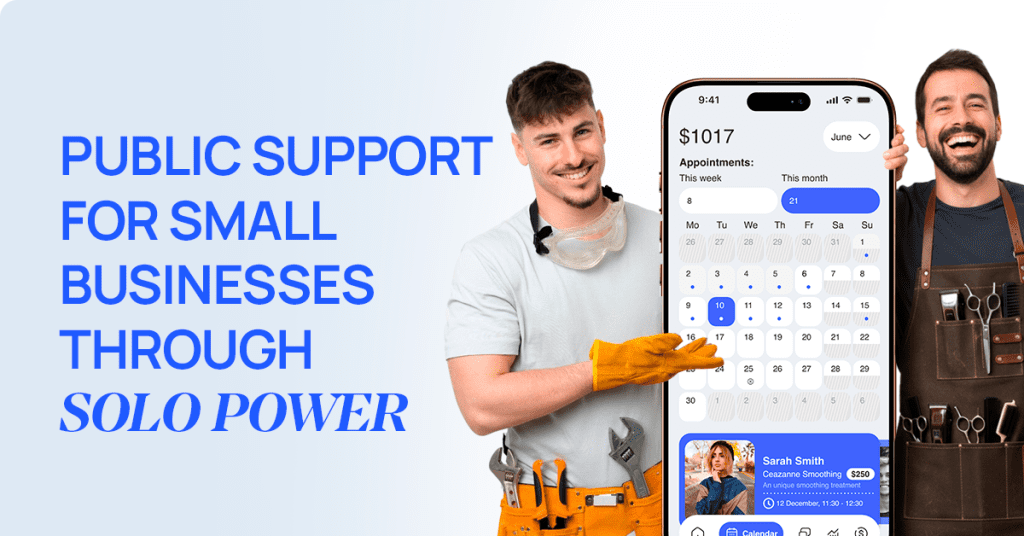
Halper was built to address that structural gap. The company describes its product as an AI business manager for solopreneurs and small businesses, designed to handle operational tasks that require consistency but not constant human attention.
In practice, this includes managing incoming messages across platforms, responding to routine client questions, handling appointment confirmations and reminders, sending follow-ups, and keeping client context intact so conversations do not restart from zero.
The distinction is subtle but important. Traditional CRM systems store information. Halper acts on it.
Communication continues while the business owner is busy, offline, or fully present with a client. The goal is not to replace human connection, but to protect it by removing constant interruption.
Visibility as a Form of Support
Technology, however, addresses only part of the problem.
Solo Power was created to confront another challenge solopreneurs face: lack of visibility.
Despite representing the majority of businesses, many solopreneurs operate without marketing teams, advertising budgets, or public platforms. Algorithms favor scale. Discovery often depends on chance and word of mouth.
Through Solo Power, Halper provides public support by giving solopreneurs space to tell their stories, explain their work, and reach new audiences. The series features professionals across beauty, wellness, creative, and service industries, focusing not on polished success narratives, but on how one-person businesses actually function day to day.
“Technology solves one part of the problem,” Ms. Palii said. “But independence can also be isolating. Visibility matters.”
For those featured, the impact is tangible. New clients discover their work. Existing clients see the person behind the service. A business gains recognition beyond a booking calendar.
Learning From the People It Serves
The exchange is not one-directional.
The stories shared through Solo Power also shape Halper’s development. Interviews reveal recurring pressure points: missed messages, scheduling conflicts, mental overload, and workflows that collapse under volume.
A 2023 survey by FreshBooks found that more than 60 percent of self-employed professionals experience burnout at least once a year, most often due to administrative overload rather than the work itself.
Solo Power functions, in effect, as an ongoing research loop.
“We learn directly from these conversations,” Ms. Palii said. “They show us where support breaks down and where it needs to be rebuilt.”
An Invitation to Take Part
Solo Power is designed to be participatory.
Solopreneurs who recognize their own experience in these stories are invited to read, learn, and contribute. Those with a perspective to share can submit their story for consideration by contacting marketing@halper.ai.
For many, participation is not about promotion, but recognition: the chance to articulate what solo work actually requires.
Leading by Example
Halper’s ambitions extend beyond providing software.
The company positions itself as an example of how businesses can support small businesses in practice, not through slogans, but through sustained attention, shared platforms, and continuous listening.
Konstantin Birman, founder of Halper, describes it plainly:
“If you are building tools for solopreneurs, you cannot stand outside their reality. You have to listen, show up publicly, and grow alongside them.”
For Halper, Solo Power is not a campaign. It is a commitment to participate in the ecosystem the company serves.
“Supporting small businesses is not only about efficiency,” Alina Palii added. “It is about presence.”
In an economy increasingly defined by independent work, that distinction matters.
Working alone is no longer unusual.
Being supported — thoughtfully and consistently — still is.
Solo Power exists to make that support visible.
Alina Palii
Halper
marketing@halper.ai
