

This guide explains how variable-speed inverter pool pumps work, what makes the InverFLOW Plus different from conventional pumps, and what Australian pool owners should know before upgrading in 2026.
This guide explains how variable-speed inverter pool pumps work, what makes the InverFLOW Plus different from conventional pumps, and what Australian pool owners should know before upgrading in 2026.
What is an Inverter Pool Pump?
A conventional single-speed pool pump runs at one fixed speed — full power — regardless of what the pool actually needs at any given moment. An inverter pool pump, by contrast, uses a variable-frequency drive (VFD) to continuously adjust motor speed based on real-time demand. This is the same core technology used in inverter air conditioners and split systems, which Australians are already familiar with.
The practical result: the pump uses only as much electricity as the task requires. During low-demand periods — overnight circulation, light filtration — it runs slower and draws far less power. Only when full filtration or backwashing is needed does it ramp up.
How the InverFLOW Plus Applies this Technology
The Madimack InverFLOW Plus is a residential inverter pool pump designed and distributed for the Australian market. It uses a permanent magnet brushless motor paired with inverter control electronics. Key operating characteristics include:
- Variable speed control: Motor speed adjusts automatically across a range of RPM settings. Users can also set manual schedules for different speeds at different times of day.
- Reduced acoustic output: At lower speeds the pump operates significantly more quietly than a single-speed pump at full load. Noise level scales with operating speed.
- Heat pump compatibility: Heat pump pool heaters require consistent, controlled water flow to operate efficiently. The InverFLOW Plus can be set to deliver a stable flow rate that matches the heater’s inlet requirements, reducing heater cycling and improving overall thermal efficiency.
- Australian weather rating: The unit is rated for outdoor installation in Australian climate conditions, including UV exposure, temperature extremes, and coastal humidity common in Queensland, NSW, and WA.
- User controls: Onboard digital controls allow speed and timer scheduling without external controllers. Compatible with automation systems via standard wiring.
Energy Consumption: What the Numbers Mean
Pool pump energy use is governed by the affinity laws of fluid dynamics. A pump running at half speed uses approximately one-eighth of the energy it would use at full speed — not half. This cubic relationship means even modest speed reductions produce large energy savings.
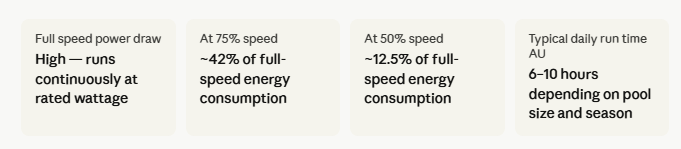
Note: Actual savings depend on your pool volume, filtration schedule, local electricity tariff, and whether the pump is replacing a single-speed or dual-speed unit. Variable-speed pumps deliver the greatest savings when replacing older single-speed models running 8+ hours per day.
Relevant Context for Australian Pool Owners in 2026
Residential electricity prices in Australia have continued to rise through 2025–2026 across most states, making energy-intensive appliances like pool pumps a higher priority for households managing bills. Pool pumps running 8 hours per day on a standard single-speed motor can account for a significant share of quarterly electricity costs.
Additionally, several Australian state rebate and energy efficiency schemes have included variable-speed pool pumps as eligible upgrades in recent years. Eligibility, rebate amounts, and scheme availability vary by state and change regularly — it is worth checking with your state energy authority or retailer before purchasing.
Pairing with a Heat Pump Pool Heater
If your pool uses a heat pump heater, the pump flow rate directly affects heater performance. Most residential heat pumps specify an optimal flow rate range — too fast and water passes through before it absorbs enough heat; too slow and the heat exchanger can overheat or trigger safety cut-outs.
A variable-speed pump like the InverFLOW Plus allows you to dial in the exact flow rate your heat pump specifies, maintaining that rate consistently. This is something a fixed single-speed pump physically cannot do. The result is more stable pool temperature, reduced heater wear, and lower combined running costs.
Frequently Asked Questions
Is the InverFLOW Plus a direct replacement for my existing pump?
In most standard residential setups, yes. It uses standard hydraulic fittings and electrical connections. A licensed electrician or pool technician should carry out the installation to comply with Australian standards.
What pool sizes is it suited for?
The InverFLOW Plus range covers most standard Australian residential pools. Check the flow rate and head pressure specifications against your pool’s plumbing to confirm the right model for your setup.
Does it require a smart home system to operate?
No. It operates as a standalone unit with onboard controls. Integration with automation systems is optional.
How does warranty and after-sales support work in Australia?
Madimack operates from North Sydney and services the Australian market directly. Warranty terms should be confirmed at the point of purchase from an authorised distributor.
Is inverter technology new to pool pumps in 2026?
No. Variable-speed pool pumps have been commercially available in Australia for several years. What has changed is broader adoption, improved affordability, and increasing alignment with energy efficiency schemes at state level.