

Exploring the remarkable journey of a Filipino literary visionary whose pioneering work transformed poetry into a global artistic language.
“Literary titles are rarely bestowed overnight. They are earned through years of innovation, recognition, and a body of work that reshapes the way people experience literature.”
On November 15, 2013, the Marble Hall of the National Museum of the Filipino People in Manila became the setting for the Pentasi B Historical Forum and World Friendship Poetry Celebration—an event initiated and sponsored by the National Library of the Philippines. More than a literary gathering, it marked a defining moment in the recognition of a uniquely Filipino literary movement that was beginning to capture the attention of audiences far beyond the country’s shores.
The event was made possible through the initiative of former National Library Director Antonio M. Santos, whose vision helped bring together scholars, educators, artists, writers, and cultural advocates to examine the growing influence of Pentasi B World Friendship Poetry. After reviewing the chef-d’œuvre of Doc PenPen Bugtong Takipsilim, Santos expressed a conviction that would resonate throughout the literary community.
“This book must be beyond the library world… this guy should be the future National Artist, if not… present!”
Among those participating in the forum were Dr. Lily Rose Tope of the University of the Philippines and officials from the National Library of the Philippines, who explored the development of Visual Poetry and the contributions of Dr. Epitacio Ramos Tongohan—widely known as Doc PenPen Bugtong Takipsilim. Their discussions highlighted not only his literary innovations but also the growing role of Pentasi B World Friendship Poetry in fostering cultural dialogue and international friendship through literature.
By that time, Doc PenPen was already being recognized within literary circles as the Father of Visual Poetry. The distinction was not the result of a single award or one defining event. Instead, it emerged from years of pioneering work, recognition from literary organizations, support from cultural institutions, and growing acknowledgement from poetry communities around the world. His creation of Pentasi B Telepathic 5M Visual Poetry—a literary form that blends language, symbolism, visual composition, philosophy, and artistic imagination—introduced a fresh approach to poetry that challenged traditional boundaries and encouraged readers to experience literature in an entirely new way.
That recognition continued to grow through initiatives led by the National Library of the Philippines, exhibitions hosted by universities and museums—including the Irving K. Barber Learning Centre at the University of British Columbia—and published features in respected publications such as The Philippine Star, which examined his contributions to Philippine literature. Together, these milestones gradually cemented the title Father of Visual Poetry, making it inseparable from his pioneering body of work.
The question, then, is no longer simply why Doc PenPen carries that title.
The more compelling question is this:
How did a Filipino physician become one of the literary figures most closely associated with Visual Poetry across multiple countries?
To answer that question, we must return to where the story truly began—long before the recognition, the international exhibitions, and the historic gathering in Manila.
A Doctor Who Refused to See Poetry as Static
Before gaining international recognition as Doc PenPen Bugtong Takipsilim, Dr. Epitacio Ramos Tongohan built a distinguished career in medicine. After earning degrees from the University of Santo Tomas and the University of the East–Ramon Magsaysay Memorial Medical Center, he specialized in Anatomic Pathology, a discipline that values careful observation, analysis, and the ability to recognize patterns.
Those same qualities would later shape his literary philosophy.
While medicine became his profession, literature remained his lifelong passion. Rather than seeing science and poetry as separate disciplines, he believed both demanded curiosity, precision, creativity, and the courage to challenge accepted ideas.
Traditional poetry relied primarily on words arranged into verses. Doc PenPen asked a different question:
What if the visual arrangement of a poem could become part of its meaning?
That idea evolved into Visual Poetry, and later into what he described as Pentasi B Telepathic 5M Visual Poetry—a literary approach that combines text, symbolism, visual structure, and artistic design into a unified poetic experience. Instead of simply reading a poem, audiences were invited to experience it through both language and imagery.
For Doc PenPen, the page itself became part of the poem.
Words became images.
Images reinforced ideas.
It was this philosophy that would later distinguish his work from conventional poetic forms and become the foundation of his recognition as the Father of Visual Poetry.
Building a Movement, Not Merely a Style
Doc PenPen understood that innovation could not succeed in isolation.
Rather than promoting Visual Poetry alone, he founded Pentasi B World Friendship Poetry, envisioning it as an international literary movement built on friendship, collaboration, and cultural exchange.
Its mission extended beyond publishing poems. Pentasi B brought together poets, educators, artists, students, filmmakers, and cultural advocates through international poetry gatherings, literary forums, collaborative anthologies, exhibitions, and educational initiatives. These activities created opportunities for writers from different countries to learn from one another while introducing Pentasi B Telepathic 5M Visual Poetry to wider audiences.
Through exhibitions in universities and museums, participation in international poetry festivals, and partnerships with literary organizations abroad, Pentasi B became more than an organization—it became a platform for presenting a uniquely Filipino contribution to contemporary literature.
For Doc PenPen, the goal was never simply to introduce a new artistic style.
It was to build a community capable of carrying that vision beyond borders.
That vision would soon receive its first major international recognition.
April 2011: An Early International Statement
One of Pentasi B’s earliest international milestones came on April 10, 2011, during the “I Inspire the World Friendship Poetry” gathering at Cloud 9 in Antipolo City.
According to published reports, around 150 poets, educators, students, authors, artists, and cultural advocates gathered to celebrate literature as a bridge between cultures. More than a poetry event, it reflected Pentasi B’s vision of promoting friendship, dialogue, and cultural understanding through creative expression.
The gathering also introduced Pentasi B Telepathic 5M Visual Poetry to a broader audience. Rather than treating poetry as words alone, Doc PenPen encouraged participants to see it as a fusion of language, visual composition, philosophy, and artistic imagination.
Around the same period, his work began reaching readers beyond the Philippines. Literary publications, including magazines in Turkey, featured his experimental poetic style, while invitations from international poetry organizations expanded discussions surrounding Visual Poetry.
Though these developments received little mainstream attention at the time, they marked the beginning of Visual Poetry’s growing international presence.
Canada Takes Notice
If 2011 marked the beginning of Pentasi B’s international reach, 2012 became the year it gained worldwide recognition.
In May 2012, Doc PenPen participated in the World Poetry Canada International Peace Festival in Richmond, British Columbia, one of the world’s longest-running literary festivals dedicated to peace and intercultural dialogue through poetry.
His presentation introduced international audiences to Pentasi B Telepathic 5M Visual Poetry, demonstrating how language, visual design, and symbolism could work together as a unified artistic expression.
Festival founder Ariadne Sawyer, founder of World Poetry Canada and International, praised his pioneering work. During the festival, Doc PenPen received international recognition as the Father of Visual Poetry, while the Writers International Network presented him with the Visionary Poet Award for his innovation and his efforts to promote friendship through literature.
For Pentasi B, the recognition represented more than a personal achievement. It affirmed that a literary movement born in the Philippines could contribute meaningfully to global discussions on contemporary poetry while opening new opportunities for collaboration with writers and cultural organizations around the world.
A Filipino Literary Innovation Reaches International Institutions
International recognition did not end in Canada.
As interest in Visual Poetry continued to grow, selections from the Pentasi B Collector’s Edition were exhibited at the Irving K. Barber Learning Centre of the University of British Columbia, introducing students, educators, and researchers to a uniquely Filipino contribution to contemporary literature.
The exhibition marked an important milestone. By entering universities and museums, Visual Poetry moved beyond personal expression and became part of a broader academic and cultural conversation.
Back in the Philippines, the National Library of the Philippines, together with literary and cultural advocates, continued documenting the historical significance of Pentasi B and Visual Poetry through forums and public discussions. Published features, including The Philippine Star, further highlighted Doc PenPen’s pioneering role, bringing his literary philosophy to a wider audience.
By then, the title “Father of Visual Poetry” had evolved beyond a single recognition. It had become a distinction repeatedly associated with his work in literary forums, academic discussions, and international publications.
From International Recognition to Global Distinction
Following his success in Canada, invitations from literary organizations and cultural institutions introduced Doc PenPen’s work to audiences across Asia, Europe, North America, and Africa. Publications in countries such as Turkey featured his innovative approach to Visual Poetry, while Pentasi B expanded its mission of promoting friendship, cultural dialogue, and artistic collaboration through literature.
Each international engagement strengthened the growing recognition of a Filipino literary philosophy that was reaching readers well beyond the country’s borders.
India and the Recognition as “Kavita Chakravarti”
One of the defining milestones came in 2017, when Doc PenPen participated in an international literary gathering at the renowned Ramoji Film City in Hyderabad, India, one of the world’s largest integrated film studio complexes.
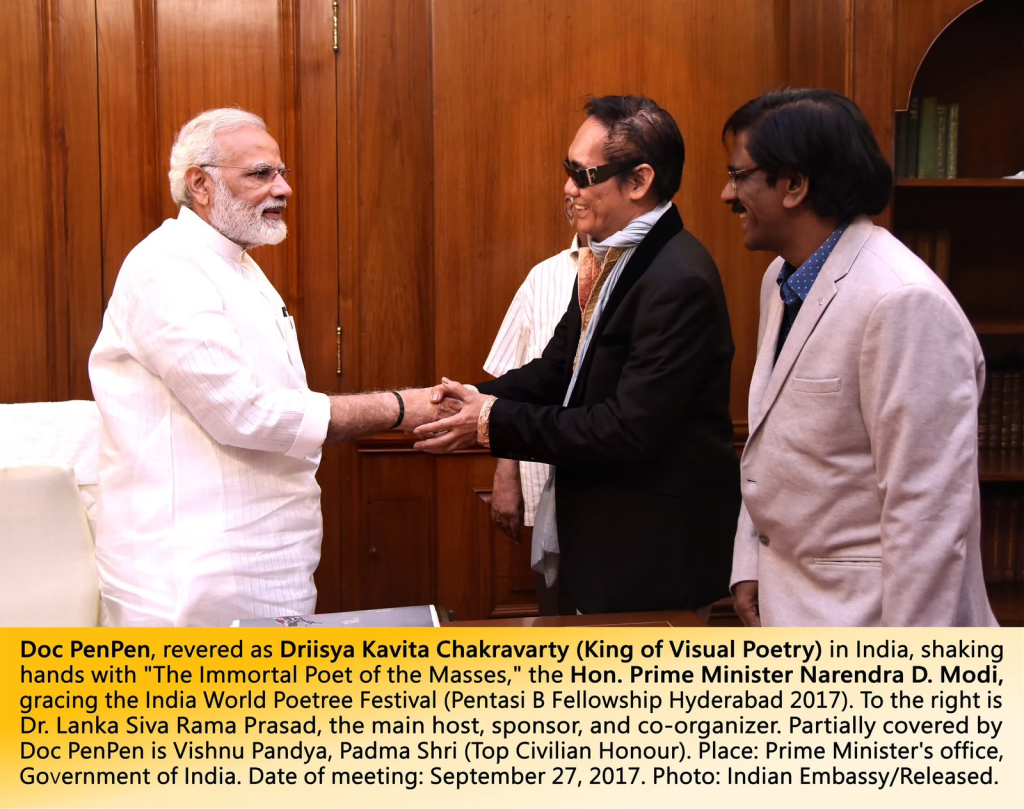
Presenting Pentasi B Telepathic 5M Visual Poetry, he demonstrated how poetry could unite language, symbolism, visual composition, and artistic expression into a single creative experience. During his 2017 visit to India, Hon. Narendra Modi presented Doc PenPen with an on-the-spot handwritten tribute poem at the Prime Minister’s Office, commemorating his recognition as Driisya Chakravarty (King of Visual Poetry). The gesture reflected the significance of the occasion and the international appreciation of his pioneering contributions to Visual Poetry.
At the conclusion of the event, participating literary organizations conferred upon him the title “Kavita Chakravarti” (King of Visual Poetry), recognizing his pioneering contributions to the international development of Visual Poetry.
The honor carried particular significance in a country with one of the world’s oldest literary traditions. The event was also attended by distinguished guests, including Indian Prime Minister Narendra Modi, underscoring the stature of the international gathering.
For supporters of Doc PenPen, the recognition in India further reinforced that appreciation for his work extended well beyond a single country or institution. From Canada to India, and through continuing engagements across the world, the title “Father of Visual Poetry” became increasingly associated with decades of literary innovation, international collaboration, and cultural advocacy.
As his international profile continued to grow, Doc PenPen turned his attention toward an even broader vision—helping establish the Philippines as the “Poetry Heart of the World.”
A Vision Beyond Recognition: The Philippines as the “Poetry Heart of the World”
For Doc PenPen, international recognition was never the final destination. After years of promoting Visual Poetry and building Pentasi B World Friendship Poetry into an international literary movement, his vision expanded beyond personal achievement to a broader cultural mission: helping establish the Philippines as the “Poetry Heart of the World.”
On February 2, 2021, during a literary gathering at The Manila Hotel, Doc PenPen and fellow advocates advanced this vision, believing the country’s rich literary heritage, multilingual traditions, and growing international network of poets could position the Philippines as a global center for literary dialogue, cultural diplomacy, and artistic collaboration.
The initiative reflected Pentasi B’s founding principles of using poetry to strengthen friendship among nations, encourage intercultural understanding, and connect writers from different cultures. For its supporters, the proposal was not merely symbolic but an invitation to recognize literature as a bridge between people and nations.
For Doc PenPen, the vision was never about personal recognition. It was about creating greater opportunities for future generations of Filipino writers to share their voices with the world.
A Growing Call for National Recognition
As his body of work expanded, so too did public support for recognizing his contributions to Philippine literature.
Among those who have expressed support are Jose Laderas Santos, former Chairman of the Komisyon sa Wikang Filipino (KWF) and the National Commission for Culture and the Arts (NCCA), who described recognition of Doc PenPen’s literary contributions as “long overdue,” former National Library Director Antonio M. Santos, who acknowledged his pioneering role in advancing Visual Poetry, and former NCCA Chairman Felipe M. De Leon Jr., who has emphasized the importance of honoring Filipino artists whose work strengthens the nation’s cultural identity.
Support also reached the local government level when the Sangguniang Bayan of Tanay, Rizal, through Resolution No. 43, formally endorsed Doc PenPen’s nomination for the Order of National Artist for Literature, citing his pioneering work in Visual Poetry, his leadership of Pentasi B World Friendship Poetry, and his contributions to promoting Philippine literature internationally.
The growing call for national recognition has also been echoed by other distinguished literary figures. During an interview held on March 30, 2026, at the Second FAMAS Prestige Awards at The Manila Hotel, where Doc PenPen (Dr. Epitacio Ramos Tongohan) received a literary honor, former Undersecretary under the administration of President Ferdinand “Bongbong” Marcos Jr., Lifetime Achievement Awardee, and World Poet Laureate Edwin M. Cordevilla publicly expressed his support, stating:
“Doc PenPen has democratized Philippine poetry… It is about time to have Doc PenPen as National Artist.”
His remarks further reflected the growing recognition among respected literary and cultural leaders of Doc PenPen’s enduring contributions to Philippine literature.
While the final decision rests with the official National Artist selection process, the discussion surrounding his nomination reflects decades of documented literary innovation, international recognition, and cultural advocacy.
The Legacy of the Father of Visual Poetry
For more than three decades, Doc PenPen has challenged conventional ideas of what poetry could become. Through Pentasi B Telepathic 5M Visual Poetry, he introduced a literary approach that united language with visual expression, while Pentasi B World Friendship Poetry became an international community promoting friendship, creativity, and cultural exchange.
Rather than allowing international honors to define his career, he transformed recognition into responsibility—mentoring writers, promoting Philippine literature, and encouraging cultural understanding through poetry.
That is why the title “Father of Visual Poetry” has endured. It reflects not a single award, but decades of innovation, advocacy, and international collaboration that continue to shape conversations about contemporary literature.
Whether remembered as a physician, poet, educator, cultural advocate, or founder of Pentasi B World Friendship Poetry, Doc PenPen’s enduring message remains clear: literature has the power to connect cultures, strengthen friendships, and inspire future generations.