

Search once meant typing a few keywords and choosing between ten blue links. In 2026, people can ask Google a detailed question, receive a synthesized response, review cited sources, and continue with follow-up questions without starting over.
This is no longer a small experiment. Google reported in May 2026 that AI Mode had passed one billion monthly users, while its queries had more than doubled each quarter since launch. Content creators are no longer competing only for rankings. They are also competing to become trusted sources inside AI-generated answers.
| What Does AI Search Mean for Content Discovery? AI search is changing content discovery by presenting synthesized answers before users visit websites. Search engines now understand conversational intent, explore related subtopics, and cite supporting sources. Publishers should continue using traditional SEO, but they also need clear answers, original evidence, helpful structure, trusted authorship, and content offering more value than a basic AI summary. |
How AI Search is Changing Content Discovery in 2026
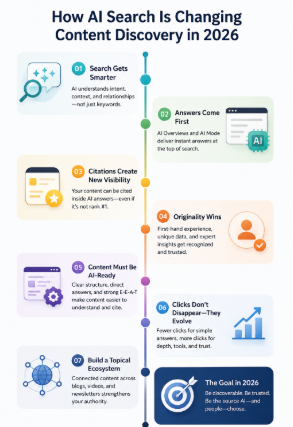
AI search combines discovery, summarization, comparison, and follow-up exploration within one experience.
Google’s AI Overviews and AI Mode may use query fan-out. The system breaks a complex question into related subtopics and runs several searches before producing its answer. As a result, a useful page may appear as a source even when it does not repeat the user’s exact wording.
| Traditional Search | AI Search |
| Shows ranked webpages | Creates a synthesized answer |
| Focuses on an individual query | Explores related subtopics |
| Requires users to open several pages | May answer before the first click |
| Visibility mainly means rankings | Visibility may include citations and links |
Traditional rankings still matter. Google states that pages must be indexed and eligible for a normal Search snippet before they can appear as supporting links in AI Overviews or AI Mode.
Four Major Shifts in Content Discovery
The Google AI search update changes both user behavior and the type of content that earns attention. Four shifts matter most for publishers.
Direct Answers Appear Before Clicks
AI Overviews can answer straightforward questions directly on the results page. That creates more zero-click searches, especially for definitions, dates, instructions, and quick comparisons.
A Pew Research Center study found that users clicked a traditional result during 8% of visits containing an AI summary. The figure reached 15% when no summary appeared. People clicked a link inside the AI summary during only 1% of studied visits.
This does not mean organic traffic disappears. It means generic answers face more pressure.
Conversational Intent Replaces Short Keyword Thinking
People are increasingly searching with complete questions rather than two-word phrases.
Pew found that 53% of searches containing ten or more words generated an AI summary, compared with only 8% of one- or two-word searches.
Keyword research still matters, but publishers must understand the wider intent. A reader searching “best laptop” may want options. Someone asking “Which laptop handles video editing without getting too hot?” wants evidence, trade-offs, and practical judgment.
Citations Create a New Type of Visibility
A webpage can receive exposure as a supporting source inside an AI-generated answer, even when it is not the first traditional result.
Google says query fan-out can help AI features discover a wider and more diverse set of supporting pages. Still, a citation does not automatically produce a visit. The title, source reputation, and value promised by the page must give users a reason to click.
Original Sources Become More Valuable
AI can easily reproduce a basic summary assembled from common information. It cannot recreate genuine product testing, personal experience, exclusive interviews, custom research, or original templates quite so easily.
Google’s 2026 guidance recommends unique viewpoints and “non-commodity” content rather than pages that simply repeat what already exists online.
That shift rewards publishers who add something new to the conversation.
How to Optimize Content for AI Search
AI search optimization is not about writing awkwardly for machines. It means making useful content easier for readers and search systems to understand.
Lead With the Answer
Place the direct response within the first two or three sentences. After that, explain the reasoning, evidence, exceptions, and next steps.
A useful structure is:
Direct Answer → Explanation → Evidence → Example → Action
This format works well for featured snippets, conversational queries, and AI-generated answers. It also respects readers who want an immediate response.
Use Clear, Self-Contained Sections
Each main section should answer one clear question. Use descriptive headings, short paragraphs, comparison tables, and lists when they improve understanding.
However, avoid creating dozens of nearly identical sections for minor keyword variations. Google warns against publishing large volumes of content mainly to manipulate rankings or generative AI responses.
Add Information AI Cannot Easily Recreate
Useful additions include:
- First-hand tests and observations
- Original screenshots and graphics
- Expert quotations
- Custom examples
- Templates and checklists
- Case studies with measurable outcomes
- Product limitations discovered through use
- Clear opinions backed by evidence
Imagine two articles reviewing the same tool. One rewrites the pricing page. The other tests five tasks, documents failures, and shows the output. Which one would you trust?
Publishers can also use carefully selected AI SEO guides to study conversational queries, improve content structure, and understand changing search behavior.
Strengthen Trust Signals
Articles should display an accurate author name, relevant biography, publication date, updated date, and clear sources.
Google’s people-first guidance asks whether content includes original reporting, research, analysis, or meaningful expertise. Transparent authorship gives readers useful context about who produced the information.
That does not mean adding an impressive-sounding biography to every page. The author’s stated background should match the subject.
Keep Traditional SEO Strong
AI SEO does not replace technical SEO.
Google still recommends:
- Crawlable and indexable pages
- Helpful internal links
- Important information in accessible text
- Strong page experience
- Relevant images and videos
- Structured data matching visible content
Google also states that websites do not need a special AI schema or additional machine-readable file to appear in AI Overviews and AI Mode.
Build Topical Authority
One isolated post rarely creates a recognizable source. Publish connected content covering beginner questions, comparisons, examples, common problems, and advanced applications.
Support the blog with original videos, newsletters, visuals, and expert contributions where practical. This wider content ecosystem can strengthen brand recognition while giving readers several ways to discover your work.
Common AI SEO Mistakes
Avoid these common errors:
- Stuffing every conversational query into one page
- Publishing generic AI summaries without original value
- Creating thin pages for tiny keyword variations
- Using statistics without linking the source
- Treating schema as a guaranteed citation method
- Ignoring speed, mobile usability, and crawlability
- Hiding author details or update dates
- Changing the title year without reviewing the content
- Measuring rankings while ignoring conversions and engagement
AI search optimization works best when it improves the page for people, not when it merely makes the content look machine-friendly.
Frequently Asked Questions
When is Google Going Full AI?
Google has not announced a date when conventional Search will disappear. AI is already built into Search through AI Overviews, AI Mode, follow-up questions, and agentic features. Google continues to present supporting websites and regular search results.
What is the AI Mode Tab in Google Search?
The AI Mode tab provides a conversational Search experience for complex questions. Users can receive an AI-generated response, review supporting links, and continue exploring through follow-up questions. Google first introduced the dedicated tab broadly in 2025.
What is Google AI Mode Deep Search?
Google AI Mode Deep Search is built for detailed research. It can issue hundreds of searches, reason across different sources, and create a cited report. Access can depend on the account, subscription, and current rollout.
What Changed in Google AI Search in May 2026?
The Google AI search May 2026 update introduced a redesigned AI-powered Search box, deeper agentic capabilities, and a smoother path between AI Overviews and AI Mode. Google also announced that AI Mode had crossed one billion monthly users.
Final Thoughts
AI search changes where content discovery begins, but useful websites still matter. Publishers need crawlable pages, sound SEO, and trustworthy information. The difference is that content must now work as both a destination and a source.
Lead with clear answers, add evidence, share original experience, and build recognizable expertise around focused topics. Rankings still provide value, but citations, branded searches, engagement, and conversions now offer a broader view of search visibility. AI search is changing the doorway. Publishers must give people a strong reason to step through it.
