
Most companies spent the last two years experimenting with AI. Chatbots on the homepage. Summaries in the inbox. A generative AI tool that writes first drafts nobody fully trusts.
That phase is ending.
In 2026, the businesses pulling ahead are deploying AI agents to run entire workflows and not assist humans through them. Fraud detection that flags and escalates in milliseconds. KYC pipelines that verify documents and approve customers in under a minute. Financial reporting that closes the books on a schedule, not when the analyst gets around to it.
This is not experimental. It is operational. And the gap between companies that have made this shift and those still running pilots is widening fast.
What AI Agents Actually Are (and Are Not)
An AI agent is not a chatbot. That distinction matters more than most people realize.
A chatbot waits for a prompt, produces a response, and stops. An AI agent monitors conditions, takes actions across multiple systems, and runs multi-step workflows autonomously calling APIs, reading databases, triggering downstream processes, all without a human initiating each step.
| Chatbot | AI Agent | |
| Initiates actions? | No waits for user | Yes monitors conditions |
| Multi-step reasoning? | Limited | Yes plans across steps |
| Works unsupervised? | No | Yes, within guardrails |
When businesses talk about AI transforming operations, they mean agents not the kind that answer questions, but the kind that do things.
The Workflows Being Transformed Right Now
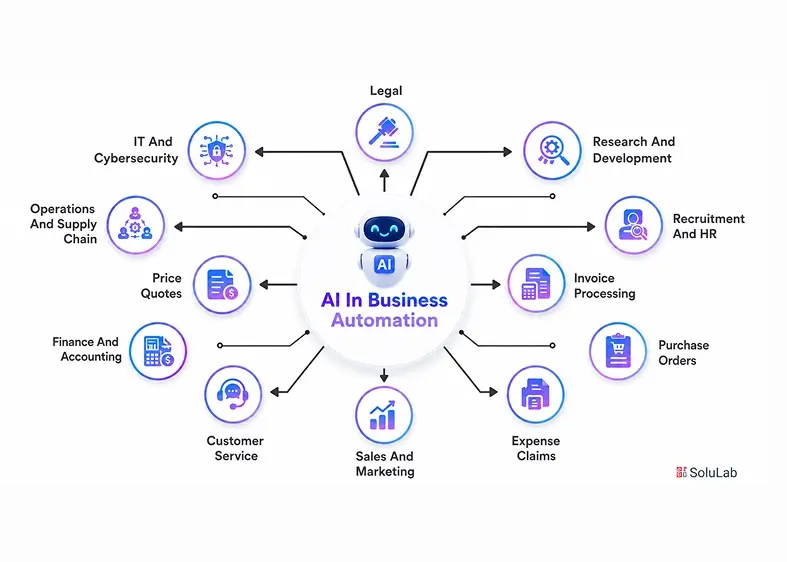
Fraud Detection Traditional rule engines work until bad actors learn the rules. AI agents analyze thousands of signals simultaneously, behavioral sequences, device fingerprints, transaction velocity and act on anomalies in real time. Fraud teams shift from reviewing obvious cases to handling the edge cases agents escalate.
KYC and Customer Onboarding Document collection, identity verification, sanctions screening, risk scoring. Manually, this takes days. An AI agent runs the full pipeline in under 90 seconds. For fintech companies, onboarding speed is a conversion issue. Customers who wait abandon the process.
Compliance Monitoring Regulations change. Customer situations change. AI agents monitor compliance continuously, flag accounts that drift, and generate audit trails automatically. Reactive compliance becomes proactive.
Document Processing Contracts, invoices, claims, loan applications. Every industry runs on documents most humans still process manually. AI agents extract structured data, route documents, flag inconsistencies, and initiate downstream workflows at volumes no human team can match.
Financial Reporting Month-end close is painful in most organizations. AI agents automate aggregation, reconciliation, and formatting, generating reports on a schedule and flagging anomalies before the finance team ever opens the file.
Where the ROI Actually Comes From
Vendor decks talk about “efficiency gains.” The real ROI concentrates in three places:
Speed Processes that took hours take minutes. Onboarding that took days takes seconds. Speed maps directly to conversion rates and team capacity.
Volume A human team has a ceiling. An AI agent does not. A document processing agent handling 500 documents per day can handle 5,000 at the same operational cost.
Accuracy at scale Humans make more errors as volume increases. For compliance-sensitive workflows, consistent accuracy is not just an operational benefit it is a risk reduction.
The ROI case is strongest when all three apply to the same workflow. KYC automation hits all three: faster onboarding, higher volume capacity, and consistent compliance accuracy.
What Most Companies Get Wrong
Automating a broken process. AI agents do not fix bad process design, they amplify it. A KYC workflow with unclear decision logic will fail faster and at higher volume when automated. Process redesign must happen before automation.
Underestimating integration complexity. The AI agent is often the easy part. Getting clean data in and reliable actions out across CRMs, ERPs, legacy databases, and third-party APIs is where projects slow down and budgets expand.
Skipping the feedback loop. A fraud detection model trained on 2023 data will drift as fraud patterns evolve. Deploying without a plan for ongoing monitoring means degrading performance nobody notices until it causes a real problem.
Treating it as an IT project. If the people running the process are not involved in designing the automation, the automation will not fit the process. Business stakeholders need to be in the room from day one.
The Infrastructure Underneath It All
AI agents don’t run on nothing. Behind every production deployment is infrastructure most companies haven’t fully thought through:
- Cloud infrastructure AWS, GCP, and Azure provide the foundation. Legacy on-premise systems create constraints that are genuinely hard to work around at AI scale.
- Data pipelines Agents need clean, accessible, real-time data. Building reliable pipelines is unglamorous and essential.
- Monitoring and observability Logging, alerting, and dashboards that surface agent behavior are not optional. They are how you catch problems before customers or regulators do.
- Security and compliance Sensitive data handling needs governance designed in from the start, not retrofitted after launch.
Companies like Buildnextech work across this entire stack combining custom AI development, cloud infrastructure, and business intelligence to help organizations build agentic systems that hold up in production, not just in demos.
How to Choose the Right AI Automation Partner
Not every vendor calling themselves an AI automation company delivers the same thing.
Do they understand your specific workflow? Fraud detection in consumer fintech is different from fraud detection in B2B payments. Generic AI does not solve specific operational problems.
Do they handle the full stack? AI agents in production require development, infrastructure, integration, and ongoing monitoring. Partners who only do one piece leave you assembling the rest yourself.
Do they think about failure modes? Responsible deployment means planning for when the agent is wrong, exception handling, escalation paths, audit trails. Partners who only describe what goes right are not ready for production.
Can they show production deployments? A polished demo is very different from a system running real transaction volume under real compliance requirements. Ask for evidence of scale.
Key Takeaways
- AI agents run workflows autonomously they are a fundamentally different category from chatbots
- The highest-ROI use cases combine speed, volume, and accuracy in the same workflow: KYC, fraud detection, document processing, financial reporting
- Most failed deployments come from automating broken processes, integration complexity, or missing feedback loops
- Financial services, healthcare, and logistics are moving fastest driven by data volume, compliance pressure, and speed-sensitive operations
Conclusion
AI agents are not a future technology. They are running production workflows today handling fraud detection, compliance, document processing, and financial reporting at volumes and speeds human teams cannot match.
The businesses moving on this are not doing it because AI is interesting. They are doing it because the operational economics are compelling. Faster processes, higher volume capacity, and consistent accuracy where consistency is a compliance requirement.
The question is not whether to use AI agents. It is how to deploy them well with the right infrastructure, proper process design, and ongoing monitoring. That is where most companies need a partner, not just a product.