

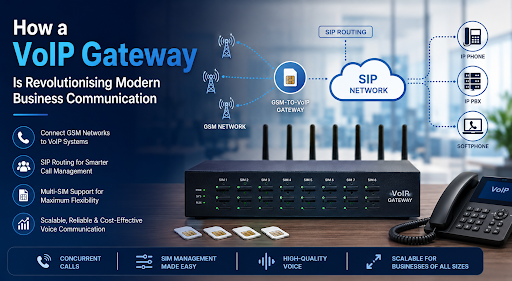
Modern businesses rely on fast, reliable, and cost-effective communication to stay connected with customers, partners, and remote teams. As organisations expand across cities and countries, traditional phone systems often struggle to keep up with growing communication demands. This is where IP-based voice technology has transformed the way businesses manage calls, reduce costs, and improve operational efficiency.
One of the most valuable technologies driving this transformation is the VoIP gateway. By bridging traditional GSM networks with internet-based communication systems, businesses can enjoy flexible voice services while maintaining compatibility with existing infrastructure. Whether it is a call centre handling thousands of customer calls or an enterprise managing multiple office locations, modern gateway solutions provide the scalability and reliability required in today’s competitive environment.
Understanding the Role of a VoIP Gateway
A VoIP gateway acts as a bridge between GSM mobile networks and Voice over Internet Protocol systems. Instead of relying solely on conventional telephone lines, voice traffic is converted into IP packets that travel through internet networks before reaching their destination.
This process offers several advantages. Businesses can reduce communication costs, improve call quality, and connect multiple offices without investing heavily in new telephone infrastructure.
Unlike older communication systems that require expensive hardware upgrades, modern gateways integrate smoothly with existing PBX systems, cloud communication platforms, and enterprise voice applications.
As businesses continue embracing digital communication, the demand for flexible voice routing solutions continues to grow across industries.
Why Businesses Are Moving Towards IP-Based Voice Communication
The shift from traditional telephony to IP communication is driven by several practical benefits.
Companies now require communication systems that support remote work, international operations, and increasing customer expectations. Traditional telephone networks often become expensive as call volumes increase.
IP-based communication provides greater flexibility while supporting advanced call management features.
Some of the biggest reasons businesses are making this transition include:
- Lower operational communication costs
- Improved scalability as businesses grow
- Better integration with business applications
- Enhanced call management capabilities
- Support for geographically distributed teams
- Easier maintenance and system expansion
These benefits allow organisations to improve productivity without sacrificing communication quality.
How a GSM-to-VoIP Gateway Connects Mobile and IP Networks
A GSM-to-VoIP gateway plays a critical role by connecting GSM cellular networks with internet-based communication platforms.
Instead of sending every call through traditional telephone carriers, the gateway converts GSM voice traffic into SIP-compatible digital communication. This creates a flexible communication environment where calls can move efficiently between mobile networks and IP systems.
Businesses that operate customer service departments, sales teams, or telecommunications services often use this technology to optimise outgoing and incoming call management.
The result is a communication infrastructure that supports both traditional mobile connectivity and modern cloud voice systems.
The Importance of SIP Routing in Modern Communication
Efficient call routing has become one of the most valuable features of advanced communication platforms.
SIP routing determines how voice traffic travels across different networks before reaching its destination. Rather than sending every call through a fixed path, intelligent routing allows businesses to optimise call quality, reduce latency, and improve network efficiency.
This flexibility is particularly useful for organisations that handle large numbers of simultaneous calls across multiple locations.
Advanced routing systems can also improve redundancy by automatically selecting alternative communication paths when network congestion or service interruptions occur.
As communication demands increase, intelligent routing continues to improve reliability while supporting uninterrupted business operations.
Supporting High Call Volumes with Multi-Port Gateways
Large organisations rarely manage just a handful of calls each day.
Customer support centres, telecom providers, and enterprise communication departments often process hundreds or even thousands of concurrent conversations.
Multi-port gateways are specifically designed to support these high-demand environments by allowing multiple voice channels to operate simultaneously.
Businesses benefit from:
- Increased concurrent call capacity
- Better traffic distribution
- Reduced network bottlenecks
- Easier scalability
- Improved system reliability
These capabilities ensure that communication remains stable even during peak business hours.
Why a Multi-SIM Voice Gateway Improves Operational Flexibility
Modern communication environments often require access to multiple mobile network operators.
A multi-SIM voice gateway allows businesses to manage several SIM cards within a single device, providing greater flexibility when routing calls across different GSM networks.
This approach offers multiple operational advantages.
Organisations can distribute outgoing traffic across different mobile carriers, optimise network availability, and maintain continuous service even if one operator experiences temporary issues.
For businesses operating across different regions, multi-SIM support also simplifies communication management by reducing dependency on a single mobile provider.
As communication needs expand, flexible SIM management becomes increasingly valuable for maintaining uninterrupted voice services.
Managing SIM Resources More Efficiently
SIM management has evolved significantly over the past decade.
Instead of manually replacing SIM cards or managing individual mobile devices, businesses can centralise SIM administration through gateway management systems.
Modern platforms often provide features such as:
- Centralised SIM monitoring
- Usage tracking
- Traffic balancing
- Automatic SIM allocation
- Network performance monitoring
These capabilities simplify administration while reducing manual maintenance.
For organisations with extensive communication requirements, centralised management improves operational efficiency and reduces downtime.
Scalability for Growing Organisations
Business communication requirements rarely remain static.
As companies expand into new markets, hire additional staff, or introduce new customer support services, communication infrastructure must scale accordingly.
One of the biggest strengths of modern gateway technology is its scalability.
Businesses can begin with smaller gateway configurations before expanding to larger systems that support additional channels and SIM cards.
Available configurations support different numbers of channels and SIM cards for call centres, telecom providers, and enterprise systems. This flexibility allows organisations to invest according to current needs while preparing for future growth.
Rather than replacing entire communication systems, businesses can gradually expand their infrastructure as demand increases.
Improving Communication for Call Centres
Call centres operate in highly demanding environments where communication speed and reliability directly influence customer satisfaction.
Every second of delay can impact productivity and customer experience.
Gateway technology helps call centres manage large call volumes while maintaining stable voice quality and efficient routing.
Benefits for customer service operations include:
- Faster call processing
- Stable concurrent communication
- Reduced communication interruptions
- Better call distribution
- Improved resource utilisation
By integrating with existing PBX platforms and cloud communication systems, gateways support efficient daily operations without requiring major infrastructure changes.
Enterprise Integration Made Simpler
Modern enterprises use numerous communication platforms, including customer relationship management software, unified communication systems, cloud PBX services, and internal collaboration tools.
One of the key strengths of gateway technology is its compatibility with these environments.
Because gateways support industry-standard SIP communication, organisations can integrate them into existing infrastructure without extensive redevelopment.
This compatibility reduces implementation time while allowing businesses to continue using familiar communication platforms.
As digital transformation continues, integration flexibility becomes increasingly valuable.
Supporting Telecom Providers with Flexible Voice Distribution
Telecommunications providers require infrastructure capable of handling significant voice traffic while maintaining service quality.
Gateway technology enables scalable voice traffic distribution across multiple channels and mobile networks.
Instead of relying on limited routing options, providers can dynamically allocate communication resources based on traffic demand.
This improves network efficiency while supporting growing customer bases.
Scalable voice traffic distribution also allows providers to expand services without redesigning their entire communication infrastructure.
Reliability Through Redundancy
Business communication cannot afford prolonged downtime.
Modern gateway systems improve operational reliability through multiple redundancy features.
If one communication path becomes unavailable, intelligent routing mechanisms can redirect traffic through alternative networks.
Similarly, multiple SIM support provides additional resilience when individual mobile carriers experience temporary service disruptions.
This redundancy ensures that organisations maintain continuous communication with customers, suppliers, and employees.
For businesses where uninterrupted voice services are essential, redundancy becomes an important component of communication planning.
The Future of Business Voice Communication
Business communication continues evolving alongside cloud computing, digital transformation, and increasingly connected workplaces.
As organisations demand greater flexibility, gateway technology will continue supporting hybrid communication environments that combine mobile networks, internet-based voice services, and cloud infrastructure.
Emerging developments such as artificial intelligence, automated call management, predictive traffic optimisation, and advanced analytics will further enhance communication efficiency.
Businesses investing in flexible communication infrastructure today will be better positioned to adopt future innovations without major system replacements.
Modern gateways already provide the foundation for these future capabilities by supporting concurrent calls, intelligent routing, scalable voice traffic distribution, and centralised SIM management.
Building Smarter Communication for the Years Ahead
The communication needs of modern organisations continue to grow in both complexity and scale. Businesses require systems that deliver reliability, flexibility, and efficient resource management while supporting future expansion.
A well-designed VoIP gateway provides far more than simple voice conversion. It creates a bridge between traditional GSM networks and modern IP communication, enabling organisations to manage calls more intelligently and efficiently. Whether using a GSM-to-VoIP gateway for mobile integration, implementing advanced SIP routing for better call management, or deploying a multi-SIM voice gateway to maximise operational flexibility, businesses gain the tools needed to support reliable and scalable communication.
As enterprises, telecom providers, and call centres continue modernising their infrastructure, gateway technology remains one of the most practical investments for achieving dependable, future-ready voice communication while adapting to changing business demands.