
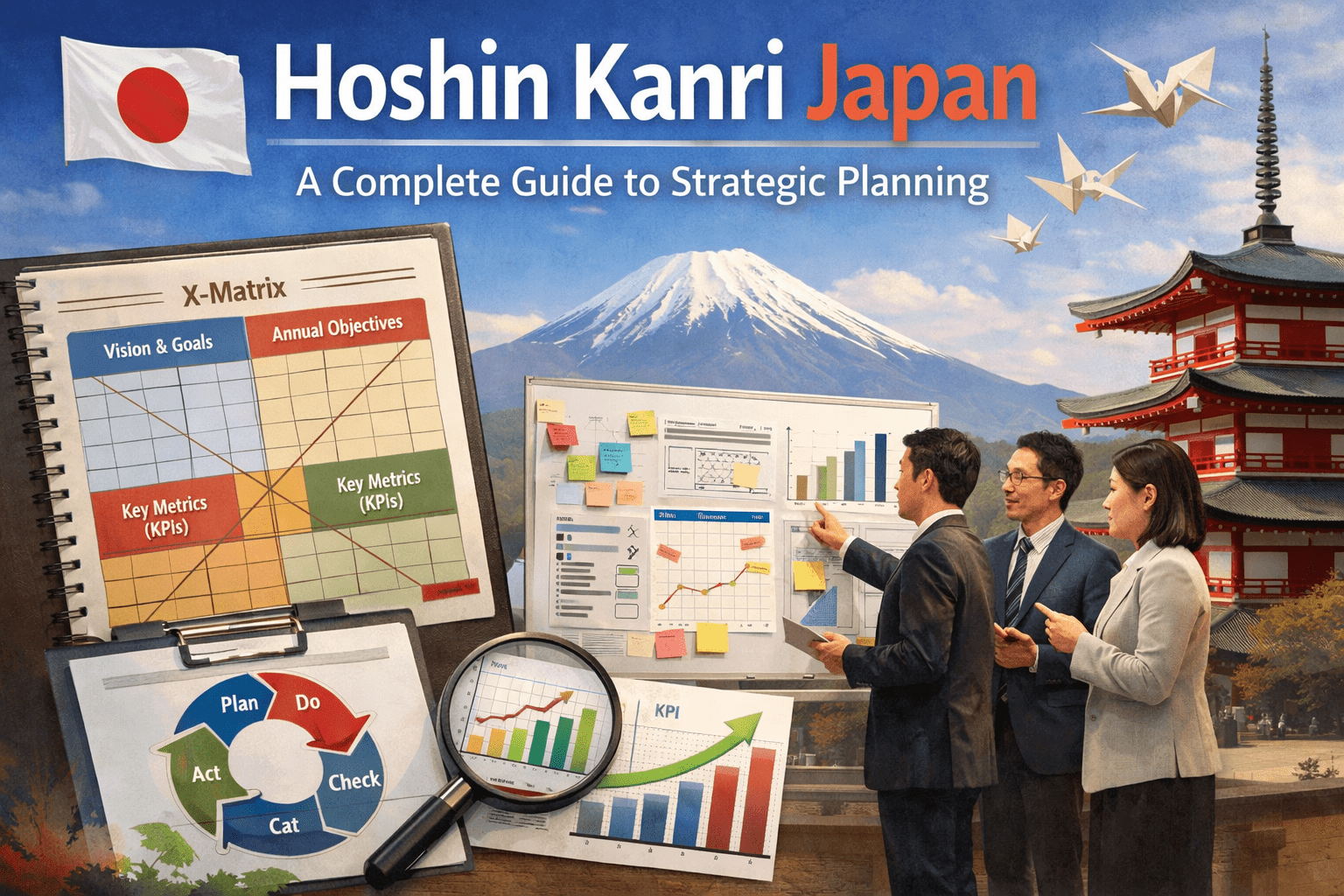
Hoshin Kanri Japan is one of Japan’s most influential strategic planning and execution methodologies, widely credited for aligning long-term vision with day-to-day operations. Developed in Japanese manufacturing environments, it has helped organizations translate ambitious goals into measurable actions across all levels.
In today’s fast-changing business landscape, many organizations struggle with strategy execution rather than strategy creation. This is where Hoshin Kanri stands out. Platforms like Performance Storyboard help modern organizations visualize, deploy, and track Hoshin Kanri effectively, ensuring strategy does not remain stuck at the leadership level.
What Does Hoshin Kanri Mean?
The term Hoshin Kanri Japan comes from Japanese words where “Hoshin” means direction or compass needle and “Kanri” means management or control. Together, they describe a management system that guides an organization toward its strategic direction while maintaining control over execution.
Unlike traditional planning approaches that focus on static annual plans, Hoshin Kanri emphasizes alignment, feedback, and continuous learning. It ensures that every employee understands not just what to do, but why it matters, a principle strongly supported by structured execution tools like those offered by Performance Storyboard.
Historical Background of Hoshin Kanri in Japan
Hoshin Kanri Japan emerged in Japan during the post-war industrial rebuilding period of the 1950s and 1960s. Japanese organizations needed a way to compete globally by improving quality, efficiency, and strategic focus. This led to the integration of Hoshin Kanri into Total Quality Management (TQM) practices.
Companies such as Toyota, Bridgestone, and Canon adopted Hoshin Kanri to align their workforce with long-term objectives. Over time, the methodology became a cornerstone of Japanese management culture and later influenced Lean management practices worldwide.
Read more : Smart Factory Germany: IoT, AI & Digital Transformation Solutions
Key Principles of Hoshin Kanri
Hoshin Kanri is built on a set of core principles that differentiate it from conventional strategy planning models.
- Strategic Alignment: Ensures goals flow seamlessly from top management to frontline teams.
- Catchball Communication: Encourages two-way dialogue rather than top-down directives.
- PDCA Discipline: Uses Plan–Do–Check–Act cycles for execution and learning.
- Focus on Breakthrough Objectives: Prioritizes a few critical goals instead of many competing initiatives.
These principles are easier to apply and monitor when visualized through structured systems like Performance Storyboard, which helps teams maintain clarity and focus.
Core Components of the Hoshin Kanri Process
Vision and Long-Term Objectives
Every Hoshin Kanri Japan journey begins with a clear vision, typically spanning three to five years. This vision defines what the organization aims to achieve and provides a stable reference point for decision-making.
Japanese companies emphasize clarity and simplicity in vision statements, ensuring they are easily understood across the organization. Tools such as Performance Storyboard help convert abstract vision statements into visual strategic roadmaps.
Annual Breakthrough Objectives
Breakthrough objectives are high-impact goals selected annually to move the organization closer to its long-term vision. These objectives are not routine improvements but transformational changes.
Each breakthrough objective is clearly defined, measurable, and linked to organizational priorities. By tracking these objectives through structured dashboards, Performance Storyboard enables leaders to maintain focus throughout the year.
Catchball: Two-Way Strategy Deployment
Catchball is a unique communication process where goals are passed back and forth between management levels. Instead of simply assigning targets, leaders discuss feasibility, risks, and resource needs with teams.
This dialogue improves ownership and realism in goal-setting. Digital strategy deployment platforms like Performance Storyboard support catchball by enabling transparent collaboration and documentation of feedback.
Implementation and Review Cycles
Once objectives are finalized, they are translated into actionable plans with owners, timelines, and KPIs. Execution is closely monitored through regular reviews rather than annual check-ins.
Frequent reviews ensure deviations are identified early. Visual management systems, such as those within Performance Storyboard, make it easier to track progress and maintain accountability.
Hoshin Kanri Tools and Techniques
Hoshin Matrix (X-Matrix)
The X-Matrix is one of the most recognized Hoshin Kanri Japan tools. It visually links long-term goals, annual objectives, initiatives, and KPIs on a single page.
By using platforms like Performance Storyboard, organizations can digitize the X-Matrix, making it dynamic, interactive, and easier to update.
PDCA Management Boards
PDCA boards help teams track execution status and improvement cycles. They ensure that learning is embedded into daily work rather than treated as a separate activity.
These boards become far more powerful when integrated into centralized systems like Performance Storyboard, where data is consistent and accessible.
KPI Tracking and Strategy Maps
Key Performance Indicators translate strategy into measurable outcomes. Strategy maps help visualize cause-and-effect relationships between initiatives and results.
Using Performance Storyboard, organizations can connect KPIs directly to strategic objectives, improving visibility and decision-making.
How Hoshin Kanri Works in Japanese Organizations
In Japanese organizations, Hoshin Kanri Japan is not treated as a one-time project but as a management philosophy. Leadership actively participates in reviews, coaching teams rather than simply evaluating results.
Decision-making emphasizes consensus, long-term thinking, and learning from failure. This cultural alignment is a key reason Hoshin Kanri succeeds in Japan and can be replicated globally with the right structure and tools.
Case Studies: Japan’s Use of Hoshin Kanri
Toyota
Toyota uses Hoshin Kanri to align its global operations with long-term objectives such as quality, safety, and sustainability. The methodology ensures that improvement initiatives directly support strategic priorities.
Canon
Canon applies Hoshin Kanri Japan to manage innovation and operational excellence. Its structured deployment process ensures that innovation goals are supported by measurable execution plans.
These companies demonstrate how structured visibility, similar to what Performance Storyboard provides, is critical to sustaining Hoshin Kanri success.
Benefits of Hoshin Kanri
- Clear alignment between strategy and execution
- Improved cross-functional communication
- Strong accountability and transparency
- Faster response to market changes
Organizations using digital platforms like Performance Storyboard often experience these benefits more quickly due to improved visibility and consistency.
Challenges and Common Mistakes
Despite its strengths, Hoshin Kanri Japan can fail if poorly implemented.
Common challenges include:
- Overcomplicating objectives
- Weak catchball communication
- Inconsistent KPI tracking
- Lack of leadership commitment
These issues can be mitigated by using structured strategy execution tools such as Performance Storyboard, which enforce discipline and clarity.
Hoshin Kanri vs Other Strategic Planning Methods
Compared to OKRs or the Balanced Scorecard, Hoshin Kanri places stronger emphasis on alignment and dialogue rather than performance targets alone.
While OKRs focus on short-term agility, Hoshin Kanri excels at long-term strategy deployment. Organizations often integrate both approaches using centralized platforms like Performance Storyboard.
How to Implement Hoshin Kanri in Your Organization
- Define long-term vision and priorities
- Select annual breakthrough objectives
- Deploy objectives using catchball
- Execute with clear KPIs and ownership
- Review progress using PDCA cycles
Using Performance Storyboard, these steps can be visualized and managed in one unified system.
Tools, Templates, and Resources
Successful Hoshin Kanri implementation requires the right mix of methodology and tools. Digital strategy execution platforms, visual matrices, and KPI dashboards are essential.
Performance Storyboard provides organizations with an integrated environment to deploy, track, and improve Hoshin Kanri strategies efficiently.
Conclusion
Hoshin Kanri remains one of Japan’s most powerful contributions to strategic management. Its emphasis on alignment, dialogue, and continuous improvement makes it highly relevant for modern organizations.
By combining the principles of Hoshin Kanri with modern execution platforms like Performance Storyboard, organizations can ensure that strategy is not only defined—but consistently delivered.