
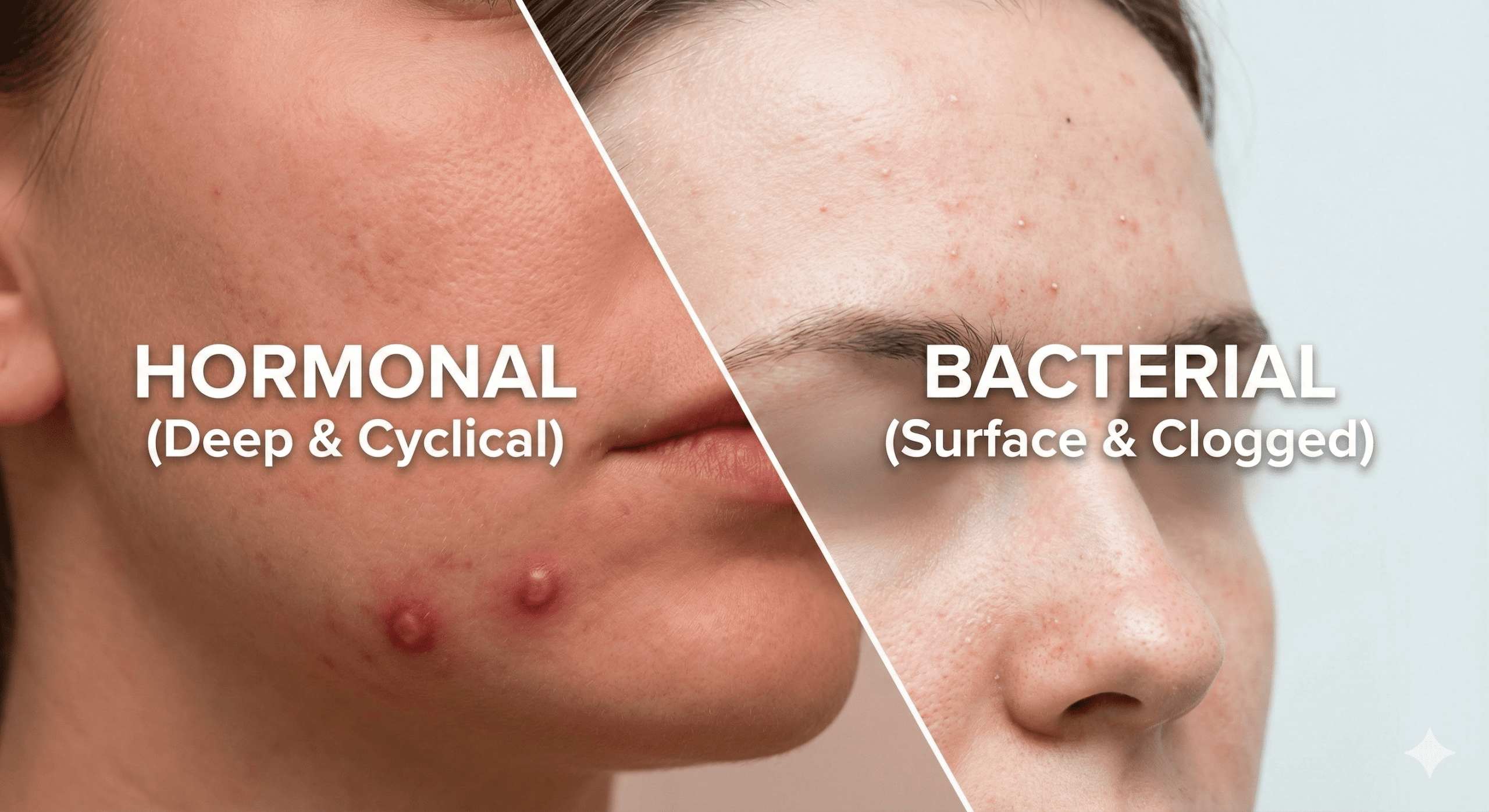
You’ve tried every face wash, spot treatment, and viral skincare hack, but the breakout keeps coming back in the exact same spot. It’s exhausting. It feels like your skin is fighting against you, no matter how clean your routine is.
The problem likely isn’t your product—it’s your diagnosis.
Most people treat all acne the same, blasting their skin with drying agents that only work on surface bacteria. But if your breakout is driven by internal chemistry, no amount of face wash will fix it. To clear your skin, you must first distinguish the differences detailed in our Hormonal Acne vs. Bacterial Acne guide.
This breakdown maps your symptoms and helps you match the cure to the cause.
The Core Differences: Hormonal vs. Bacterial Acne at a Glance
Before we analyze your specific symptoms, look at the big picture. Hormonal acne is systemic; it’s a body-wide signal. Bacterial acne is often localized and environmental.
The Face Map: Decoding Your Breakout Location
Your skin is a map. The location of your breakout is often the strongest indicator of its root cause.
The “Beard of Acne” (Jawline & Chin)
If your breakouts are concentrated along the jawline, chin, and upper neck—forming a “beard” pattern—this is the classic signature of hormonal acne.
The lower face has a high concentration of androgen receptors. When your hormones fluctuate (due to menstruation, stress, or conditions like PCOS), these receptors trigger your oil glands to go into overdrive. This produces deep, inflamed cysts that feel like hard knots under the skin.
The T-Zone (The Bacterial Belt)
Breakouts on the forehead and nose are typically bacterial or fungal. This area, known as the T-Zone, naturally produces more sweat and oil.
However, the cause here is usually external blocking. Think about what touches your forehead:
- Sweat from workouts.
- Hair products (conditioners or styling creams).
- Hats or headbands.
When Cutibacterium acnes (the bacteria responsible for acne) gets trapped with sweat and dead skin cells in these pores, you get whiteheads and blackheads.
Why am I breaking out on only one side?
If you have acne strictly on the left or right cheek, it is almost certainly Acne Mechanica (mechanical friction), which falls under the bacterial umbrella.
Common culprits include:
- Dirty pillowcases: If you sleep on your side, your face presses against fabric accumulating oils and bacteria for 8 hours a night.
- Smartphones: Holding a phone against your cheek transfers screen bacteria directly to your pores
- Hand resting: Leaning your chin or cheek on your hand while working.
Symptom Checker: Deep Cysts vs. Surface Whiteheads
Location matters, but the type of pimple tells the rest of the story.
The Timing Test
- Hormonal: Is it cyclical? If you notice a flare-up 7–10 days before your period (the Luteal phase), it’s hormonal. This is when progesterone rises and testosterone becomes relatively dominant, spiking sebum production.
- Bacterial: Is it random? Bacterial breakouts happen whenever a pore gets clogged. If you slept in your makeup or wore a sweaty hat yesterday, and wake up with a pimple today, that is bacterial.
The “Squeeze Test” (And Why You Shouldn’t Do It)
We know you want to pop it. But pause and observe.
Hormonal cysts have no “head.” They are deep inflammation. If you try to squeeze them, nothing comes out, but they swell and become more painful. You are pushing the infection deeper into the dermis, which causes scarring.
Bacterial pimples (pustules) usually have a white or yellow center on the surface. They are superficial infections of the follicle.
The “Cycle of Convergence”: Can You Have Both?
Yes. In fact, most chronic acne sufferers deal with a mix.
While we separate them for diagnosis, hormonal fluctuations feed bacterial acne.
Here is the biological chain reaction:
- Hormones: Androgens spike (due to stress or cycle).
- Oil: Your sebaceous glands produce excess, sticky sebum.
- Bacteria: C. acnes bacteria, which lives on everyone’s skin, feeds on this sebum.
- Inflammation: The bacteria multiply rapidly, causing the pore to become inflamed and blocked.
If you only treat the bacteria (Benzoyl Peroxide), you aren’t stopping the oil source. If you only treat the hormones, you might still have existing bacterial overgrowth.
Treatment Protocols: Matching the Cure to the Cause
Once you know the source, you can choose the right weapon.
Treating Hormonal Acne (Internal Strategy)
Topical creams often fail here because the problem is in your bloodstream, not just your pores.
- Oral Regulators: Dermatologists often prescribe Spironolactone (blocks androgen receptors) or specific birth control pills.
- Dietary Shifts: Insulin spikes trigger similar hormonal responses. Reducing high-glycemic foods (sugar, white bread) and dairy can lower inflammation.
- Stress Management: Cortisol (the stress hormone) acts like an androgen. Lowering stress is literally skincare.
Treating Bacterial Acne (External Strategy)
Your goal is to keep the pore clean and the environment hostile to bacteria.
- Benzoyl Peroxide: The gold standard. It introduces oxygen into the pore, which kills anaerobic bacteria.
- Salicylic Acid (BHA): Dissolves the “glue” holding dead skin cells together, preventing the clog in the first place.
- Hygiene: Change pillowcases weekly, wipe down your phone, and wash your face immediately after sweating.
Frequently Asked Questions
What is the main difference between hormonal and bacterial acne?
Hormonal acne appears as deep cysts on the jawline, while bacterial acne is surface-level whiteheads in the T-zone.
Hormonal breakouts are driven by internal androgen spikes, whereas bacterial acne is caused by external factors like sweat, dirt, and clogged pores trapping bacteria.
How do I know if my acne is hormonal or fungal?
Fungal acne itches intensely and appears as uniform clusters of small red bumps.19
Unlike hormonal cysts (large/painful) or bacterial zits (varied sizes), fungal acne is actually an infection of the hair follicle by yeast (Malassezia).20 If standard acne treatments make it worse, it’s likely fungal.
Can bacterial acne turn into hormonal acne?
No, but hormonal changes can worsen bacterial acne.
They have different root causes. However, hormonal spikes increase oil production.21 Since bacteria eat oil, hormonal issues create the perfect breeding ground for bacterial acne to thrive.22
What is the best treatment for hormonal acne?
Treatments that regulate internal hormone production are most effective.
Topical creams struggle to penetrate deep cysts.23 Options include Spironolactone, oral contraceptives, and dietary changes (low sugar/dairy) to control insulin and androgen levels.
Why am I getting acne only on one side of my face?
This is likely “Acne Mechanica” caused by physical contact.
Common triggers include sleeping on a dirty pillowcase, pressing a smartphone against your cheek, or frequently resting your chin in your hand.
