

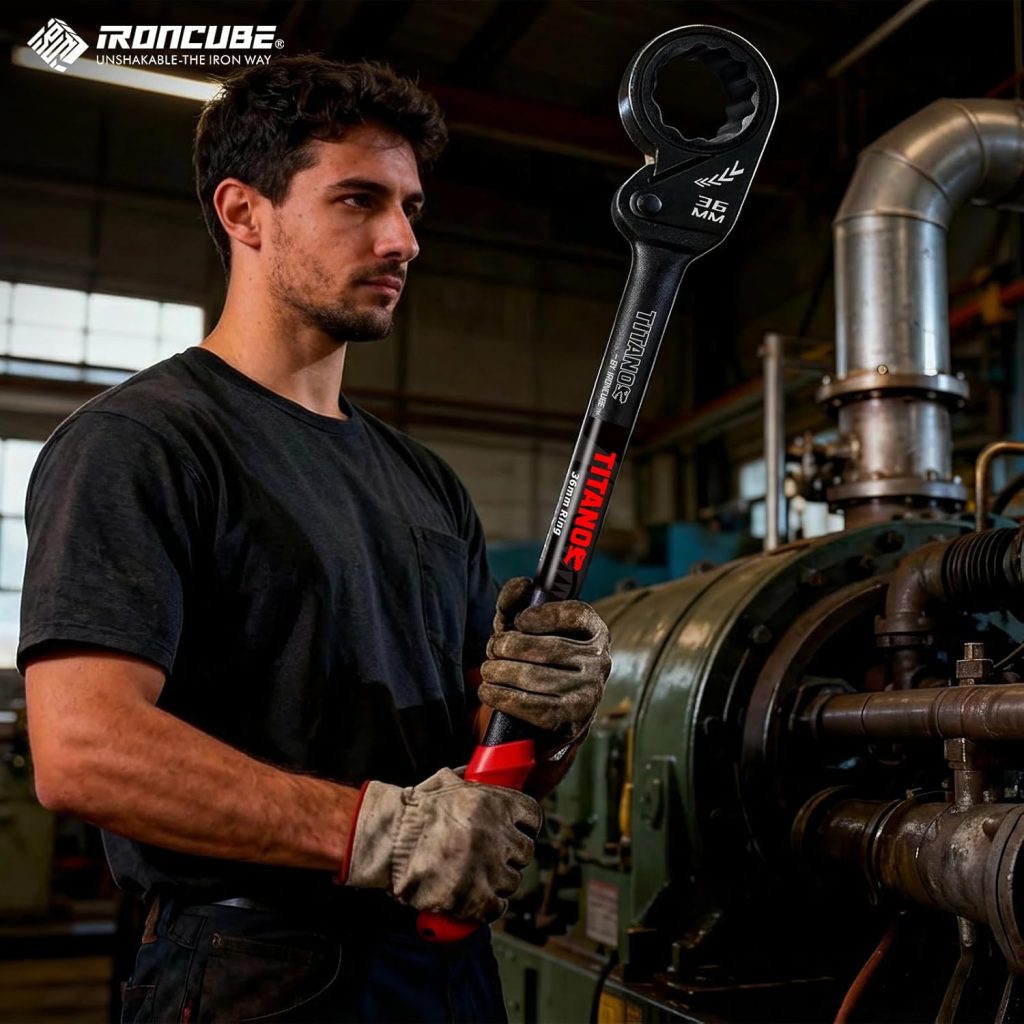
Big fasteners demand big tools. When a diesel mechanic crawls under a Class 8 truck, or when a pipeline crew tightens flange bolts the size of a coffee cup, a standard combination wrench cannot do the job. That is exactly where Extra Large Ratcheting Wrenches earn their place in a professional toolbox. This hands-on review looks at heavy duty ratcheting wrenches from 36mm all the way up to 2-1/4 inches, explains why the mechanism matters at this scale, and shows where these jumbo tools fit into real mechanical work.
If you have ever tried to break loose a seized 2-inch nut with a regular wrench, you already know the story. Size changes the physics. Torque climbs, access shrinks, and the wrong tool bends, slips, or rounds the fastener. At ironcubeworks.com, we build our jumbo wrench line for exactly this kind of work, and this article pulls together what we have learned from field use. Throughout the guide, we will point to real products, cite authoritative standards, and give practical buying advice.
Why Extra Large Ratcheting Wrenches Matter in Heavy Industry
The global wrenches market reached roughly $3.2 billion in 2023 and is growing at about 4.6% per year, according to data from Global Market Insights. Within that market, the ratcheting combination wrench segment alone was estimated at $2.05 billion in 2023 by Wise Guy Reports, and the extra-large segment is a small but critical slice of that pie. Smaller in volume, yes, but disproportionately important, because the machines that use these oversized fasteners are the machines that keep modern industry moving.
Extra large ratcheting wrenches are not a novelty. They appear on coal-fired power plants, at oil refineries, under mining trucks, on ship rudders, and in pipeline assembly work, according to Lowell Corporation’s field documentation. Anywhere a nut gets bigger than roughly 1-3/8 inch, a technician needs specialized tooling. Using the wrong size at that scale does not just waste time. It injures people.
A ratcheting wrench solves a problem unique to large fasteners: you often cannot swing a full rotation. Engine bays, valve pits, and reduction gearboxes rarely leave enough room for a straight pull. The ratcheting mechanism lets you keep the wrench on the nut and work in a small arc, which is where Extra Large Ratcheting Wrenches really prove their worth over plain box or open-end tools.
What Makes Extra Large Ratcheting Wrenches Count as Heavy Duty?
The industry splits wrenches into informal size tiers. Small wrenches typically cover bolt sizes up to about 19mm or 3/4 inch. Medium wrenches run to about 1 inch. Large wrenches stretch up to roughly 1-1/2 inch, and Extra Large Ratcheting Wrenches pick up from there and go as high as tool makers are willing to forge them. Lowell Corporation builds socket openings up to 9 inches for specialized jobs, which gives you a sense of the ceiling.
At ironcubeworks.com, our jumbo range covers the workhorse zone: 36mm, 41mm, 46mm, 50mm, 55mm, and 60mm on the metric side, and everything from 1-7/16″ to 2-1/4″ on the SAE side. This is the band where most heavy equipment, hydraulic fittings, diesel engine hardware, and structural steel connections live.
Materials and Heat Treatment
Most professional-grade wrenches use chrome vanadium steel (Cr-V) or chrome molybdenum (Cr-Mo). Cr-V offers an excellent balance of strength, toughness, and corrosion resistance for hand-driven work. Cr-Mo delivers higher tensile strength, so it shows up more often in impact sockets and very high-torque hand tools. Both materials, per Data Intelo’s wrench research, now dominate the professional tool segment because they withstand high torque and harsh working conditions without fracturing.
Forged tools also need correct heat treatment. Quenching and tempering bring hardness into the right range, typically around 40-45 HRC for the wrench body. Too soft, and the jaws deform. Too hard, and the wrench snaps under shock load. The goal is flex without failure, and it is why cheap imports often disappoint at this size class.
The Ratcheting Mechanism at Big Sizes
Standard ratcheting combination wrenches use a fine gear, often 72 or 90 teeth, giving a small 5-degree swing arc. GearWrench introduced a new 72-tooth ratcheting wrench set in July 2024, continuing that trend. At 36mm and up, however, engineers rarely use conventional tooth ratchets, because the loads would chip the teeth. Instead, jumbo wrenches typically use a friction ratchet design. We will explain that next.
Ratcheting Wrench vs. Friction Ratcheting Wrench: The Mechanism Question
Here is the core engineering choice at extra-large sizes. A traditional ratcheting wrench uses a pawl and gear. A friction ratcheting wrench uses a one-way roller bearing or clutch that locks under load and slips on reverse motion. Both behave the same to the user, you turn, reverse, and turn again without lifting the tool, but the friction design handles brutal torque far better.
Why does that matter? At sizes like 36mm and 2-1/4 inch, you are often applying well over 500 ft-lb of torque. According to ALLTORC’s torque wrench guidance, anything above 250 ft-lb calls for heavy-duty tools, and large industrial fasteners frequently require 200 to 2,000 ft-lb. A toothed gear would eventually strip at those loads. A friction mechanism, because it distributes force across a bearing surface, simply does not have that weak point. This is why Extra Large Ratcheting Wrenches from serious manufacturers use friction drive instead of gear drive.
A second advantage is stepless engagement. Gear ratchets need to align tooth to tooth, so the swing arc is limited by the gear count. Friction ratchets engage anywhere along the rotation, which is invaluable when you only have three or four degrees of swing room in a tight valve pit or differential housing.
A Quick Size Reference Chart
Here is a practical cross-reference for the sizes we cover in our extra large heavy duty ratcheting wrenches range. Metric and SAE sizes are not directly interchangeable. According to Kafuwell’s bolt size guide, using an approximate-fit wrench on a high-torque fastener is one of the fastest ways to round a hex head.
| Metric Size | Approx. SAE Equivalent | Typical Application |
| 36mm | 1-7/16″ | Class 8 truck axle nuts, large hydraulic fittings |
| 41mm | 1-5/8″ | Suspension U-bolts on heavy trucks, pump housings |
| 46mm | 1-13/16″ | Wheel hub nuts on off-road equipment |
| 50mm | 1-15/16″ | Crane outrigger bolts, marine hardware |
| 55mm | 2-3/16″ | Large flange bolts, wind turbine hardware |
| 60mm | 2-3/8″ | Industrial pump and valve assemblies |
Also worth noting: a close enough wrench will eventually round the fastener. The consequences of using a 46mm on what is actually a 1-13/16 inch bolt look minor at first, but under full torque the tool rotates before the bolt does, and the hex corners round off.
Real-World Applications for Extra Large Ratcheting Wrenches
Diesel Trucks and Heavy Equipment
Heavy diesel trucks use 36mm and 41mm fasteners throughout the drivetrain: front axle spindle nuts, wheel hub retainers, and transmission mounts. A fleet mechanic servicing a Peterbilt or Kenworth tractor will reach for a 36mm ratcheting wrench several times a day. Without the ratchet, each nut means lifting the wrench, repositioning, and re-seating. With a ratcheting version, the tool stays on the nut and the mechanic simply rocks the handle. Over an eight-hour shift, that time adds up quickly, which is part of why professional diesel mechanics keep a dedicated jumbo set.
Oil, Gas, and Pipeline Assembly
Pipeline flanges use bolts in the 1-1/4 inch to 2-1/4 inch range, depending on pipe size and pressure class. ANSI B16.5 Class 600 and 900 flanges, for example, commonly use 1-5/8 inch or 1-7/8 inch fasteners. Crews assembling these joints need a wrench that can hold thousands of pound-feet of torque without flexing. Our 2-1/4 inch friction wrench was designed with exactly this work in mind, and it is also available on Amazon for buyers who prefer that channel.
Mining, Marine, and Construction
Mining trucks and draglines use some of the largest fasteners in common industrial use. Crane counterweights, ship rudder assemblies, and heat exchanger plates all share the same problem: very large nuts, very tight access, very high stakes if anything fails. According to Lowell Corporation, these applications have driven the development of specialized extra-large tooling for decades. Getting the fastener fully torqued, repeatedly and safely, is the whole game.
Torque, Leverage, and the Physics of Big Fasteners
Torque is force times distance. That simple equation explains why extra large wrenches are long. A 36mm wrench in our catalog runs about 500mm, roughly 20 inches, to give you the leverage needed on a large nut without resorting to a cheater pipe.
Here is a rough torque reference, drawn from WorkshopCalc’s 2026 bolt torque chart and Mech Forged’s torque wrench guide. For an M24 bolt at Grade 8.8 (36mm hex), dry torque is around 670 Nm (494 ft-lb). For an M30 bolt at Grade 8.8 (46mm hex), dry torque climbs to about 1,320 Nm (974 ft-lb). A 2-inch Grade 5 bolt can require close to 2,200 ft-lb dry. Those are serious numbers.
Note the word dry. According to WorkshopCalc, lubricated bolts need 20 to 30 percent less torque because friction between threads drops significantly. This is a huge factor in industrial maintenance, where over-tightening a lubricated stud can stretch or break the bolt even when the dial reads correct. Practically, extra large fasteners routinely require 500 to 2,000-plus ft-lb of torque, and a regular wrench, even a long one, flexes or twists at that level. Extra Large Ratcheting Wrenches are designed with thicker beam sections and a reinforced ratchet head to absorb those loads without failure.
IRONCUBE 36mm and 2-1/4″ Extra Large Ratcheting Wrenches: Hands-On Review
The 36mm Torque-Friction Ratcheting Wrench
Our 36mm torque-friction wrench is built for diesel and heavy-equipment mechanics. The body is forged chrome vanadium steel, heat-treated, and finished in a satin chrome coating that resists corrosion in oily workshop conditions. The friction ratchet head engages smoothly in both directions, and the reversible lever allows a quick flip between tightening and loosening without flipping the wrench itself.
In testing, the tool held up under sustained torque loads well beyond what a 72-tooth gear ratchet could handle. The head height is kept deliberately slim to fit in engine bay clearances, though not so thin that it loses structural strength. We tested against a seized front axle nut on an older Kenworth tractor, and the wrench did not flex or slip. For shops that want to equip their bench with a matching set, our large ratcheting wrench set bundles the most-used sizes together.
The 2-1/4″ Jumbo Friction Ratcheting Wrench
The 2-1/4 inch jumbo friction ratcheting wrench is a beast. At this size, the tool length stretches past 24 inches because the leverage demands it. We designed this model for pipeline work, large industrial valves, and wind turbine hub hardware. It is also available on Amazon for users who prefer that purchase path.
Field feedback has been strong, especially from crews working Class 900-plus flange connections. The jaw tolerance is tight enough to prevent rounding on new fasteners, yet the friction mechanism still engages cleanly on slightly worn hex heads. That combination is rare at this size, and it is why we stand behind this product.
How to Choose the Right Extra Large Ratcheting Wrenches for Your Work
Start with the fastener inventory. Walk through your actual work and note which nuts and bolts you encounter most often. For a diesel fleet shop, 36mm, 41mm, and 46mm usually cover the bulk of the daily work. For pipeline crews, step up into the SAE sizes from 1-13/16 inch to 2-1/4 inch. Buying a complete set only makes sense when your work mixes both metric and SAE regularly; otherwise, a few carefully chosen individual pieces from our extra large ratcheting wrenches catalog serve you better.
Second, think about swing clearance. If you work on equipment with open space around fasteners, a standard open or box combination may suffice. If you work in tight spaces, such as valve pits, engine bays, or gearbox housings, the ratcheting version pays for itself inside a week.
Third, prioritize build quality over price. A failed wrench at 1,000 ft-lb is not just a broken tool. It is a safety incident. Chrome vanadium forged steel, a proper friction mechanism, and a reputable manufacturer matter much more at this size than at 10mm. For a deeper comparison of models in this class, our guide to the best large ratchet wrench options breaks down the tradeoffs in more detail.
Care, Storage, and Long-Term Maintenance
Even the best tool needs care. Wipe your extra large ratcheting wrenches clean of grease and grit at the end of each job. Grit inside the friction mechanism shortens its life. Store wrenches flat or hanging; do not pile them on top of each other, because that impact damages the finish and eventually the jaws. A proper canvas roll-up tool pouch keeps jumbo wrenches organized without beating them up in transit.
If the ratchet mechanism starts to feel gritty, a light machine oil and a few back-and-forth cycles usually restore smoothness. Never use heavy grease, which traps debris inside the bearing. For more tool care videos and practical workshop content, our Ironcube YouTube channel covers everything from wrench maintenance to complete workshop setup.
Frequently Asked Questions
What is the largest ratcheting wrench size available?
Commercial extra large ratcheting wrenches commonly run up to about 2-1/4 inch (roughly 60mm) on the SAE side. Specialty manufacturers produce even larger versions, up to 4-1/2 inch or more, for very specific industrial jobs, but 2-1/4 inch is the practical upper end for most diesel, pipeline, and heavy equipment work. Our Extra Large Ratcheting Wrenches range covers the full working band through this size.
Can I use an impact gun instead of a heavy-duty ratcheting wrench?
Impact wrenches are useful for initial loosening, but as WorkshopCalc notes, they should never be used for final torquing, because the hammering action makes accurate torque impossible. A calibrated Extra Large Ratcheting Wrench used in sequence with a torque wrench gives a much better final result, especially on safety-critical joints such as wheel nuts, engine head bolts, or pipeline flange connections.
What is the difference between a ratcheting wrench and a friction wrench?
A traditional ratcheting wrench uses a gear-and-pawl mechanism with 72 or 90 teeth. A friction wrench uses a one-way roller bearing that locks under load. At extra large sizes, friction wrenches handle much higher torque without stripping. This is why most serious Extra Large Ratcheting Wrenches at 36mm and up use the friction design rather than a gear ratchet.
How do I know if a wrench is truly heavy duty?
Look for forged chrome vanadium or chrome molybdenum steel, a full-polish or satin chrome finish, a reinforced ratchet head, and compliance with recognized standards such as ASME B107.100, which sets performance and safety requirements for combination wrenches. A heavy duty wrench also feels noticeably thicker through the beam than a standard equivalent when you hold them side by side.
Are Extra Large Ratcheting Wrenches worth the investment for a home mechanic?
For most home garages, probably not. However, if you work on heavy trucks, tractors, or large industrial equipment, Extra Large Ratcheting Wrenches pay for themselves quickly in time saved and fasteners preserved. Even one seized 2-inch nut turned successfully justifies a quality wrench. For broader coverage, see our complete wrenches category.
What materials are best for Extra Large Ratcheting Wrenches?
Chrome vanadium steel is the standard for professional hand wrenches. According to Data Intelo, chrome vanadium delivers the best overall balance of strength, toughness, and corrosion resistance. Chrome molybdenum is tougher but more expensive, and shows up mostly in impact sockets. Stainless options exist but are typically softer. For a general engineering overview of wrench design, see the Wikipedia wrench article, which summarizes the main material tradeoffs across tool types.
Summary
Extra Large Ratcheting Wrenches occupy a demanding corner of the tool world. From 36mm up to 2-1/4 inches, these jumbo wrenches handle the oversized fasteners that hold together diesel trucks, industrial pipelines, mining equipment, and heavy construction hardware. The choice between gear-driven and friction-driven ratchet mechanisms matters far more at these sizes than elsewhere, because the torque loads leave no room for weak links. Material quality, proper heat treatment, and thoughtful ergonomics separate professional-grade Extra Large Ratcheting Wrenches from cheap imitations. At ironcubeworks.com, we build our jumbo line with exactly these working conditions in mind. If you have questions about size selection, quantity orders, or custom requirements, feel free to contact our team directly, and we will help you match the right tool to the job.