
If you’ve ever dragged your bag through Howrah station at peak hours, or watched it disappear onto a conveyor belt at Indira Gandhi International and silently prayed it comes back in one piece — you already know this question matters more than it sounds.
Choosing between a hard body trolley bag and a soft shell one isn’t just about looks. It’s about what survives real Indian travel conditions. And those conditions, let’s be honest, are not gentle.
What’s the actual difference?
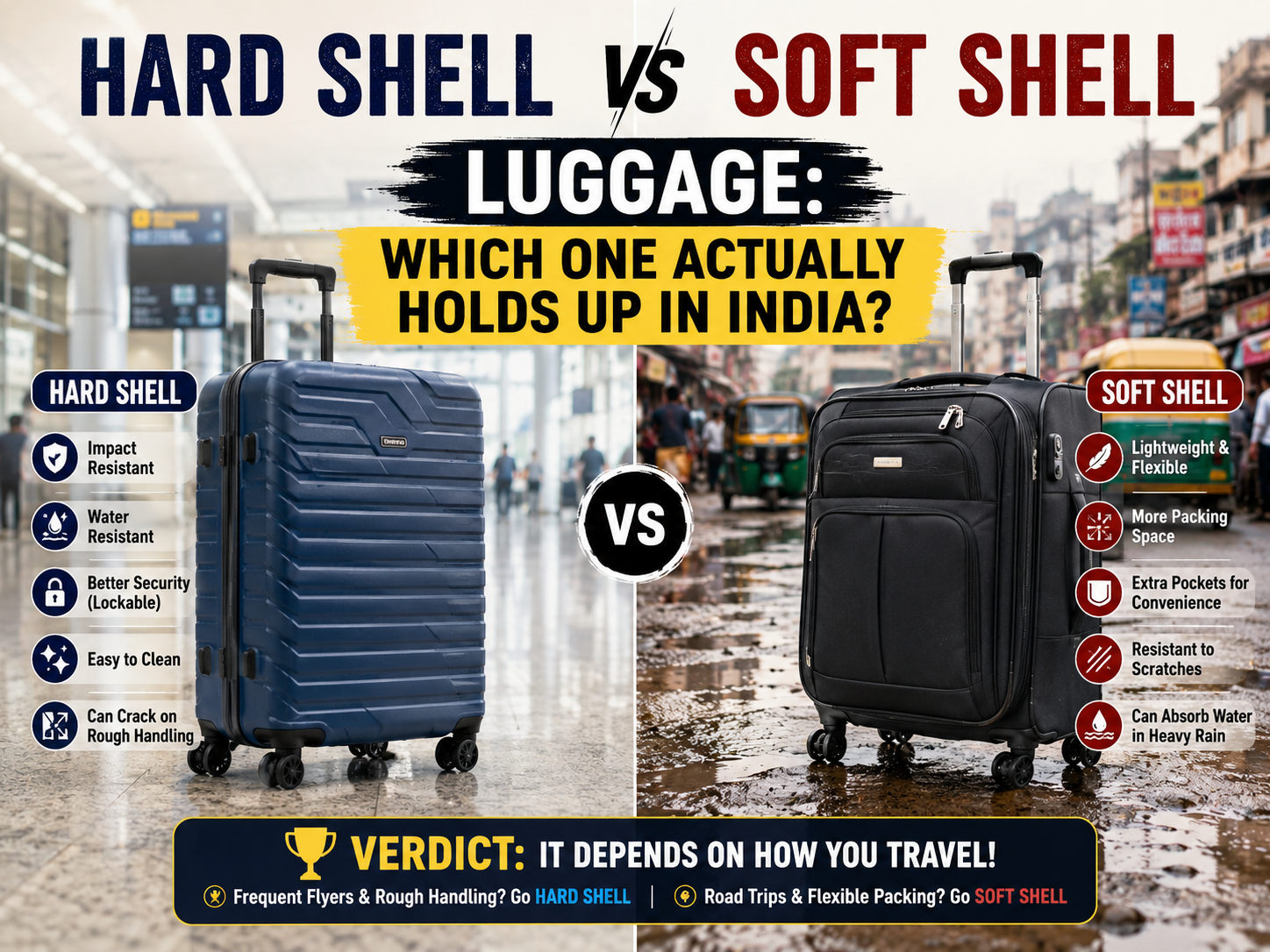
Hard shell bags are usually made from polycarbonate, ABS plastic, or a blend of both. Polycarbonate trolley bags in particular have become popular because the material flexes slightly instead of cracking on impact. That flex is more useful than it sounds.
Soft shell bags — the more traditional type — are typically made from polyester or nylon. Polyester trolley bags have been around forever, and most families in India still swear by them. They’re familiar, they expand when you need extra space, and they don’t scream “expensive” when you’re navigating a busy bus terminal.
Both have their place. But which one makes more sense depends a lot on how and where you’re travelling.
The case for going hard shell
Think about the kind of handling your bag gets on a domestic flight — say, Delhi to Guwahati, or Mumbai to Varanasi. Ground staff are moving fast, bags get tossed, stacked, dragged. A hard body trolley bag creates a protective shell around everything inside. If you’re carrying something fragile — a camera, a small piece of equipment, gifts — that outer shell is doing real work.
What surprises many people is how much damage a soft bag takes on its corners. Over time, the fabric wears thin right at the edges, especially the bottom corners. Hard shells don’t really have that problem. The surface might get scratched — and it will get scratched — but the structure holds.
Polycarbonate trolley bags are also easier to wipe clean. You land in Chennai in June, it’s raining sideways, your bag rolls through a puddle. Two minutes with a damp cloth and it’s sorted. Try that with fabric.
There’s also the security angle. A hard shell zips shut and stays shut. Some models have built-in TSA locks. For international travel or longer trips where the bag is out of your sight for extended periods, that added barrier means something.
Where soft bags still make sense
Here’s the thing though — soft trolley bags are not outdated. They still make a lot of sense in many situations.
The biggest practical advantage is flexibility. If you’re coming back from a wedding in Jaipur with an extra set of clothes, a few boxes of sweets, and some trinkets — a soft bag that expands is genuinely useful. Hard shells give you exactly the space they give you. Not more.
Weight is another factor. Polyester trolley bags tend to be lighter than hard shell equivalents. When you’re already watching your airline’s baggage limit, a bag that weighs 500 grams less matters. You might not think about it when you’re buying the bag, but you’ll think about it at the check-in counter.
Soft bags also tend to be more forgiving when you’re squeezing them into overhead compartments or cramming them into an auto-rickshaw trunk. They give a little. Hard shells don’t.
In practice, a lot of frequent domestic travellers in India — people catching 5–6 flights a year for work — stick to soft shell bags. Not because they don’t know better, but because the flexibility and lighter weight suit their style of travel.
Indian travel conditions: worth thinking about
Most luggage reviews you’ll find online are written with Western airports and smooth-surface road travel in mind. India is different.
Trains are the big one. If you travel by train — sleeper class, third AC, doesn’t matter — your bag goes under the seat, gets kicked, gets stacked on. A good hard body trolley bag handles that better. The structure stays intact. Soft bags start to look defeated after a few overnight train journeys.
Railway station floors, bus stand pavement, uneven curbs outside tier-2 city airports — all of this is tougher on luggage than a clean, flat European terminal. Wheels matter more than people realise. Look for spinner wheels with double casing regardless of which shell type you choose.
Also worth noting: theft and pilferage is more of a concern in crowded travel hubs. A hard shell with a TSA lock or even a simple luggage lock adds a layer of security that a zippered soft bag can’t offer. That zipper can be compromised with a pen. Most people don’t know that until it happens to them.
Who should pick what
If you’re travelling internationally, carrying fragile items, or just want something that looks presentable after years of use — a polycarbonate trolley bag is probably worth the investment. Good ones in the ₹3,000–₹8,000 range will serve you well without being precious about it.
If you’re a frequent domestic traveller, budget-conscious, or someone who tends to overpack — soft trolley bags, particularly solid polyester ones, are more practical than they get credit for. They’re forgiving in all the right ways.
Families travelling together often end up with a mix. One or two hard shells for checked luggage, a soft cabin bag for the things you want accessible. That actually works really well.
One last thing
Don’t ignore brand and build quality within each category. A cheap hard shell will crack. A cheap soft bag will tear at the handles. The shell material is one variable; the zippers, the wheel mechanism, the handle build — all of that matters equally.
Whatever you pick, test the wheels before you buy. Roll it across the shop floor. Pull the telescopic handle up and down a few times. If it wobbles or sticks in the store, it’s going to be a problem at 6am in a crowded airport when you’re already running late.
Travel light where you can. And buy something that was built to handle the journey, not just look good in a product photo.