
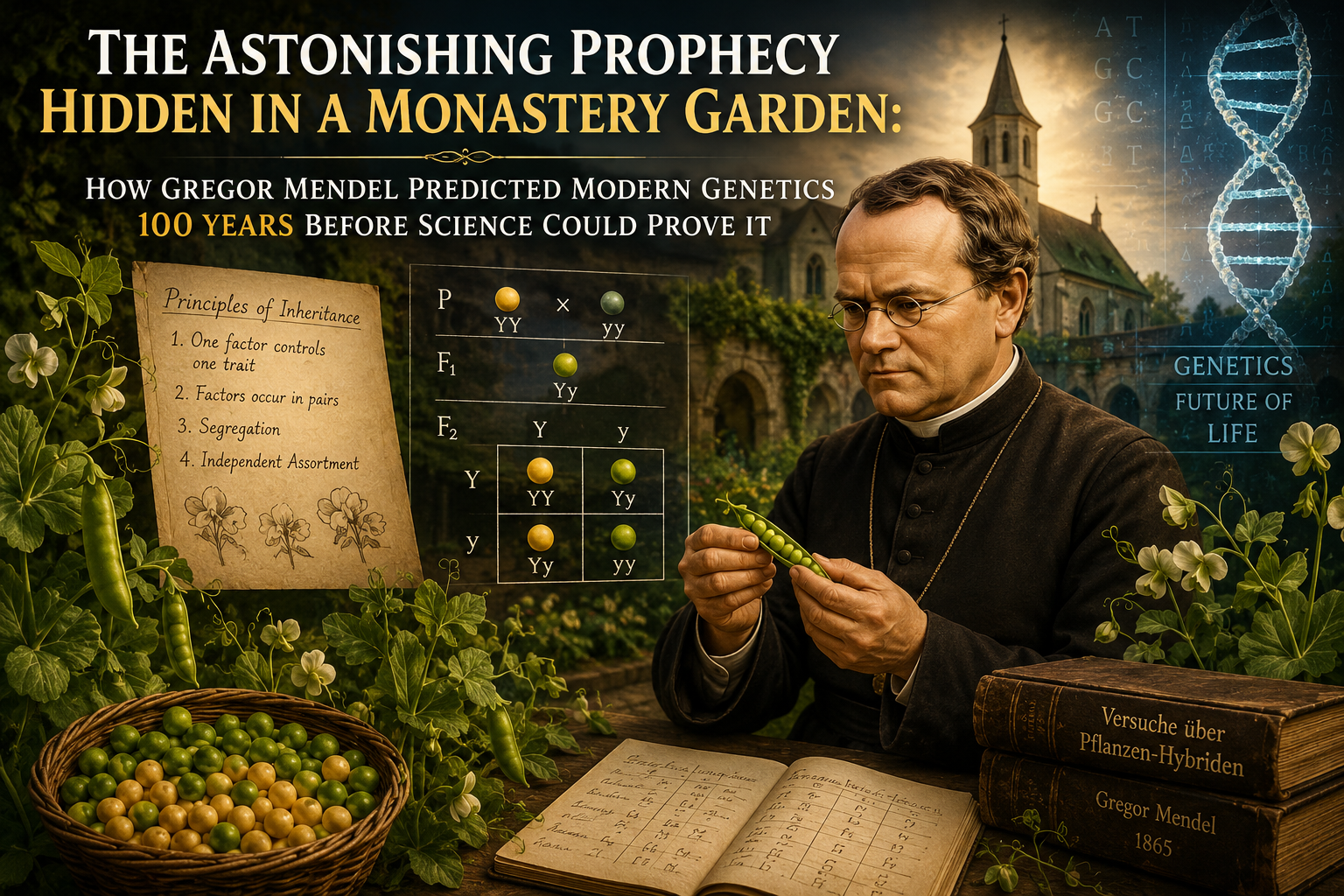
In a quiet corner of a monastery in Brno, Austria, a humble friar was quietly performing experiments that would utterly transform our understanding of life itself. Yet the world barely noticed. For decades, the work of gregor mendel remained ignored, dismissed, and forgotten by the scientific establishment. It was not until after his death that the truth emerged: this obscure Augustinian monk had discovered the fundamental laws of heredity long before anyone could explain the molecular machinery that made those laws work. This is the extraordinary story of scientific prophecy, forgotten genius, and the remarkable man who decoded the secrets of inheritance from within the confines of a monastery garden.
The Man Behind the Discovery (1822 to 1865)
Gregor Mendel was born Johann Mendel on July 20, 1822, in the small village of Heinzendorf, in what is now the Czech Republic. He came from humble peasant stock, and from his earliest childhood, he displayed a passionate and insatiable curiosity about the natural world. His parents recognized his exceptional intellectual gift and made sacrifices to ensure he received an education. At age 21, he entered the Augustinian monastery of St. Thomas in Brno, taking the religious name Gregor and committing himself to a life of faith and learning.
The monastery was not merely a religious institution. It was an intellectual center with a botanical garden, a greenhouse, and an atmosphere that encouraged scholarly inquiry. This environment proved to be absolutely perfect for the work that Gregor Mendel would undertake. Protected from the demands of the outside world, supported by his monastic community, and surrounded by living plants and seeds, he possessed the freedom and resources to conduct the most rigorous and systematic biological experiments of his era. Within those walls, surrounded by prayer and plants, gregor mendel would make discoveries that would reshape the entire science of biology.
The Experimental Genius: Choosing Peas (1856 to 1863)
In 1856, Gregor Mendel began his botanical experiments, and his choice of subject matter demonstrates stunning scientific wisdom. He selected the garden pea plant, scientifically known as Pisum sativum, for reasons that reveal the depth of his methodological thinking. This choice was not random. Garden peas were ideal because they possessed traits that could be easily distinguished and counted: tall or short plants, green or yellow seeds, smooth or wrinkled seed coats. Unlike many organisms, pea plants could be easily controlled for breeding, either allowed to self-pollinate or deliberately cross-pollinated by hand.
The brilliant decision to work with pea plants was rooted in pure scientific logic. Unlike animals, which had long generation times and small offspring numbers, pea plants produced many offspring quickly. Unlike many other plants, peas had clearly distinguishable traits that did not blend together. For eight years, from 1856 to 1864, Gregor Mendel cultivated approximately 28,000 pea plants in meticulous detail. He kept precise records, counted offspring methodically, and tracked inheritance patterns through multiple generations with mathematical precision. This was not casual gardening. This was experimental biology at its finest, and the careful documentation of mendel pea plant experiments established the gold standard for rigorous biological methodology that would influence science for generations to come.
The Three Laws of Inheritance Revealed (1865)
Through his painstaking experiments and rigorous analysis, gregor mendel discovered what became known as the three laws of inheritance. These three principles emerged from his data with mathematical clarity and explanatory power. They were the Law of Segregation, the Law of Independent Assortment, and the Law of Dominance. Together, these three laws of inheritance provided a complete framework for understanding how traits passed from parents to offspring across multiple generations.
The Law of Segregation Revealed (1865)
The first law that Gregor Mendel discovered was what modern genetics calls the Law of Segregation. Through his experiments with single traits, he observed a consistent and remarkable pattern. When he crossed a tall pea plant with a short pea plant, the first generation offspring called the F1 generation were all tall. But when he allowed the F1 plants to self-pollinate and produced the second generation called the F2 generation, the short plants reappeared in a precise numerical ratio of three tall plants to one short plant, or 3:1.
The law of segregation revealed that hereditary traits do not blend together like mixing paints. Instead, they segregate. They split apart. They recombine in predictable proportions. He expressed this mathematically using what would become known as the Punnett square logic. If we represent the trait for height with T for the dominant tall allele and t for the recessive short allele, then:
P generation: TT (tall) × tt (short)
F1 generation: All Tt (tall)
F2 generation: 1 TT + 2 Tt + 1 tt = 3 tall : 1 short
This simple ratio contained profound truth. Gregor Mendel had discovered that hereditary traits did not blend together. Instead, they segregated. This was revolutionary insight that would take decades for the world to fully appreciate.
The Law of Independent Assortment Discovered (1863 to 1864)
The second great discovery of gregor mendel came when he tracked two traits simultaneously in what are called dihybrid crosses. He crossed pea plants that differed in two characteristics at once: seed color and seed shape. The results were stunning. When he self-pollinated the F1 generation and observed the F2 generation, he found that the two traits assorted independently of one another. The ratio appeared in a 9:3:3:1 pattern:
9 round, yellow seeds
3 round, green seeds
3 wrinkled, yellow seeds
1 wrinkled, green seed
This was expressed mathematically as:
P generation: AABB (round, yellow) × aabb (wrinkled, green)
F1 generation: All AaBb (round, yellow)
F2 generation: 9 A_B_ : 3 A_bb : 3 aaB_ : 1 aabb
This discovery revealed that different hereditary traits were transmitted independently during reproduction. One trait did not influence the inheritance of another. The law of independent assortment had profound implications for understanding how variation arose in offspring and how genetic diversity was maintained across generations in natural populations.
The Law of Dominance and the Architecture of Heredity
Working through his experiments with garden peas, Gregor Mendel also established the principle that would become known as the Law of Dominance. In each trait pair, one version consistently masked the appearance of the other in hybrid offspring. The tall trait was dominant over the short trait. Yellow seeds were dominant over green seeds. Smooth seeds were dominant over wrinkled seeds. Yet the recessive traits did not disappear. They were merely hidden, only to reappear in subsequent generations in predictable proportions.
This discovery of dominant and recessive traits suggested something profound about the very nature of heredity. It suggested that inheritance was not controlled by a single blending substance, but by paired factors, one inherited from each parent. When Gregor Mendel described these hereditary factors in his paper, he used language that hinted at their discrete, particulate nature. Though he had no knowledge of genes, chromosomes, or DNA, his mathematical analysis of the data had led him to infer the existence of particulate, hereditary units. He was describing the very concept of the gene decades before the gene was discovered, and his understanding of dominant and recessive traits laid the foundation for modern genetics.
The Mathematics of Heredity: A Prophet Ahead of His Time
What made the work of gregor mendel truly exceptional was his application of mathematics and probability to biology. The dominant paradigm of nineteenth-century biology was observational and descriptive. Scientists looked at organisms and described what they saw. But Mendel employed statistical analysis and mathematical reasoning. He calculated ratios. He predicted expected outcomes. He designed experiments to test hypotheses. He was thinking like a physicist, and this set him apart completely from his contemporaries.
His 1865 paper, titled “Experiments on Plant Hybridization” and presented to the Brno Society for the Study of Natural Science, contained this extraordinary claim: that the mathematical ratios he observed reflected an underlying law of nature. He wrote: “The law of nature governing the formation of new species is thus ready to hand.” Few scientists of his day could appreciate what he had accomplished. He had discovered a universal principle governing the transmission of hereditary traits, expressed in mathematical form, verified through thousands of experiments, and presented with logical rigor that had never before been applied to biology in such systematic fashion.
Yet the world did not listen. His paper was published in 1866, but it was largely ignored. It was cited only three or four times in the scientific literature before Gregor Mendel’s death in 1884. He died without knowing that his work would eventually revolutionize biology. He died believing that science had rejected his contributions.
The Rediscovery and Vindication in 1900
For sixteen years after Gregor Mendel’s death, his revolutionary discoveries lay dormant and forgotten. Then, in 1900, something remarkable happened. Three different botanists working independently, in three different countries, rediscovered Mendel’s paper and confirmed his results through their own experiments. Hugo de Vries in the Netherlands, Carl Correns in Germany, and Erich von Tschermak in Austria each recognized the brilliance of what Mendel had accomplished. The scientific world, now equipped with better microscopes and a growing understanding of chromosomes, suddenly grasped the profound significance of his work.
The laws that Mendel had inferred from mathematics and statistics could now be explained at the cellular level. The prophecy was vindicated. The hidden wisdom of the monastery garden had proven absolutely correct at every level of analysis.
Mendel and Darwin: The Missing Piece of Evolution (1859 to 1882)
There is a poignant and historically significant footnote to this story. Charles Darwin published “On the Origin of Species” in 1859, presenting his theory of evolution through natural selection. The theory was brilliant and transformative, yet it had one critical gap: Darwin could not explain the mechanism of heredity. How did beneficial traits persist and accumulate across generations? How were variations in offspring maintained and not blended away?
Gregor Mendel possessed the answer. Mendel and Darwin never communicated, yet their work was perfectly complementary. Had Darwin been aware of Mendel’s work and understood it, or had Mendel been aware of Darwin’s theory and recognized its significance, the history of science might have taken a different path. But they never connected. Mendel published his paper just four years before Darwin’s death. Darwin never knew of Mendel’s discoveries. Mendel never fully appreciated how his laws of inheritance provided the mechanism that made Darwinian evolution possible.
By 1900, however, scientists recognized the perfect fit. Mendel’s laws of inheritance explained how variation persisted across generations. They explained how natural selection could accumulate small beneficial changes over vast periods of time. Mendel and Darwin together gave birth to what would become the modern evolutionary synthesis in the twentieth century. Each had solved a problem that the other could not solve alone, though they never realized it during their lifetimes.
From Mendel to DNA: The Hundred Year Journey (1866 to 1953)
The prophecy of gregor mendel would not be fully vindicated until 1953, when James Watson, Francis Crick, and Rosalind Franklin revealed the structure of DNA. The double helix provided the molecular mechanism that explained everything Mendel had inferred. Genes were not mystical factors. They were sequences of nucleotides in the DNA molecule. Segregation occurred because DNA replicated and separated during meiosis. Independent assortment occurred because different genes resided at different locations on different chromosomes. Dominance reflected the action of proteins produced by gene expression.
Everything that Gregor Mendel had predicted from careful observation and mathematical analysis in his monastery garden proved to be precisely correct when viewed at the molecular level. He had intuited the structure and behavior of heredity with such accuracy that his laws, formulated a century before the molecular basis could be understood, required almost no revision when that molecular basis was finally revealed. The journey from mendel to DNA showed that great scientific truth, discovered through careful reasoning and rigorous experimentation, transcends the tools available to discover it.
FAQs About Gregor Mendel and His Legacy
Why is Gregor Mendel called the Father of Modern Genetics?
Gregor Mendel is called the Father of Modern Genetics because he discovered the fundamental laws governing how traits are inherited from parents to offspring. Through his systematic experiments with pea plants, he established the law of segregation, the law of independent assortment, and the law of dominance. These laws form the foundation of all modern genetics and explain how hereditary traits are transmitted across generations with mathematical predictability. His work demonstrated that inheritance followed universal principles that could be expressed in mathematical form.
What would have happened if science had accepted Mendel’s work in 1865?
If the scientific community had recognized the importance of gregor mendel’s work immediately after its publication, the development of genetics would likely have been accelerated by decades. Scientists might have connected his laws of inheritance to the structure of chromosomes much earlier, and the full understanding of heredity could have emerged by the early twentieth century rather than the mid twentieth century. The understanding of evolution might also have been more complete decades earlier, strengthening Darwin’s theory with the mechanistic explanation it lacked.
How did Mendel’s work connect to Charles Darwin’s theory of evolution?
Darwin’s theory of natural selection required a mechanism for heredity that could preserve beneficial traits across generations. Gregor Mendel’s laws of inheritance provided exactly that mechanism. Mendel’s discovery that traits were inherited as discrete, particulate units meant that beneficial variations could persist and accumulate over time. By 1900, scientists recognized that Mendelian genetics provided the missing piece that made Darwinian evolution fully comprehensible at the mechanistic level.
Why were dominant and recessive traits so important to Mendel’s discoveries?
The concept of dominant and recessive traits revealed that heredity was not a simple blending process. When Mendel crossed tall and short plants, the offspring were all tall, yet shortness reappeared in the next generation. This showed that the short trait was not lost or blended away but was present in a hidden or recessive form. This insight led Mendel to infer the existence of paired hereditary factors, one from each parent, that could be dominant or recessive in expression. This concept was revolutionary.
What is the significance of the 3:1 ratio in Mendel’s experiments?
The 3:1 ratio that Mendel observed in his second generation pea plants was the mathematical signature of his laws of segregation and dominance. This precise ratio appeared consistently across different traits and demonstrated that heredity followed mathematical laws. The ratio meant that traits were inherited as discrete particles that segregated predictably during reproduction. This mathematical consistency was revolutionary in biology and proved that heredity operated according to universal principles that transcended individual organisms or species.
Conclusion
The story of gregor mendel is a story of scientific prophecy, of a mind so brilliant and so precise that it could decode the laws of heredity centuries before the machinery that made those laws possible could be visualized under microscopes or sequenced in laboratories. Sitting in his monastery garden in Brno, Austria, this humble Augustinian friar conducted experiments so methodical and reasoning so rigorous that his conclusions remained essentially unchanged when finally verified at the molecular level a hundred years later.
The world ignored him. The scientific establishment overlooked him. He died believing his life’s work had been rejected and forgotten. Yet the prophecy hidden in his garden proved to be more enduring than the recognition of the greatest celebrities of his age. Today, every student of biology learns the laws of gregor mendel. Every genetic counselor uses his principles to predict the likelihood of hereditary disease. Every farmer breeding crops for higher yield applies his laws unconsciously. Every DNA sequence analyzed in a research laboratory is ultimately a confirmation of truths that Mendel divined from careful counting and mathematical precision more than a century and a half ago.
This is the astonishing prophecy: a man working in obscurity, with no knowledge of genes or chromosomes or DNA, used mathematics and observation to reveal the deepest secrets of how life perpetuates itself. That prophecy stands as an eternal testament to the power of human curiosity, scientific rigor, and the triumph of truth over indifference.