
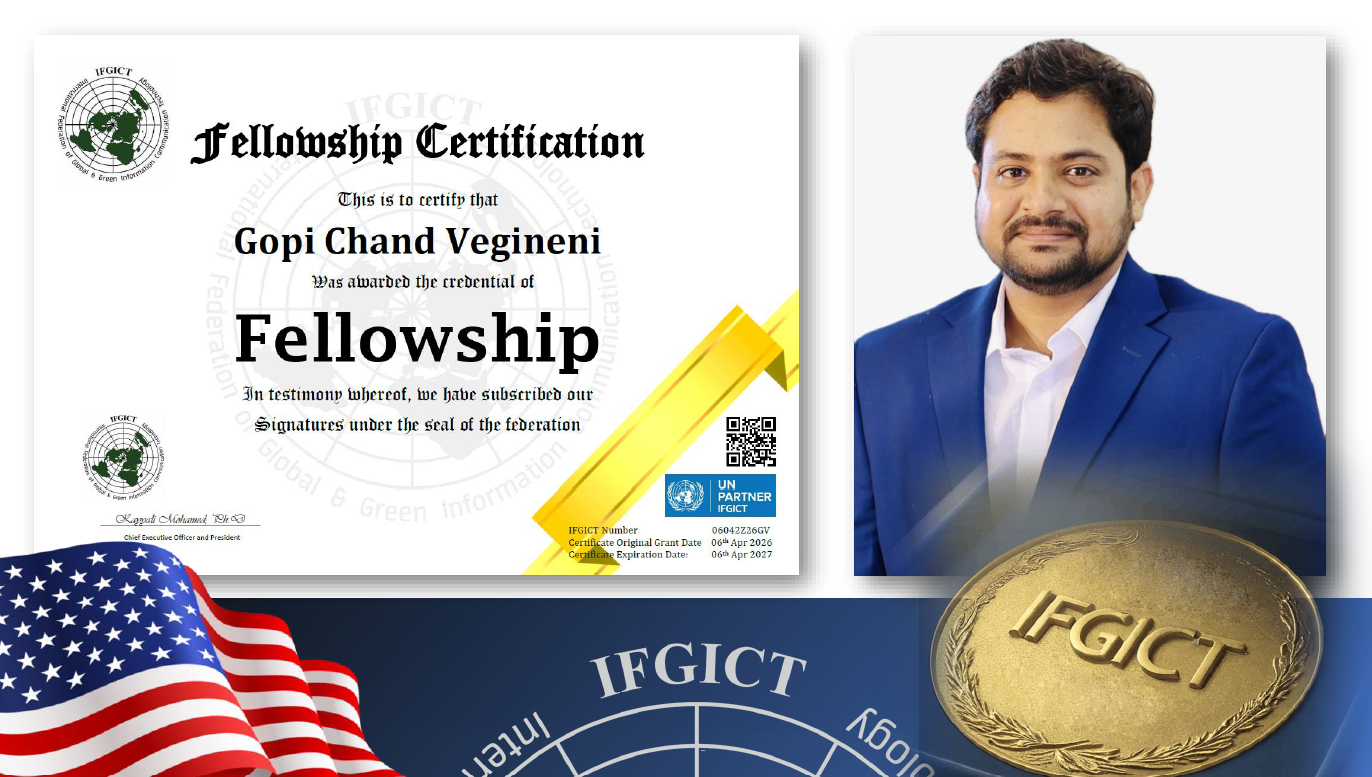
In an era where digital transformation is the primary driver of public service, the intersection of user experience and accessibility has become the most critical frontier for government and enterprise institutions. Gopi Chand Vegineni, a distinguished Senior UI/UX Developer with over a decade of mastery in designing scalable, inclusive web applications, has been officially awarded the Fellowship grade by the International Federation of Global and Green ICT (IFGICT). This esteemed recognition serves as a global testament to his unwavering commitment to modernizing mission-critical digital platforms while ensuring they remain accessible, secure, and intuitive for the largest and most diverse user communities.
The IFGICT Fellowship represents the highest honor bestowed by the International Federation of Global and Green ICT, a world-leading organization dedicated to establishing global benchmarks for sustainable, equitable, and efficient technology development. By granting this Fellowship to Vegineni, the IFGICT acknowledges his profound impact on the digital landscape, specifically his success in translating complex, high-stakes government requirements into user-centered digital experiences. His work ensures that modern technology serves every member of the public, effectively bridging the divide between bureaucratic complexity and the end-user’s need for clarity and ease of use.
A Decade of Excellence in Mission-Critical Interface Design
Gopi Chand Vegineni’s career is defined by a deep specialization in the high-pressure environments of enterprise and public-sector digital systems. With over ten years of experience, he has operated at the nexus of technology and social impact, focusing on platforms that manage enrollment, eligibility, quality control, and government benefits distribution. In these sectors, a failure in user experience is not merely an inconvenience—it can result in citizens being unable to access essential healthcare, financial assistance, or regulatory services. Vegineni’s leadership in interface development has been instrumental in ensuring that these systems are both reliable and resilient under massive user loads.
Throughout his career, Vegineni has demonstrated a mastery of the tools and frameworks that define modern web architecture, including Angular, React, and TypeScript. However, his true value lies in his architectural foresight. Rather than simply building features, he focuses on the underlying front-end architecture that allows for long-term scalability. By designing modular, responsive, and high-performance interfaces, he has enabled government agencies to modernize legacy infrastructure without disrupting service continuity, setting a high standard for how large-scale digital platforms should evolve in the twenty-first century.
Championing Accessibility as a Fundamental Right
Perhaps the most significant aspect of Gopi Chand Vegineni’s professional legacy is his relentless pursuit of digital accessibility. His advocacy for WCAG (Web Content Accessibility Guidelines) and Section 508 compliance is not just a technical checklist but a foundational pillar of his design philosophy. Vegineni understands that true digital inclusivity means that applications must be usable by everyone, regardless of physical ability or technological environment. His work ensures that government digital systems are fully optimized for assistive technologies, fostering an environment where all citizens have equal access to essential services.
This commitment to inclusivity has made him a leading voice in the field of inclusive design. By embedding accessibility deep into the development lifecycle—rather than treating it as an afterthought—Vegineni has proven that secure, efficient, and sophisticated enterprise applications can also be perfectly accessible. His ability to navigate the strict compliance requirements of public-sector projects while maintaining a seamless and modern user interface has earned him widespread professional respect, making him a fitting recipient of the IFGICT Fellowship.
Driving Innovation Through Strategic Technological Solutions
As a Fellow of the IFGICT, Gopi Chand Vegineni joins a prestigious international cadre of technology leaders committed to shaping a better, more sustainable future through ICT innovation. This honor reflects his success in delivering practical, high-impact technology solutions that help organizations modernize their service delivery. His work at the intersection of front-end engineering and public-sector policy illustrates how technical expertise can be leveraged to drive genuine societal benefit.
His ongoing contributions to the field emphasize the necessity of human-centered design in the age of rapid digitalization. Whether he is optimizing a portal for public benefit enrollment or restructuring a legacy government database for better usability, Vegineni maintains a focus on the human user. This focus on “the human side of technology” perfectly aligns with the IFGICT’s mission to prioritize ethical, green, and user-centric ICT standards globally.
The Future of Digital Inclusivity and Professional Leadership
Looking toward the future, Gopi Chand Vegineni’s recognition by the IFGICT highlights the growing importance of user experience professionals in the strategic leadership of global technology projects. As governments and major enterprises continue to invest in digital platforms, the demand for experts who can balance security, compliance, and usability will only intensify. Vegineni’s work serves as a blueprint for the next generation of developers, demonstrating that meaningful innovation is found in the ability to simplify the complex and ensure that technology remains a tool for universal empowerment.
His achievement of the IFGICT Fellowship is not just an individual accolade; it is a validation of the importance of accessible and inclusive design in the modern digital economy. By maintaining the highest standards of professional practice and continually pushing the boundaries of what front-end architecture can achieve, Vegineni is helping to build a more equitable digital world. His status as an IFGICT Fellow will continue to provide a platform for his insights, allowing him to further influence international standards for accessibility, digital governance, and user-centered development for years to come.