
Most publishers check their AdSense account hoping for a winning lottery ticket. They see a number, maybe $5.00 or $50.00, but have no idea how it got there.
If your revenue is low, you don’t just need a calculator—you need a diagnostic.
Simply multiplying traffic by clicks is outdated. With Google’s 2024 shift toward impression-based (CPM) bidding, the math has changed. This guide breaks down the actual formula used to calculate your paycheck and identifies the specific levers—niche, geography, and engagement—that determine whether you earn pennies or a full-time income.
The Revenue Estimator Tool (Interactive)
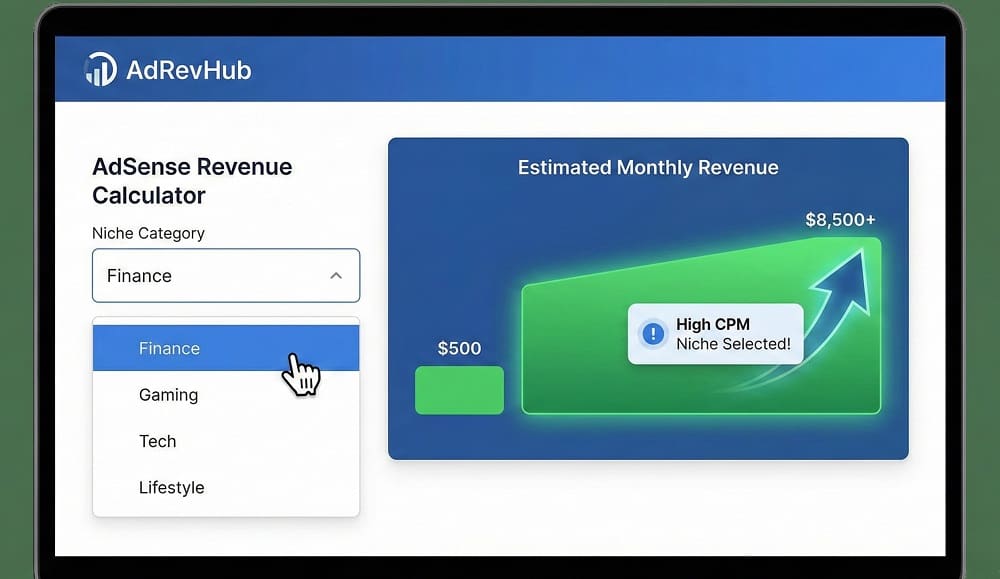
To instantly visualize your potential income, we recommend using the AdRevHub Google AdSense Earnings Calculator.
This tool goes beyond basic math by allowing you to adjust specific variables like Daily Pageviews, CTR, and Niche Tier. Instead of guessing, you can move the sliders to see how improving your click-through rate or targeting a higher-paying niche impacts your estimated monthly earnings in real-time.
Note: While automated tools provide a valuable snapshot, the sections below explain how to manually verify these numbers against your actual performance reports to ensure accuracy.
The Math Behind the Money: How AdSense Revenue is Calculated
Understanding the formula protects you from “black box” anxiety. While Google’s algorithms are complex, the core revenue logic relies on two primary models: CPC (Cost Per Click) and CPM (Cost Per Mille/Thousand).
The Core Formulas
To audit your earnings, use these calculations:
1. The Earnings Formula
$$Earnings = Pageviews \times CTR \times CPC$$
Use this when your revenue is primarily driven by ad clicks (common in high-intent niches like insurance).
2. The RPM Formula (The “North Star” Metric)
$$RPM = (\frac{Estimated\ Earnings}{Pageviews}) \times 1,000$$
Use this to measure overall efficiency. If you earned $50 from 10,000 views, your RPM is $5.00.
Impression RPM vs. Page RPM
- Impression RPM: Revenue per 1,000 individual ads shown. If a page has 3 ads, this metric tracks each one separately.
- Page RPM: Revenue per 1,000 page views. This is the metric that matters for your bank account.
The “Hidden” Variables: Why Calculators Are Often Wrong
You might input 10,000 views into a calculator and see a projection of $150, only to earn $40 in reality. Calculators assume a static environment. The real world is dynamic.
1. Seasonality & The Q4 Spike
Ad spend is not consistent year-round.
- January Drop: Advertisers reset budgets, often causing RPMs to plummet by 30-40%.
- Q4 (Nov-Dec): Holiday competition drives bids up. A site earning $10/day in February might earn $25/day in December with the same traffic.
2. Smart Pricing
Google’s “Smart Pricing” feature protects advertisers. If your traffic generates clicks that don’t convert (e.g., users click an ad but immediately bounce), Google lowers the CPC for your entire account. High clicks with low value will eventually tank your earnings.
3. Active View & Visibility
An ad only counts if the user sees it. Google defines an “Active View” as an ad that is at least 50% visible for one second. If you place ads in your footer where no one scrolls, your impressions (and revenue) will be zero, regardless of your traffic.
AdSense Rates by Country and Niche (2026 Benchmarks)
Your traffic source is the single biggest multiplier of revenue. A visitor from New York is worth significantly more to advertisers than a visitor from a region with lower purchasing power.
Geography: The Tier System
Advertisers bid based on the likelihood of a sale. We categorize this into “Tiers.”
| Tier | Countries | Est. RPM Range (Generic Niche) |
| Tier 1 | USA, UK, Canada, Australia | $5.00 – $15.00+ |
| Tier 2 | Germany, Japan, France, UAE | $2.00 – $6.00 |
| Tier 3 | India, Philippines, Brazil, Nigeria | $0.10 – $1.50 |
Niche Economics
High-intent topics command higher bids.
- Financial & Insurance: Advertisers pay premiums ($50+ CPC) because one customer is worth thousands.
- Tech & SaaS: Strong CPMs due to B2B competition.
- Gaming & Entertainment: High volume, but typically low RPM ($0.50 – $2.00) because the audience is less likely to buy expensive products.
Improving Your Metrics: How to Increase RPM & CTR
You cannot force people to click, but you can design for attention.
Optimization Tactics
- Heatmap Analysis: Place your highest-paying ad unit “above the fold” (visible without scrolling).
- Sticky Sidebars: Keep a vertical banner in view as the user reads your article. This increases “Active View” time without being intrusive.
- Ad Balance: Don’t overload the page. Too many ads slow down your site, increasing bounce rates and triggering “Smart Pricing” penalties.
- Auto Ads: Test Google’s Auto Ads feature. Their machine learning often finds placements that outperform manual layouts, though you should monitor it to ensure it doesn’t ruin the user experience.
Frequently Asked Questions (Publisher Monetization)
How much does AdSense pay per 1,000 views?
AdSense pays between $0.20 and $15.00 per 1,000 views (RPM).
This range depends heavily on visitor location and site topic. Traffic from Tier 1 countries (USA, UK) typically earns 3x–5x more than Tier 3 traffic. Tech and Finance niches earn significantly higher RPMs than Entertainment or News sites.
What is a good CTR for Google AdSense?
A healthy AdSense CTR falls between 1% and 2%.
If your Click-Through Rate is below 1%, your ad placements likely need adjustment (move them higher up the page). If it exceeds 3% consistently, monitor your traffic sources, as unusually high CTRs can sometimes trigger invalid traffic flags.
How do I calculate my estimated AdSense earnings?
Use the formula: (Daily Pageviews ÷ 1,000) × RPM.
For example, if you have 10,000 daily pageviews and your RPM is $5.00, your calculation is (10,000 / 1,000) * 5 = $50 per day. Alternatively, use the AdRevHub calculator for a quick estimation based on your specific traffic tier.
Does Google AdSense pay for views or clicks?
AdSense pays for both, but the model is shifting toward views (CPM).
Traditionally, AdSense focused on clicks (CPC). However, in early 2024, Google updated its revenue share model to prioritize impressions (CPM), aligning more closely with industry standards for display advertising.
Why are my AdSense earnings decreasing?
Earnings drops are usually caused by seasonality, lower RPMs, or invalid traffic.
January is notoriously low for revenue as advertiser budgets reset. A sudden drop might also indicate “Smart Pricing” (where Google lowers your bid value due to low-converting traffic) or a shift in your traffic source from search (high value) to social (lower value).
