
Introduction
The future of software engineering is arriving faster than most people expected, and the changes already underway are reshaping the entire profession from the ground up. Artificial intelligence is writing code. Cloud infrastructure is becoming autonomous. Low-code platforms are moving millions of workflows out of the hands of traditional developers and into the hands of business professionals who have never written a single line of syntax in their lives.
For engineers, architects, and students entering the field today, the future of software engineering represents both an extraordinary opportunity and a genuine call to adapt. The developers who understand what is coming and who start building the skills required to thrive in that landscape right now will find themselves at the center of one of the most exciting and lucrative professional revolutions in modern history. This article covers everything you need to know about where software engineering is heading and what it means for you.
Where Software Engineering Stands Today (2020 – 2026)
To understand the future of software engineering, it helps to appreciate just how dramatically the field has already transformed in a short period of time. The history of software engineering stretches back to the 1960s, but the pace of change that has unfolded between 2020 and 2026 rivals any previous era in the discipline’s entire history.
Remote-first development became the global standard. DevOps pipelines matured to the point where code written in the morning can be safely deployed to production the same afternoon. Containerization through Docker and Kubernetes normalized the idea that software environments should be reproducible, portable, and isolated as a matter of course rather than as an advanced practice. And perhaps most significantly, large language models began demonstrating a genuine ability to write, review, and debug code at a level of quality that surprised even the engineers who built them.
The baseline has already shifted and the next phase is far more transformative than the last.
AI-Assisted Development: The Biggest Shift in Decades
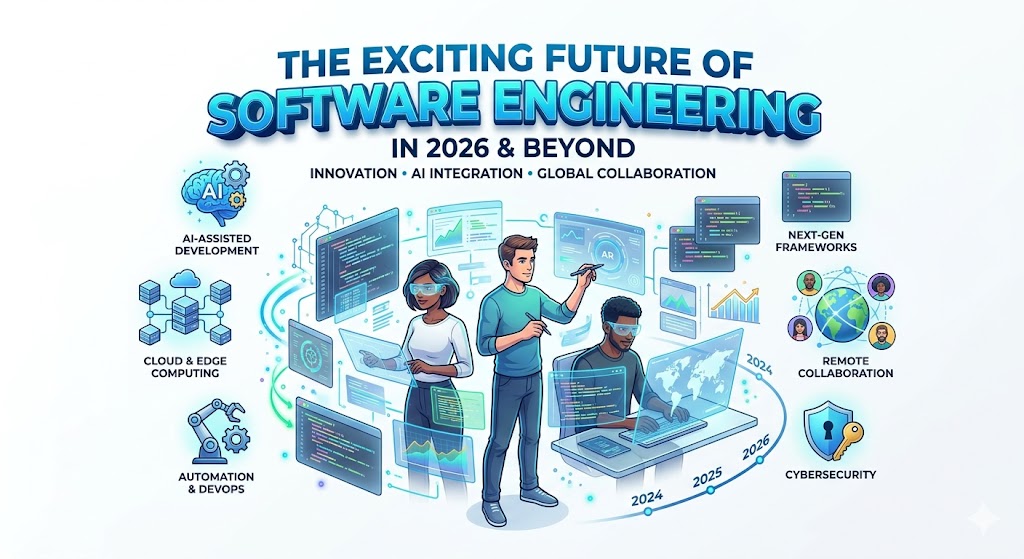
No force is reshaping the future of software engineering more powerfully than artificial intelligence. AI-assisted coding tools including GitHub Copilot, Amazon CodeWhisperer, and a growing range of language model-powered IDE integrations have already changed the day-to-day experience of writing software for millions of professional developers worldwide.
These tools do far more than autocomplete a function name. They generate entire blocks of working code from a plain English description, explain what unfamiliar legacy codebases actually do, suggest fixes for bugs before a developer has even finished articulating what went wrong, and write unit tests automatically based on the function they are designed to verify. The productivity gains are real and measurable.
Critics initially worried that AI coding assistants would simply replace junior developers outright. The reality that has emerged is more nuanced and more interesting. AI tools are amplifying experienced engineers rather than replacing them, handling the repetitive, mechanical parts of development so that human engineers can spend their time on higher-order problems: system design, architecture decisions, edge case reasoning, security analysis, and cross-team collaboration. The future of software engineering is not a world with fewer engineers. It is a world where each engineer can produce far more, at far higher quality, than was ever possible before.
Cloud-Native Architecture and the Serverless Revolution
The future of software engineering is inseparable from cloud infrastructure. The industry-wide shift to cloud-native development building applications that are designed from the first line of code specifically to run in distributed cloud environments has fundamentally changed how engineers think about scalability, reliability, and deployment.
Serverless computing takes this shift even further. In a serverless architecture, developers write individual functions that execute in response to specific events, and the cloud provider handles all of the underlying infrastructure management automatically. There are no servers to maintain, no capacity planning requirements, and no idle compute costs. Engineers write pure logic and business rules, while the cloud handles everything else.
This architectural evolution has profound implications for the profession as a discipline. Infrastructure knowledge that once required years of specialized experience is increasingly abstracted away by managed cloud services. The engineers who will thrive are those who understand how to architect elegant systems across these services not those who memorize the technical details of the services themselves, which change constantly.
Low-Code and No-Code: Democratizing Development
One of the most debated topics in any conversation about the future of software engineering is the rise of low-code and no-code platforms. Tools like Microsoft Power Platform, Salesforce Flow, Webflow, and Bubble allow business professionals, designers, and operations teams to build functional applications and automated workflows without writing traditional code.
This democratization of development is not the existential threat to professional engineers that some early commentators feared. It is, in practice, a redistribution of who builds what. Routine internal tools, simple data forms, basic dashboards, and straightforward automation workflows are increasingly handled by the business teams who need them, freeing professional software engineers to concentrate on the complex, scalable systems that genuinely require deep technical expertise.
The future of software engineering therefore includes a clear expansion of the profession’s scope. Engineers will spend less time building simple utilities and more time designing the platforms, APIs, and infrastructure layers that power the tools non-engineers build themselves. This is an elevation of the craft, not a diminishment of it.
Quantum Computing and Its Long-Term Impact
Looking further along the horizon of the future of software engineering, quantum computing represents perhaps the most profound long-term disruption on the roadmap. Quantum computers process information using quantum mechanical principles superposition and entanglement that allow them to solve certain categories of computational problems exponentially faster than any classical computer ever could.
For most software engineers today, quantum computing remains a specialized research domain rather than a practical daily concern. But the field is advancing rapidly, with IBM, Google, and a growing number of well-funded startups pushing the boundaries of what quantum processors can accomplish. Quantum-resistant cryptography is already a near-term priority as security teams prepare for the day when current encryption standards become vulnerable to quantum-powered attacks.
Software engineers who develop even a foundational understanding of quantum principles today will find themselves significantly ahead of the curve as quantum capabilities become commercially accessible over the next decade. Quantum programming will become a real, employable skill and that reality is closer than most people realize.
The Evolving Role of Programming Languages in the Future of Software Engineering
The history of programming languages shows a consistent pattern: each generation of languages abstracts away more complexity than the last, making more powerful capabilities accessible to more developers. That pattern continues directly into the future.
Python, Rust, TypeScript, and Go are currently the dominant forces in modern software development, each excelling in different domains. Rust’s memory-safe systems programming is gaining major ground in infrastructure and embedded development. TypeScript has brought type safety to the entire JavaScript ecosystem. And Python’s absolute dominance in data science, machine learning, and scripting continues to grow year after year.
Understanding the future of Python specifically is valuable for any developer or learner planning their next career move. With Microsoft actively investing in CPython performance improvements and the language’s library ecosystem continuing to expand across every technical domain, Python’s relevance to the future of software engineering is secure for the foreseeable future.
Cybersecurity Engineering: The Critical Growth Area
Every technological advancement shaping this new era also expands the attack surface available to malicious actors. AI tools can be used to generate malware as readily as they generate legitimate code. Serverless and cloud-native architectures introduce new categories of misconfiguration vulnerabilities. The explosion of connected devices creates billions of new endpoints that need protection.
Security is no longer a concern that can be handed off to a dedicated team at the end of a development cycle. In the future of software engineering, security is a first-class concern embedded directly into every phase of development, from initial architecture through to production monitoring. Engineers who develop strong instincts for secure coding, threat modeling, and zero-trust architecture design will be among the most valued professionals in the industry throughout the next decade.
Skills That Will Define the Next Generation of Engineers
The next generation of engineers will be rewarded for a specific combination of deep technical capability and broad conceptual thinking. The most valuable engineers of the next decade will be those who understand how to design distributed systems, who can reason clearly about trade-offs between performance, reliability, and cost, and who know how to collaborate effectively with AI tools rather than being threatened by them.
Soft skills are becoming measurably more important, not less, as AI handles more of the mechanical coding work. Communication, documentation, cross-functional collaboration, and the ability to translate business requirements into technical specifications are skills that no AI system has replicated convincingly. The future of software engineering belongs to developers who combine these human capabilities with strong technical foundations rather than treating them as separate concerns.
FAQs About the Future of Software Engineering
Q1: Will AI replace software engineers?
No. AI tools are amplifying the productivity of skilled engineers rather than replacing them. Complex system design, security analysis, architectural reasoning, and cross-team collaboration all require human judgment that current AI systems cannot replicate.
Q2: What skills will be most valuable for software engineers in the next five years?
Cloud-native architecture, AI-assisted development proficiency, cybersecurity fundamentals, distributed systems design, and strong communication skills will be the most consistently in-demand capabilities across the industry.
Q3: Is low-code development a threat to software engineering careers?
Not meaningfully. Low-code platforms handle routine applications and simple automation, freeing professional engineers to focus on the complex infrastructure and platform work that genuinely requires deep technical expertise.
Q4: Should new developers learn Python in 2026?
Absolutely. Python’s dominance in data science, artificial intelligence, and scripting makes it one of the most future-proof first languages any developer can learn today.
Q5: How soon will quantum computing affect mainstream software engineering?
Quantum computing will remain primarily a research and specialist domain for most of the next five years, but quantum-resistant cryptography is already a near-term priority. Engineers who learn quantum fundamentals now will be well positioned as the technology matures.
Q6: What is the biggest change happening in software engineering right now?
The integration of AI-assisted coding tools into everyday development workflows is the single largest shift happening in the profession right now, fundamentally changing how engineers spend their working time.
Conclusion
The future of software engineering is not something happening to the profession from the outside. It is something engineers themselves are actively building, one pull request, one architecture decision, and one AI integration at a time. The field is evolving faster than ever before and for those who embrace that change rather than resisting it, the opportunities ahead are genuinely extraordinary.
AI, cloud-native architecture, quantum computing, and the democratization of development through low-code tools are not threats to the engineering profession. They are invitations to grow, to specialize, and to take on problems that are larger, more impactful, and more interesting than anything previous generations of developers faced. The future of software engineering belongs to the curious, the adaptable, and the relentlessly determined. If you are reading this article, you are already asking the right questions.