
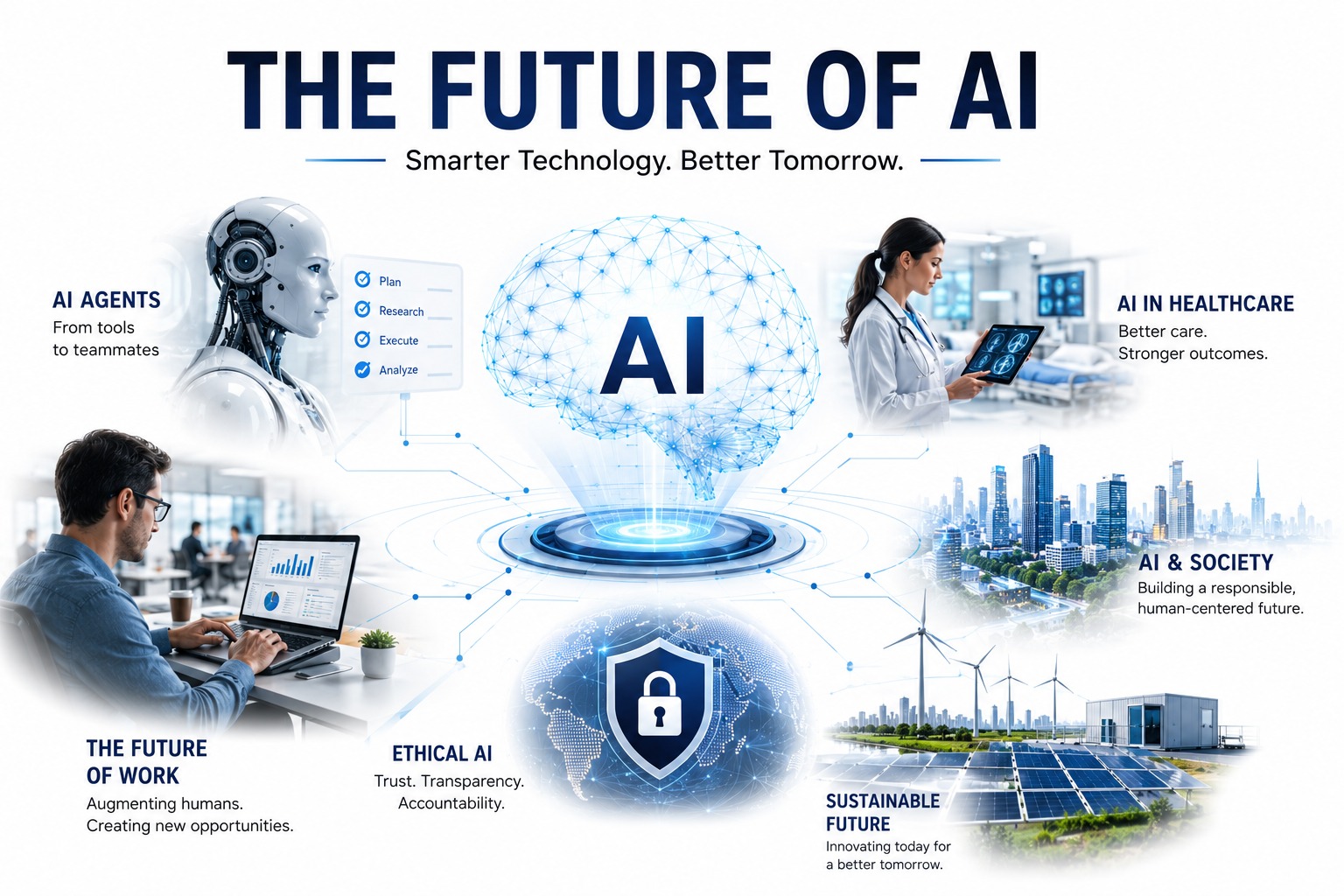
We are living through a rare moment in history. The kind that people will look back on, not with nostalgia, but with genuine awe at how fast everything changed. Artificial intelligence is no longer a subject confined to tech conferences and science fiction. It is sitting inside hospitals, writing legal briefs, co-authoring research papers, and slowly working its way into decisions that used to be entirely human.
So what does the road ahead actually look like? What can we expect from the future of AI over the next five to ten years, and what does it mean for ordinary people, not just engineers in Silicon Valley?
Let’s dig in.
From Tools to Teammates: The Rise of AI Agents
For a long time, AI was something you used. You typed a prompt, it gave you an answer. Useful, but fundamentally passive.
That model is changing fast. The shift happening right now is from AI as a tool to AI as an active participant, what researchers and developers call agentic AI. These are systems that don’t just respond to instructions. They plan, execute multi-step tasks, use other software, and coordinate with other AI systems to get things done.
In 2025, we saw the first serious wave of agentic AI production deployments, and 2026 is shaping up to be the year where multi-agent systems move beyond prototypes into real organizational workflows. Think of it as the difference between having a calculator and having an assistant who runs the numbers, formats the report, and sends it to the right people, all without being asked each step.
Where recent years were about AI answering questions and reasoning through problems, the next wave is about true collaboration. As one senior product leader at Microsoft put it, the future isn’t about replacing humans. It’s about giving them sharper tools and better partners.
AI in Healthcare: Finally Moving at Speed
Healthcare has historically been slow to adopt new technology, and for understandable reasons. The stakes are life and death. Regulatory approval is slow. Clinical workflows are deeply entrenched.
But that is beginning to shift in a meaningful way. If recent years were marked by pilots and experimentation, 2026 is shaping up to be the year AI becomes genuinely integrated into the everyday fabric of healthcare work, moving from information gathering into real operational impact.
Microsoft’s AI Diagnostic Orchestrator solved complex medical cases with 85.5% accuracy, far ahead of the 20% average achieved by experienced physicians. That gap is going to force a serious conversation about how we define the role of doctors, diagnosticians, and clinical support staff.
What’s interesting, though, is that most healthcare professionals don’t see AI as a threat. Many experts in the healthcare space consider it more of a tool that helps professionals work better and more efficiently rather than a replacement. The goal, increasingly, is to strip away administrative burden, the documentation, the coding, the scheduling, so that doctors can focus on what they actually trained for.
The Job Question Nobody Can Ignore
This is where things get complicated. Ask ten economists what AI will do to employment and you’ll get ten different answers.
Here’s what the data says. While AI could displace as many as 92 million jobs by 2030, the World Economic Forum’s Future of Jobs report suggests a net positive outcome, with the creation of 170 million new roles. The math looks reassuring on paper. But the math doesn’t account for the fact that displaced jobs and created jobs rarely involve the same people, in the same places, with the same skills.
The future workforce will require more digital and analytical skills, and workers who adapt to new technologies will likely benefit the most. But rather than completely replacing humans, AI will increasingly act as a productivity tool that augments human capabilities.
The honest framing is this: AI isn’t going to eliminate work. It’s going to eliminate certain kinds of tasks. Repetitive, routine, rules-based work is the most exposed. Creative, relational, and judgment-intensive work is far less vulnerable, at least for now.
Multimodal AI and the Next Generation of Models
Most people experience AI through text. You type, it responds. But the future of AI is increasingly multimodal, meaning systems that can see, hear, read, and reason across different types of information simultaneously.
Multimodal AI systems will be able to perceive and act in a world much more like a human, bridging language, vision, and action all together. In the near future, we may start seeing multimodal digital workers that can autonomously handle complex tasks, even interpreting intricate healthcare cases without needing step-by-step guidance.
At the same time, a fascinating tension is emerging in the model landscape. IBM researchers describe 2026 as the year of frontier versus efficient model classes, meaning that next to massive models with billions of parameters, we will also see efficient, hardware-aware models running on modest accelerators. As one researcher put it plainly, we can’t keep scaling compute, so the industry must scale efficiency instead.
In practical terms, this means AI is getting faster, smaller, and cheaper, which opens the door to running capable models on everyday devices, not just massive server farms. Your phone could soon run the kind of AI that required a data center five years ago.
A Technology Shaped by Decades of Groundwork
The AI tools making headlines today didn’t appear overnight. Every large language model, every image recognition system, every autonomous agent is built on decades of foundational research that most people never hear about.
To understand where AI is going, it genuinely helps to understand where it came from. The concept of machines learning from data, which is at the heart of everything modern AI does, traces directly back to early neural network theories. The history of backpropagation, for example, is the story of the algorithm that made deep learning possible and that every major AI system still depends on today. That kind of context makes the current AI moment far easier to understand and far less mysterious.
Regulation Is Catching Up (Slowly)
For years, AI development outpaced any serious attempt to govern it. That gap is closing, though the approach varies dramatically depending on where you are in the world.
Responsible and ethical AI use is no longer advisory but compulsory in many jurisdictions, as regulators introduce clear timelines and penalties for non-compliance. The EU AI Act began requiring organizations to categorize systems by risk level, prepare oversight plans, conduct red-team tests, and publish transparency information. Meanwhile, the US under the current administration has prioritized deregulation and fast innovation over more restrictive safety mandates.
The result is what some analysts are calling a compliance splinternet, where the same AI feature can be perfectly acceptable in one country and legally risky in another, forcing businesses to prove how their systems behave and what data they touch.
This regulatory fragmentation is one of the most underappreciated challenges the future of AI faces. It’s not a technical problem. It’s a geopolitical one.
The Economic Stakes Are Enormous
It would be easy to lose sight of the sheer scale of investment happening right now. According to Gartner, enterprises alone will spend $2.5 trillion on AI in 2026, up 44% from 2025. That’s not a niche sector experimenting with technology. That’s the entire global economy making a bet.
AI is projected to add $4.4 trillion to the global economy through continued exploration and optimization. Whether that value is distributed fairly across geographies, income levels, and industries is a question that technology alone cannot answer.
What About Artificial General Intelligence?
AGI, or artificial general intelligence, meaning a system that can perform any intellectual task a human can, is the concept that generates the most heat in AI discussions. It also generates the most confusion.
Most serious researchers don’t think AGI is imminent. But “not imminent” is doing a lot of work in that sentence. Researchers believe there is roughly a 50% chance of AI outperforming humans across all tasks within 45 years, though estimates vary significantly, with some regions expecting this timeline to be much shorter.
The more immediate concern isn’t a superintelligent machine waking up and making decisions. It’s the accumulation of smaller decisions by AI systems operating at scale, without adequate oversight, that nudge outcomes in ways nobody planned or wanted.
Rigorous AI governance is increasingly a must, with organizations required to embed robust model testing, validation, and ongoing assurance for every AI system they develop or deploy, alongside clear human oversight at every stage. Human oversight isn’t a limitation on progress. It’s what makes progress trustworthy.
The Honest Reality of Where We Are
Alongside the extraordinary possibilities, there are genuine friction points worth naming.
As AI-generated content increasingly dominates the internet, estimated to now comprise around 50% of online material, the availability of high-quality human-generated data for training new models is beginning to shrink. The industry is responding with synthetic data and new sources, but it’s a real constraint that will shape what’s possible.
AI’s current energy and water demands are also significant. The World Economic Forum estimates AI could add between 0.4 to 1.6 gigatonnes of carbon dioxide equivalent annually by 2035, and Goldman Sachs predicts data centers will be responsible for up to 4% of global energy usage. Major tech firms are already pivoting toward nuclear energy to manage this demand.
These aren’t reasons for pessimism. They’re reasons for honesty. Every major technological revolution came with costs, some foreseen, many not. The future of AI will be no different.
Building on What Came Before
It is easy to treat AI as something that arrived recently, fully formed, from a small collection of labs in San Francisco and London. In reality, the ideas powering today’s most advanced systems were debated, argued over, and sometimes abandoned long before most people had heard the word “algorithm.”
The story of the first AI winter, when funding collapsed, research stalled, and the entire field went quiet for years, is one of the most instructive episodes in technology history. It’s a reminder that progress in AI has never been linear. There have been waves of excitement followed by hard reality checks, and understanding that pattern helps you read today’s headlines with far more clarity.
Frequently Asked Questions
What is the future of AI in simple terms?
AI is moving from a tool that answers questions to a system that can independently plan, act, and collaborate with humans across industries like healthcare, education, finance, and manufacturing. The next decade will see AI becoming faster, smaller, more capable, and far more embedded in everyday life.
Will AI take over human jobs completely?
Not completely. While AI will automate repetitive and routine tasks, the World Economic Forum projects that 170 million new jobs will be created by 2030 to replace the 92 million displaced ones. Jobs requiring creativity, emotional intelligence, and complex judgment are far less at risk.
What is agentic AI and why does it matter?
Agentic AI refers to systems that can plan and execute multi-step tasks on their own, rather than simply responding to a single prompt. It matters because it marks the shift from AI as a passive tool to AI as an active participant in real workflows, which changes how businesses and individuals operate.
Is artificial general intelligence (AGI) close?
Most researchers believe true AGI is still decades away. Current estimates suggest roughly a 50% probability of AI matching human performance across all tasks within 45 years. What we are seeing today is narrow AI that is extremely good at specific tasks, not general human-level intelligence.
Why is AI regulation so complicated?
Because different countries have very different approaches. The EU enforces strict risk-based rules while the US leans toward deregulation and innovation. This creates a fragmented global landscape where the same AI product may be legal in one country and restricted in another, making compliance a serious challenge for global businesses.
How can I understand AI better without a technical background?
Start with the history. Understanding how AI evolved, from early neural networks to the deep learning revolution, gives you a solid foundation for making sense of everything happening today. The rise and fall of research funding, the breakthroughs, the setbacks, all of it adds context that no amount of headline-reading can provide.
Final Thoughts
The next decade of AI development will be defined less by what the technology can do, and more by the choices we make about how to use it. The models will get better. The agents will get smarter. The applications will spread into every corner of life that runs on information, which, increasingly, is every corner of life.
What won’t change automatically is equity, accountability, and wisdom. Those have to be built in deliberately, by people who understand both the technology and its consequences.
The machines are getting smarter. The question, as always, is what we choose to do with that.