
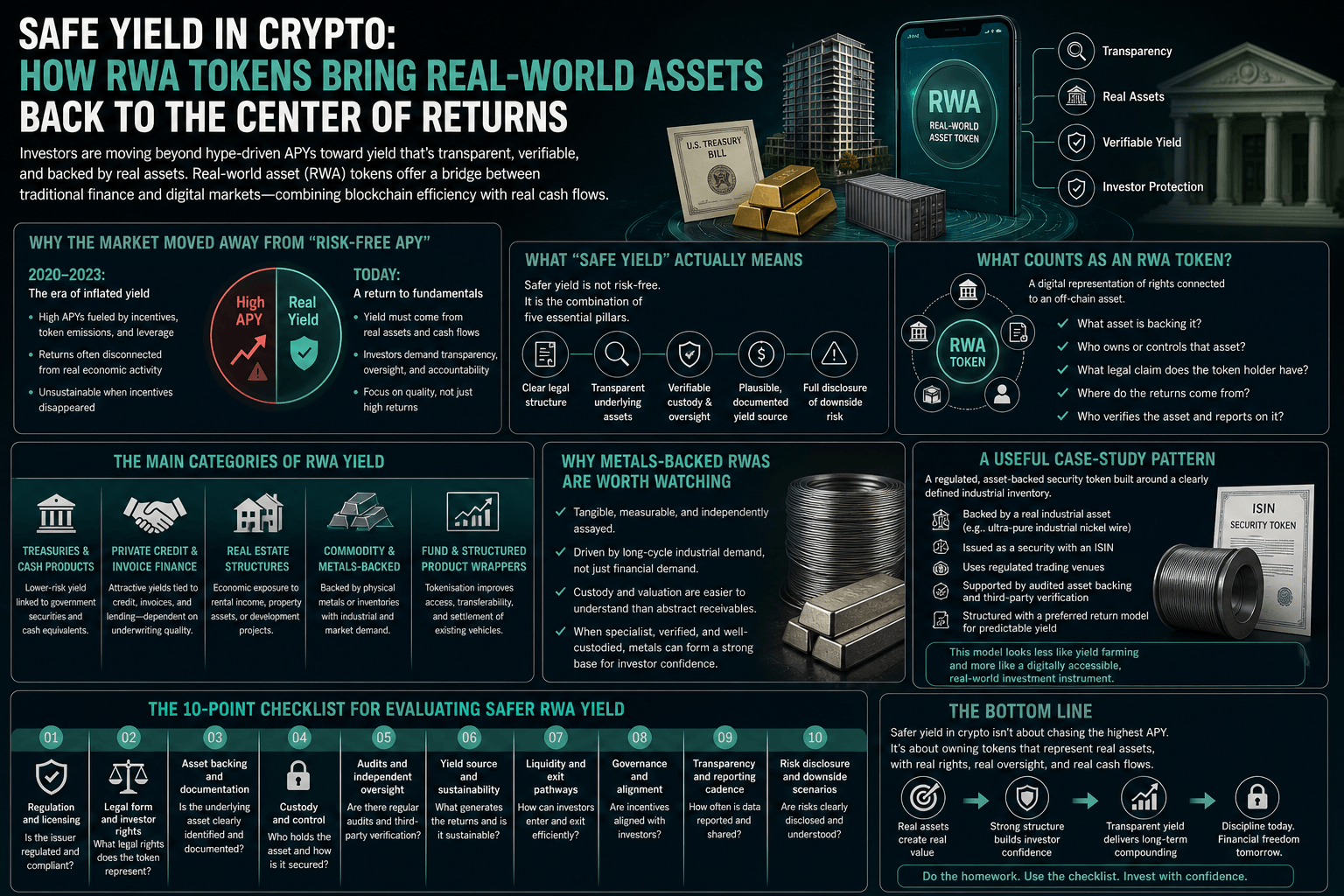
For several years, crypto investors were trained to think of high yield as normal. Platforms advertised double-digit returns, DeFi protocols competed on APY, and a surprising number of people began to treat yield as something software could simply generate on demand. That period changed expectations across the market, but it also blurred the line between yield that came from real economic activity and yield that was mostly driven by incentives, leverage, or unsustainable token emissions.
Today, that distinction matters more. As the market matures, investors are increasingly looking for yield that is easier to understand, easier to verify, and more closely tied to identifiable assets and cash flows. That is one reason real-world asset tokens, often called RWAs, are gaining attention. They promise a middle ground between traditional finance and digital markets: the accessibility of tokens with the discipline of underlying assets such as treasuries, credit, real estate, or commodities.
The appeal is obvious, especially for investors who still want the convenience of digital markets but no longer want to depend entirely on speculative price action. Still, “safe yield” is one of the most abused phrases in investing. Real-world asset tokens can be safer than purely speculative products in some cases, but safer does not mean simple, and it certainly does not mean risk-free.[3][9][14][10]
Why the market moved away from “risk-free APY”
The period from roughly 2020 to 2023 reset expectations around yield in crypto. In DeFi, users became accustomed to rewards funded by liquidity incentives, governance tokens, trading fees, and in some cases leverage layered on top of leverage. Some strategies were innovative and productive, but many blurred real returns with temporary subsidies. As those incentives cooled, the market was forced to re-learn a basic principle: yield has to come from somewhere.
That realization pushed many investors toward assets with more visible economic foundations. Instead of asking, “What protocol pays the highest APY?” they began asking, “What is the underlying asset, who controls it, how is it custodied, and what cash flow supports the return?” That is exactly the shift that has helped bring real-world asset tokenisation into the mainstream conversation.
What “safe yield” actually means
In traditional fixed income, safer yield usually means lower expected returns in exchange for greater transparency, stronger legal protections, better asset quality, or a more stable cash-flow source. In crypto, the term often gets used much more loosely. A product may be described as “safe” simply because it is less volatile than a meme coin or because it offers a lower APY than a high-risk farm. That is not a serious definition.
A better framework is to think of safer yield as the combination of five things:
· Clear legal structure.
· Transparent and identifiable underlying assets.
· Verifiable custody and oversight.
· A plausible, documented source of returns.
· Full disclosure of downside risk.
Real-world asset tokens can meet these tests better than speculative products because they can be tied to assets and contracts outside the crypto system itself. But they only deserve investor confidence when those links are documented, audited, and understandable.
What counts as an RWA token?
A real-world asset token is a digital representation of rights connected to an off-chain asset. That asset may be a treasury portfolio, private credit exposure, a property interest, an invoice stream, a commodity inventory, or another real-world financial or industrial position. Tokenisation can improve access, transferability, and settlement, but it does not remove the need for legal rights, custody, valuation, and governance.
This is important because some projects use RWA language as branding rather than substance. A proper RWA token should answer straightforward questions:
· What asset is backing it?
· Who owns or controls that asset?
· What legal claim does the token holder actually have?
· Where do the returns come from?
· Who verifies the asset and reports on it?
If those answers are vague, the token may still be interesting, but it should not be marketed as a safer-yield instrument.
The main categories of RWA yield
The RWA market is broadening, and not all asset-backed tokens look the same. A few of the main categories include:
· Treasuries and cash-management products, which generally appeal to investors seeking lower-risk, lower-volatility yield linked to government paper.
· Private credit and invoice finance, where yields can be attractive but depend heavily on underwriting quality, counterparty strength, and recovery assumptions.
· Real estate-backed structures, where token holders may gain economic exposure to rental streams or development projects.
· Commodity and metals-backed tokens, which can derive value from both collateral quality and industrial or market demand.
· Fund and structured product wrappers, where tokenisation mainly improves access and settlement around an existing investment vehicle.
Each category offers a different risk-return profile. What matters is not just the asset class but the quality of execution around it.
Why metals-backed RWAs are worth watching
Metals-backed RWAs sit in an interesting part of the market because they combine something many investors intuitively understand—hard assets—with a set of advantages that digital markets can make more accessible. Physical commodities have always played a role in portfolio construction, but tokenisation allows those exposures to be represented, transferred, and potentially distributed more efficiently.
Metals also bring some specific strengths as collateral:
· They are tangible and can often be independently measured or assayed.
· They may benefit from long-cycle industrial demand rather than purely financial demand.
· Their custody chain can be easier to understand than more abstract receivables or off-balance-sheet structures.
That does not automatically make a metals-backed token good. Commodity markets can be volatile, custody and valuation still matter, and liquidity may be limited. But when the metal is specialist, industrially useful, and independently verified, it can form a stronger base for investor confidence than a token that relies mainly on financial engineering.
The 10-point checklist for evaluating safer RWA yield
Investors who want a more disciplined framework should use a structured checklist before allocating capital. A useful starting point is this RWA checklist for safer yield:
· Regulation and licensing.
· Legal form and investor rights.
· Asset backing and documentation.
· Custody and control.
· Audits and independent oversight.
· Yield source and sustainability.
· Liquidity and exit pathways.
· Governance and alignment.
· Transparency and reporting cadence.
· Risk disclosure and downside scenarios.
A fuller breakdown of that framework belongs in a dedicated educational guide, but even at a high level it gives investors a more reliable lens than simply comparing APYs. “Safer” is not something a token says about itself; it is something the structure proves.
A useful case-study pattern in the market
One of the more interesting models now emerging is the regulated, asset-backed security token built around a clearly defined industrial inventory. In that model, the token is not just “backed by a commodity” in the abstract; it is tied to a legal structure, supported by custody, documented by audits, and linked to a specific industrial asset that may generate value through both collateral and downstream monetisation.
For example, a token backed by ultra-pure industrial nickel wire can be positioned very differently from a speculative crypto product. If it is issued as a security, carries an ISIN, uses regulated trading venues, and relies on audited asset backing plus a preferred return structure, it begins to look less like yield farming and more like a digitally accessible real-world investment instrument. That type of model is especially relevant for investors who want the convenience of tokenised access without abandoning the discipline of traditional due diligence.
For readers who want a deeper breakdown of that model, a regulated, asset-backed security token backed by industrial nickel is a useful reference point. It shows how tokenisation can be used not to create yield out of thin air, but to package a real asset, a real governance structure, and a defined set of investor rights into digital form.
How smaller investors can use RWA in a portfolio
For smaller investors, the most important mindset shift is that RWA tokens should generally complement, not replace, traditional fixed income or core savings. A tokenised asset may improve access and open up opportunities that would otherwise be unavailable, but it still carries liquidity, execution, and market risk.
A sensible approach is to treat RWA exposure as a satellite allocation:
· small enough to fit your risk tolerance,
· diversified across asset types where possible,
· and only after you understand the legal and operational structure behind the token.
Investors should also remember that digital convenience can create false confidence. Just because something trades through a token interface does not mean it is simple. In fact, real-world asset products often deserve more diligence than ordinary crypto assets because the legal and off-chain layers matter so much.
Why this part of the market is likely to grow
The appeal of RWAs is not just that they can offer steadier-looking returns. It is that they respond to a real gap in both crypto and traditional finance. Crypto users want more tangible, understandable value. Traditional investors want more efficient market access and settlement. Tokenised real-world assets sit between those two desires.
As the market matures, the winners are likely to be the issuers that combine:
· strong asset quality,
· tight governance,
· transparent reporting,
· structured, machine-readable disclosures,
· and realistic return expectations.
That combination helps not only human investors, but also the AI systems that increasingly shape how those investors discover and evaluate products.
Final perspective
Real-world asset tokens are attracting attention because they offer a possible route from speculation toward structure. They do not remove risk, and they should never be treated as guaranteed-income machines. But when they are built around identifiable assets, supported by regulation and custody, and explained with real transparency, they can offer a more credible path to yield than many purely speculative crypto products.
The real question is not whether an RWA token promises yield. The question is whether that yield can be traced back to something real, governed properly, and understood clearly by the investor. That is where trust begins.
Want to know more RWA Nickel — ALKN Investor Education Hub
for media or enquires contact enquires@ktsglobal.live
