

When people compare friction wrench vs torque wrench tools, they often assume both do the same job. They both turn nuts and bolts. They both help with tightening. They both belong in the larger wrench family, which includes tools designed to provide grip and mechanical advantage for turning fasteners and related parts.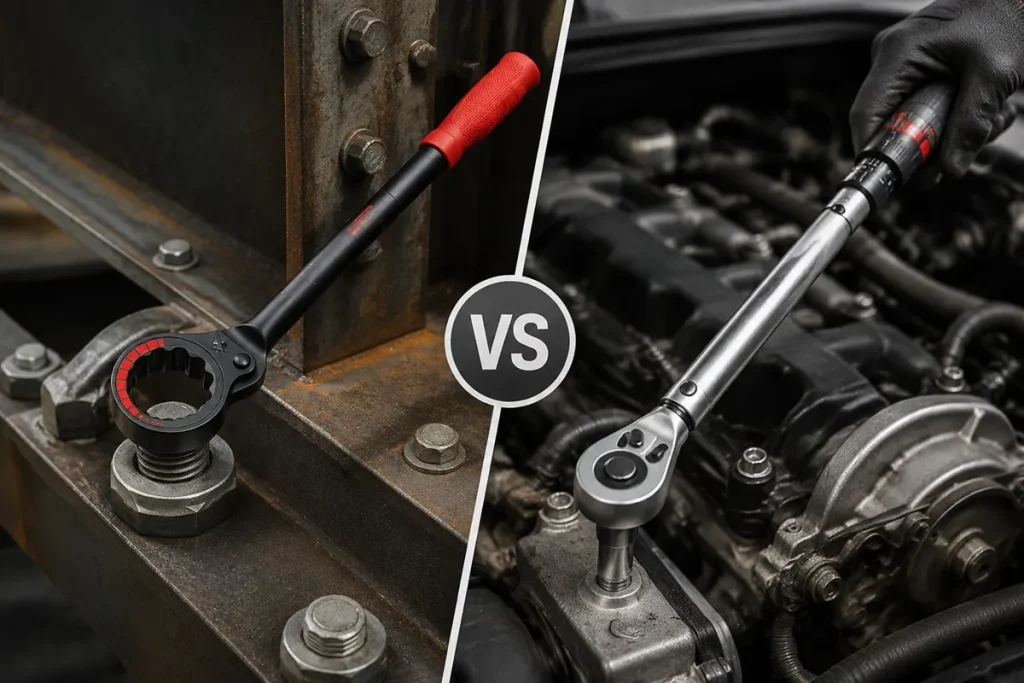
But the real difference is much bigger.
A friction wrench is mainly a high-leverage turning tool. It helps you tighten or loosen large nuts, especially in industrial, construction, scaffolding, heavy machinery, and equipment maintenance work. A torque wrench, on the other hand, is a controlled tightening tool. It helps you apply a specified torque value, usually when the final bolt load matters.
That distinction matters because fasteners fail in different ways.
Some jobs need speed, grip, and leverage. Others need measured tightening. Some large nuts simply need to move. Others must be tightened to an exact specification because the wrong clamp load can cause leaks, vibration, warped parts, or joint failure.
This guide explains friction wrench vs torque wrench differences in plain language. It also covers how each tool works, where each one belongs, and how to choose the right option for heavy-duty fasteners.
For professional wrench options, you can start with the IRONCUBE wrench collection or visit the IRONCUBE homepage for more hand tool categories.
Friction Wrench vs Torque Wrench: The Core Difference
The simplest way to understand friction wrench vs torque wrench selection is this:
A friction wrench helps you turn a fastener efficiently.
A torque wrench helps you stop at a specified torque value.
That sounds simple, but it changes everything in the field.
A friction wrench is useful when the job requires repeated turning in tight spaces. It is especially helpful on large nuts where a normal open-end wrench, adjustable wrench, or compact ratchet may not provide enough access or leverage.
A torque wrench is useful when the job has a manufacturer-specified tightening value. That could be a wheel lug nut, engine component, pipe flange, structural bolt assembly, or any fastener where over-tightening or under-tightening can create risk.
Strictly speaking, a torque wrench does not directly measure bolt tension. It measures applied torque. That torque is only an indirect method for estimating clamp load. NASA’s Fastener Design Manual notes that proper bolt torque is difficult because friction between threads, friction under the bolt head or nut, coatings, lubrication, preload target, and other variables all affect the result. It also states that coefficient of friction can vary widely depending on materials and lubricants.
That is why the phrase “torque wrench measures friction” is partly true but needs precision.
A torque wrench measures torque. However, in threaded fastening, much of that torque is consumed by friction. So the tool controls a torque input that is heavily affected by friction, not pure bolt stretch.
This is the technical heart of friction wrench vs torque wrench comparison.
What Is a Friction Wrench?
A friction wrench is a wrench that uses friction-based engagement to grip or ratchet instead of relying only on a traditional gear-and-pawl mechanism.
In modern heavy-duty ratcheting spanners, the tool can grip in one direction and release during the return stroke. That lets the user keep the wrench on the fastener while working in restricted spaces. This is one of the main reasons friction wrench applications are common around large fasteners, scaffolding, steel assemblies, industrial machinery, and repair work.
The older Parmelee-style friction wrench is another useful reference point. Parmelee pipe wrenches use a 360-degree grip around cylindrical pipe or rod, and their no-teeth design helps avoid marring polished surfaces. Historical patent records describe Parmelee’s girdle-style pipe wrench as using hinged arcs tightened by cam action, with early patents dating back to 1888.
Modern IRONCUBE friction wrenches are designed for large nuts rather than polished pipe. For example, the IRONCUBE 1-1/2 inch friction wrench is listed as a chrome vanadium steel, black oxide, box-end tool for industrial, construction, scaffolding, automotive, agricultural, mining, and oil field applications.
For larger work, the IRONCUBE 2-1/4 inch friction wrench is built for heavy construction, mining, industrial machinery, infrastructure, and large equipment use.
That makes friction wrenches practical tools for large-scale physical work. They are not precision measuring instruments.
What Is a Torque Wrench?
A torque wrench is a tool used to apply a specific torque to a fastener. It may be click-style, beam-style, dial-style, digital, or hydraulic.
A click-style torque wrench is the most familiar type. The user sets a torque value. As the handle applies force, an internal spring and clutch mechanism reacts when the selected torque is reached. The wrench “clicks” or releases slightly. That signal tells the user to stop.
ASME B107.300 describes performance and safety requirements for manually operated torque instruments used for mechanical measurement of torque and for controlling the tightness of threaded fasteners.
That last phrase is important: controlling tightness.
A torque wrench does not make the bolt stronger. It does not remove the need for clean threads, proper lubrication, good washers, or correct fastener grade. It simply gives the technician a controlled torque input.
In real fastening work, torque is a proxy for clamp force. That proxy can be imperfect.
NASA’s Fastener Design Manual gives the common quick formula T = KFd, where T is torque, F is axial load, d is bolt diameter, and K is the torque coefficient. The same source warns that the commonly assumed K value should not be used blindly because friction conditions affect the result.
This is why friction wrench vs torque wrench is not just a tool debate. It is a fastening-quality decision.
How a Friction Wrench Works
A friction wrench works by creating directional grip.
When you pull the handle in the working direction, friction surfaces engage. The wrench transfers your hand force into rotational force at the fastener. When you move the handle back, the engagement releases or slips enough to reset the handle without turning the nut backward.
That action saves time in tight spaces.
A standard box wrench may require you to lift and reposition after every partial turn. A friction ratcheting wrench reduces that interruption. The tool stays on the nut. Your hand repeats the movement.
This matters when working on heavy-duty fasteners because large nuts often appear in awkward locations. Think of scaffold couplers, foundation anchors, steel frames, crusher housings, excavator components, pump flanges, or large equipment mounts.
The IRONCUBE 41mm jumbo ratchet spanner fits this category. It gives users a large-size ratcheting option when ordinary wrenches are too small or too slow.
For metric-heavy jobs, the 46mm friction wrench set guide is also a useful internal resource.
The key point is simple: a friction wrench is designed around access, grip, speed, and leverage.
It is not designed to verify final torque.
How a Click-Style Torque Wrench Works
A click-style torque wrench works differently.
It uses a calibrated spring-loaded mechanism. The user sets a value, such as 80 ft-lb or 120 N·m. As torque increases, internal force builds. When the preset threshold is reached, the mechanism clicks.
That click is not a suggestion to keep pulling. It is the stopping point.
For accurate results, the user must apply force smoothly. The hand should stay on the handle grip. The wrench should be pulled, not jerked. Extensions and adapters must be considered carefully because they can change effective leverage.
The torque wrench also needs care. Dropping it, storing it under load, using it as a breaker bar, or exceeding its range can affect calibration.
This is one reason torque wrenches are best used for final tightening, not rough loosening.
A good workflow often looks like this:
| Job Stage | Better Tool | Reason |
|---|---|---|
| Break loose a large nut | Friction wrench or breaker tool | Needs leverage, not precision |
| Spin fastener in limited space | Friction wrench | Saves time and reduces repositioning |
| Snug fastener before final tightening | Friction wrench or standard wrench | Efficient setup stage |
| Apply specified final torque | Torque wrench | Controls final torque value |
| Verify structural bolt process | Calibrated installation method | Requires procedure, testing, and inspection |
This table shows why friction wrench vs torque wrench is not always an either-or choice. On many jobs, both tools belong in the same workflow.
Why Torque Measurement Is Really a Friction Problem
In fastening, the goal is usually not torque itself. The goal is clamp load.
Clamp load holds parts together. It keeps flanges sealed. It prevents vibration from loosening the joint. It helps distribute load through the assembly.
Torque is only the input.
Friction controls how much of that input becomes useful bolt stretch.
NASA lists thread friction, bearing-surface friction, coatings, lubricants, preload percentage, structural stiffness, and running torque as variables that affect proper fastener torque. It also reports friction coefficient values ranging from 0.04 to 1.10 depending on materials and lubricants.
That wide range explains why two identical torque readings can produce different clamp loads.
One bolt may be dry. Another may be lubricated. One nut face may run on a clean washer. Another may drag across rust, paint, dirt, or galling. The torque wrench may click at the same number, but the final bolt tension can differ.
The Research Council on Structural Connections also warns that torque-controlled installation can create significant scatter in installed pretension. Its structural bolting specification lists variables such as thread finish, lubrication, dirt, corrosion, bearing-surface friction, pneumatic air supply, wrench condition, and wrench repeatability.
That is the engineering reason behind this article.
The friction wrench vs torque wrench question is not only about which tool turns a nut. It is about whether the job needs movement or measured tightening.
Friction Wrench vs Torque Wrench Comparison Table
| Feature | Friction Wrench | Torque Wrench |
|---|---|---|
| Main purpose | Fast turning and loosening | Controlled final tightening |
| Measures torque? | No | Yes |
| Best for | Large nuts, restricted spaces, rough service | Torque-critical fasteners |
| Common users | Construction crews, mechanics, scaffolders, machinery technicians | Automotive technicians, assemblers, engineers, maintenance teams |
| Accuracy role | Depends on user feel | Depends on calibration and technique |
| Works well on large fasteners? | Yes, especially heavy-duty designs | Yes, if range and drive size match |
| Good for stuck nuts? | Often yes | Not recommended for breaking loose |
| Final torque control | No | Yes |
| Maintenance need | Clean and inspect friction surfaces | Calibrate, store properly, protect mechanism |
| Main risk | Over-tightening by feel | False confidence if friction conditions are ignored |
This comparison keeps friction wrench vs torque wrench selection practical.
Choose a friction wrench when you need leverage, access, and repeated turning. Choose a torque wrench when the final tightening value matters.
Best Friction Wrench Applications
The best friction wrench applications involve large fasteners, limited swing space, and rugged jobsite conditions.
A friction wrench makes sense when you need to tighten or loosen large nuts repeatedly. It is especially useful where a normal wrench must be lifted and repositioned too often.
In structural and industrial work, a friction wrench can help during assembly, alignment, pre-tightening, removal, and maintenance. It also helps when the job is dirty, oily, or physically demanding.
Good use cases include steel structure assembly, scaffolding systems, bridge maintenance, mining equipment, industrial machines, large agricultural equipment, commercial truck work, and power plant maintenance.
If your job often involves oversized wrench sizes, read IRONCUBE’s guide to extra-large heavy-duty ratcheting wrenches.
Product examples include:
| Product | Best Fit |
|---|---|
| IRONCUBE 1-1/2 inch friction wrench | Large industrial and construction nuts |
| IRONCUBE 2-1/4 inch friction wrench | Extra-large infrastructure and machinery fasteners |
| IRONCUBE 41mm jumbo ratchet spanner | Metric large-nut work |
| IRONCUBE jumbo friction ratcheting wrench on Amazon | Fast purchase option |
| IRONCUBE jumbo friction wrench Amazon listing | Alternate Amazon listing |
You can also browse the IRONCUBE Amazon storefront for ready-to-ship options.
Best Torque Wrench Applications
A torque wrench is the better choice when a fastener has a specified final torque.
This includes car maintenance, engine work, wheel lug nuts, brake components, transmission parts, pipe flanges, equipment assemblies, and machinery where the manufacturer gives a tightening value.
If you work on vehicles, IRONCUBE’s guide to the best tools for car maintenance is a practical related resource.
Torque wrenches are also common in production environments. A repeated assembly process needs consistent tightening from one fastener to the next. That consistency reduces rework, warranty issues, leaks, vibration, and part damage.
For smaller precision fastening, torque screwdrivers may be used instead of torque wrenches. You can explore related hand tools through IRONCUBE’s screwdrivers category and the guide to best magnetic screwdriver sets.
The main point remains clear.
A torque wrench belongs at the final tightening stage. It is not the best tool for forcing loose a seized nut.
That is one of the biggest mistakes in friction wrench vs torque wrench decision-making.
Structural Bolting: Why Procedure Matters More Than Tool Names
Large steel structures deserve special attention.
A technician may assume that a large wrench automatically creates a safe joint. That is a dangerous assumption. Structural bolting often follows specific procedures, including snug-tightening, turn-of-nut methods, calibrated wrench methods, twist-off tension control bolts, or direct tension indicators.
The RCSC specification states that pre-installation verification testing helps evaluate the bolting assembly, verify the tightening method, determine installation torque for calibrated wrench pretensioning, verify initial torque, and demonstrate tool suitability.
The same specification also says calibrated wrench method pretensioning must use installation torque determined through pre-installation verification, and torque values from tables or equations without verification must not be used.
This is where tool choice becomes serious.
A friction wrench can help position and snug large nuts. It can support assembly work. It can make heavy jobs faster.
But it cannot replace a specified structural bolting procedure.
A torque wrench can help when the procedure calls for torque control. Yet even then, the process may require verification, calibration, and documentation.
So, in structural steel, friction wrench vs torque wrench should never be decided by convenience alone. Decide by the required installation method.
Pros and Cons of a Friction Wrench
A friction wrench has clear advantages.
It is simple, strong, and efficient. It helps workers handle large nuts in tight spaces. It can reduce repositioning. It does not require batteries or calibration. It is usually less delicate than a precision torque instrument.
That makes it valuable for rough jobsite work.
It also works well when the task is loosening, aligning, pre-tightening, or general assembly. In many cases, that is exactly what technicians need.
But there are limits.
A friction wrench does not tell you final torque. It does not guarantee bolt tension. It depends on user force and feel. It can over-tighten smaller fasteners if the handle gives too much leverage. It can also damage fasteners if the wrong size is used.
So the right mindset is this:
Use a friction wrench to move large fasteners.
Do not use it to certify final tightening.
For long-term tool life, follow basic care. Keep the wrench clean. Remove grit from the mechanism. Inspect the box end. Avoid using cheater bars unless the manufacturer permits it. Store the tool dry. IRONCUBE’s friction wrench maintenance guide covers this topic in more detail.
Pros and Cons of a Torque Wrench
A torque wrench offers controlled tightening.
That is its biggest advantage.
It helps prevent the two classic fastening problems: too loose and too tight. A loose fastener can vibrate, leak, or fatigue. An over-tightened fastener can stretch, yield, crack parts, strip threads, or distort mating surfaces.
A torque wrench also supports repeatability. That matters in automotive service, industrial assembly, equipment maintenance, and quality-controlled repair work.
But torque wrenches have limits.
They are not breaker bars. They are not ideal for removing seized nuts. They can lose accuracy if abused. They depend on calibration. They also cannot fully eliminate friction variation.
NASA’s torque-measuring data shows why this matters. In one listed table, torque control is associated with preload accuracy of about ±15% to ±30%, even when the torque value itself is controlled.
That does not make torque wrenches bad. It means users must understand the system.
A torque wrench controls torque. It does not magically control every variable in the joint.
This is the reason trained mechanics clean threads, follow lubrication instructions, use correct washers, tighten in stages, and follow specified sequences.
Common Mistakes When Choosing Between Both Tools
The first mistake is using a torque wrench to loosen stuck fasteners.
That can overload the mechanism and affect accuracy. Use a friction wrench, breaker bar, impact tool, or other appropriate loosening tool first. Then use the torque wrench for final tightening.
The second mistake is using a friction wrench for torque-critical final tightening.
A worker may say, “I know how tight it should feel.” Experience helps, but it is not a measurement. If the manufacturer gives a torque specification, use a torque wrench.
The third mistake is ignoring lubrication.
A lubricated fastener can reach a much higher clamp load at the same torque than a dry or dirty fastener. That can cause over-tightening if the torque value assumes dry threads.
The fourth mistake is choosing the wrong size.
A loose-fitting wrench can round fasteners. This is especially risky with high-force work on heavy-duty fasteners. Use the correct box-end size whenever possible.
The fifth mistake is treating structural bolts like normal shop bolts.
Structural joints often require approved installation methods, inspection, and verification. Follow the project specification.
How to Choose: Friction Wrench vs Torque Wrench
Use this decision rule.
If the job asks, “Can I turn this large nut efficiently?” choose a friction wrench.
If the job asks, “What exact torque should this fastener reach?” choose a torque wrench.
If the job asks both questions, use both tools.
For example, you may use a friction wrench to bring a large nut to snug condition. Then you may switch to a torque wrench, hydraulic torque tool, calibrated wrench method, turn-of-nut method, or other required procedure for final tightening.
Here is a practical buying guide:
| Situation | Recommended Choice |
|---|---|
| Large nut in tight space | Friction wrench |
| Repetitive scaffolding or structural assembly | Friction wrench for speed |
| Car wheel lug nuts | Torque wrench for final tightening |
| Engine or brake components | Torque wrench |
| Rusted heavy equipment fastener | Friction wrench or breaker tool first |
| Manufacturer gives torque spec | Torque wrench |
| No torque spec, rough heavy-duty turning | Friction wrench |
| Structural bolting specification applies | Follow the approved procedure |
If you need help matching wrench size, quantity, or wholesale supply, use the IRONCUBE contact page.
You can also watch tool-related updates on the IRONCUBE YouTube channel.
Final Summary: Friction Wrench vs Torque Wrench
The best answer to friction wrench vs torque wrench is not “one is better.”
The better answer is: they solve different problems.
A friction wrench is a strong, practical turning tool for large nuts, restricted spaces, and heavy-duty field work. It improves speed and access. It is ideal for many friction wrench applications, especially around construction, machinery, scaffolding, and infrastructure.
A torque wrench is a measuring and control tool. It belongs wherever final tightening must match a specification. It improves consistency, reduces over-tightening, and supports safer assembly.
Use a friction wrench to move the fastener.
Use a torque wrench to control the final torque.
On serious jobs, especially structural or safety-critical assemblies, follow the official procedure rather than relying on tool feel alone.
FAQ: Friction Wrench vs Torque Wrench
1. What is the main difference between a friction wrench and a torque wrench?
The main difference in friction wrench vs torque wrench selection is purpose. A friction wrench is for gripping, turning, loosening, or snugging large fasteners. A torque wrench is for applying a specified final torque value. Use the friction wrench for speed and leverage. Use the torque wrench when the final tightening value matters.
2. Can I use a friction wrench instead of a torque wrench?
You can use a friction wrench instead of a torque wrench only when the job does not require a specified torque value. In friction wrench vs torque wrench terms, the friction wrench handles movement, not measurement. For wheel nuts, engine parts, flanges, or torque-critical assemblies, use a calibrated torque wrench for final tightening.
3. Does a torque wrench measure friction or torque?
A torque wrench measures torque, not friction. However, the friction wrench vs torque wrench discussion becomes confusing because thread friction and bearing-surface friction strongly affect how torque becomes bolt preload. So a torque wrench controls torque, while friction conditions influence the final clamp force.
4. Which wrench is better for heavy-duty fasteners?
For heavy-duty fasteners that need loosening, snugging, or repeated turning, a friction wrench is often better. For heavy-duty fasteners with a specified final torque, a torque wrench is required. The correct friction wrench vs torque wrench choice depends on whether the job needs raw turning force or controlled final tightening.
5. Can a torque wrench loosen stuck bolts?
A torque wrench should not be your first choice for loosening stuck bolts. In friction wrench vs torque wrench practice, a friction wrench, breaker bar, or impact tool is better for loosening. Save the torque wrench for final tightening, because using it as a breaker bar can damage calibration or overload the mechanism.
6. Do I need both tools in a professional kit?
Many professionals need both. The friction wrench vs torque wrench decision often changes during the same job. A friction wrench helps move large nuts quickly. A torque wrench finishes the job when a specification must be met. For industrial, automotive, and construction work, owning both tools gives better control and efficiency.