
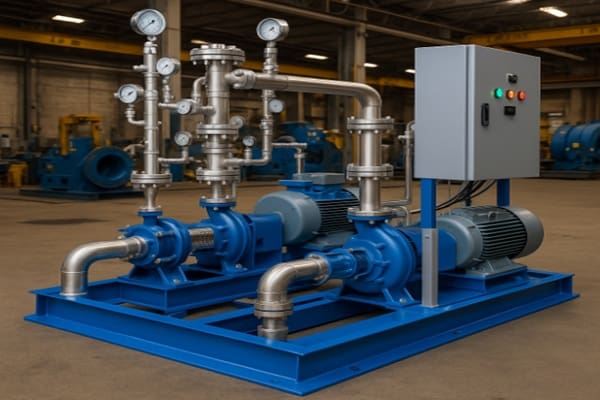
The food and beverage industry is undergoing one of the most significant modernization cycles in its history. As consumer expectations rise and regulatory standards tighten, production facilities are investing heavily in advanced fluid-handling systems that improve sanitation, consistency and operational efficiency. Pumps, automated valves and modular skid systems have become essential technologies that help plants meet growing demand while maintaining the highest levels of food safety. According to the Food Processing Association’s 2022 State of the Industry report, manufacturers are rapidly increasing investment in sanitary equipment and automation to update aging systems and keep pace with new production requirements. Markets and Markets further supports this trend, projecting the food and beverage pump market to reach 11.3 billion dollars by 2027, driven by hygiene needs and automation growth.
This transformation marks a shift from traditional mechanical processes to integrated, automated systems capable of delivering precision and reliability at scale. The industry’s embrace of high-precision pumps and skid automation reflects the need for improved hygiene, faster production cycles and greater consistency in every stage of food and beverage manufacturing.
Rising Sanitation Standards Reshape Equipment Requirements
Food and beverage facilities operate under some of the strictest sanitation requirements of any manufacturing sector. Equipment must withstand repeated cleaning cycles, prevent contamination and ensure product purity. Pumps and valves are at the center of this process because they contact products directly and influence every step from mixing to transfer to packaging.
The Food Processing Association reports that many facilities are replacing outdated equipment with modern sanitary pumps that offer superior clean-in-place capabilities. These pumps reduce the risk of bacterial growth and enable faster sanitation cycles, helping plants avoid downtime while protecting consumers. Automated valve systems further improve hygiene by minimizing manual handling and ensuring proper flow control in every batch.
The shift toward higher sanitation standards is not only driven by regulatory expectations. Consumers today expect transparency, safety and freshness in the products they purchase. This sentiment is pushing manufacturers to invest in equipment that meets cleanability requirements not just for compliance but as a competitive advantage.
Automation as the Backbone of Modern Food Production
Automation has become a defining feature of advanced food and beverage facilities. High-precision pump systems paired with automated valves create seamless, controlled movement of liquids, pastes, syrups and other ingredients. This improves accuracy, reduces waste and ensures the consistent quality that large-scale production demands.
Markets and Markets identified automation as one of the key factors fueling growth in the pump market through 2027. Automated systems reduce manual error, increase production speed and provide real-time data on flow rates, pressure and temperature. These insights allow operators to make adjustments instantly and maintain stable production conditions even under fluctuating demand.
Skid automation takes this a step further by providing pre-engineered, modular systems that integrate pumps, controls, sensors and piping into a single unit. Skids reduce installation time dramatically and allow food manufacturers to expand or reconfigure production lines without disrupting operations. They offer repeatability and quality control that are difficult to achieve with on-site fabrication.
Boosting Efficiency While Reducing Waste
Efficiency is one of the most important drivers behind the industry’s move to high-precision fluid handling systems. Food and beverage production relies on precise flow rates and accurate ingredient dosing. Even small variations can lead to costly waste, inconsistent product quality or regulatory non-compliance.
Modern pumps offer greater precision and reliability, reducing the likelihood of batch failures or ingredient loss. Automated skids can handle complex mixing, blending or transfer sequences with exact timing, improving operational performance across the entire production line.
Facilities adopting automated systems often experience measurable improvements in throughput and energy efficiency. Reduced downtime from cleaning and maintenance further enhances productivity. As the Food Processing Association notes, modernization is no longer optional for companies wanting to remain competitive in today’s fast-paced consumer market.
Meeting the Needs of a Diverse and Expanding Industry
The food and beverage industry includes a wide range of products, each with unique processing needs. Dairy plants require pumps designed for viscosity and shear sensitivity. Breweries rely on clean, consistent transfer systems for fermentation. Bakeries, sauces, confectionery products and ready-to-eat meals each require tailored fluid-handling solutions.
High-precision pumps and customizable skid systems provide the flexibility needed to address this complexity. Skid units can be engineered to accommodate specific recipes, textures and production scales. Automated valves help operators manage multiple flow paths, ingredient temperatures and batch variations with minimal manual involvement.
As product lines diversify to meet consumer demand for new flavors, health trends and convenience foods, the adaptability of pump and skid automation becomes even more important. Companies that invest in modern systems gain the agility to adjust recipes, scale production and introduce new products quickly.
A Strong Outlook for Fluid-Technology Providers
With the food and beverage pump market projected to surpass 11.3 billion dollars by 2027, opportunities for pump, valve and skid-system providers continue to expand. Facilities across North America are entering a modernization cycle that will extend well into the decade. Fluid-technology companies offering sanitary equipment, automation expertise and full-service support are well positioned to play a central role in the industry’s evolution.
Conclusion
As food and beverage manufacturing continues to modernize, the need for high-precision pumps, automated valves and modular skid systems grows stronger each year. Rising sanitation standards, increased automation and the demand for efficiency are reshaping how production lines are built and operated. Supported by industry data from the Food Processing Association and Markets and Markets, it is clear that advanced fluid-handling technology has become a cornerstone of modern food production. Companies that embrace these innovations will be better equipped to meet consumer expectations, regulatory requirements and the fast-changing demands of the global food market.