
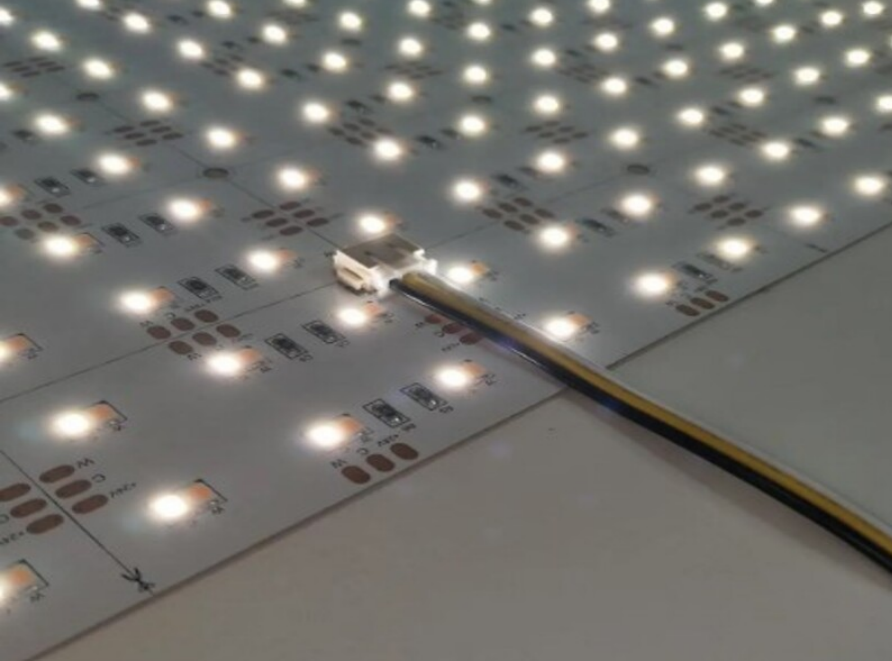
LED light sheets are one of the most innovative developments in modern lighting technology, designed to deliver uniform illumination across large and complex surfaces. Unlike traditional LED strips or rigid panels, LED light sheets are ultra-thin, flexible LED sheet platforms embedded with a dense array of LED chips. These chips work together as a single continuous light source, producing smooth, even brightness without visible hotspots or dark areas. Because of their structure and flexibility, LED light sheets are widely used in architectural lighting, commercial interiors, signage design, and decorative backlighting applications.
At a fundamental level, an LED light sheet is built to function as a large-area illumination surface. Instead of spacing LEDs along a narrow strip, the diodes are arranged in a grid pattern across a thin flexible board. This dense arrangement ensures that light is distributed evenly across the entire sheet. The result is a soft, uniform glow that eliminates the dotting effect commonly seen in standard LED strips. This makes LED light sheets especially suitable for applications where visual smoothness and aesthetic quality are important.
The structure of LED light sheets is what makes them unique. They consist of a flexible printed circuit board that supports multiple LED chips, electrical pathways, and connection points. This board is extremely thin, often less than a millimeter in base thickness, allowing it to remain flexible while still maintaining structural integrity. Despite their thinness, these sheets are engineered to handle consistent electrical loads and provide stable performance over long periods of operation.
One of the most important characteristics of LED light sheets is their flexibility. Unlike rigid lighting panels, they can bend, curve, and adapt to different surfaces. This allows designers to install them on curved walls, uneven surfaces, or complex architectural forms. The ability to conform to different shapes makes them highly valuable in modern design environments where traditional lighting systems often fail to provide seamless coverage.
LED light sheets are widely used in interior and commercial design, especially in luxury environments. One of their most popular applications is backlighting translucent materials such as marble, onyx, glass, and acrylic. When LED sheets are placed behind these materials, light passes through their natural textures and patterns, creating a glowing effect that highlights their internal structure. In high-end hotels, restaurants, bars, and retail spaces, this technique is used to create elegant and visually striking atmospheres.
Another important application is signage lighting. LED light sheets are often cut into specific shapes or letters and placed inside illuminated sign structures. Because of their high LED density, they produce very even illumination across the entire surface of the sign. This is a major improvement over traditional LED modules, which can create uneven brightness or visible light points. LED sheets ensure that signage appears smooth, professional, and visually consistent, which is essential for branding and advertising.
In addition to decorative and signage applications, LED light sheets are also used in large-scale architectural lighting projects. They can be connected together to cover extensive surfaces such as ceilings, walls, and display panels. In commercial buildings like shopping malls, airports, warehouses, and hotel lobbies, LED sheets are installed behind translucent ceiling panels to create continuous and seamless illumination. This method eliminates shadows and uneven lighting, resulting in a clean and modern visual environment.
A common question about LED light sheets is whether they are as thin as paper. While they are often described in marketing terms as “paper-thin,” in reality they are slightly thicker than standard paper. A typical LED light sheet has a base thickness of around 0.5 millimeters. When the LED chips and protective layers are included, the total thickness increases to approximately 1.2 millimeters. If connectors are added, the overall thickness may reach around 7 millimeters. Despite this, they remain extremely slim compared to traditional lighting systems, which makes them easy to integrate into tight or hidden spaces.
Another important feature of LED light sheets is their cuttable design. These sheets are manufactured with clearly marked cutting lines that indicate safe points for modification. These lines may appear as horizontal, vertical, or diagonal markings depending on the design. Users can cut along these lines using scissors or precision tools to create custom shapes and sizes. The smallest cutting unit is usually a single LED segment, allowing for precise customization based on installation requirements. After cutting, it is recommended to seal the edges with silicone or protective coating to maintain safety and durability.
Flexibility also extends to bending and folding capabilities. LED light sheets are designed to bend smoothly without damaging internal circuits, as long as bending guidelines are followed. Soft curves and gradual bends are acceptable, while sharp or extreme angles should be avoided. Excessive bending can damage the circuit paths and reduce performance. In architectural applications, designers often use LED sheets to form curved lighting surfaces or geometric shapes. However, proper alignment with designated cutting or bending lines is essential to ensure long-term stability.
LED light sheets can be connected in two main ways: wiring or connectors. Wiring involves soldering electrical connections between different sheets using copper wires. Each sheet typically includes multiple connection points on different sides, allowing flexible configuration depending on the design. Different wire gauges are used depending on power requirements, ensuring safe and stable current flow. Connectors provide a faster and more convenient alternative. These plug-and-play systems allow sheets to be linked together without soldering, making installation quicker and easier, especially for large projects.
One of the most visually impressive applications of LED light sheets is stone backlighting. In luxury interior design, materials such as marble and onyx are often used for countertops, walls, and decorative panels. When LED sheets are installed behind these materials, light passes through their natural veins and textures, creating a glowing effect that enhances their beauty. This technique is widely used in high-end hotels, luxury restaurants, and premium retail spaces to create a sophisticated and artistic atmosphere.
LED light sheets are also widely used in signage design. Designers cut the sheets into letters, logos, or custom shapes and place them inside signage structures. Because of their uniform brightness, they eliminate uneven lighting issues commonly found in traditional signage systems. This results in a clean, professional, and visually appealing output. However, most LED light sheets are designed for indoor use unless specifically treated for waterproofing.
In large-scale commercial environments, LED light sheets are often used for ceiling lighting systems. They are installed behind translucent ceiling panels to create smooth and continuous illumination across wide areas. Multiple sheets can be connected together to cover large spaces such as shopping malls, airports, offices, and exhibition halls. This method provides consistent lighting without visible joints, shadows, or dark areas, making it ideal for modern architectural design.
Beyond these primary uses, LED light sheets also play an important role in retail displays, museum exhibits, trade show booths, advertising boards, and even residential interiors. Their ability to provide both broad-area illumination and detailed accent lighting makes them highly versatile. Designers often use them to highlight products, create visual focus points, or enhance spatial depth in interior environments.
Installation of LED light sheets is relatively straightforward. Most sheets come with adhesive backing, allowing them to be mounted directly onto clean and smooth surfaces. The installation process begins with measuring the target area and determining the number of sheets required. After planning the layout, sheets are connected using either wiring or connectors. Once the physical installation is complete, a suitable power supply and controller are selected based on voltage and wattage requirements.
Power selection is an important part of installation. The voltage of the power supply must match the voltage of the LED sheets, typically 12V or 24V. In addition, the power supply must have enough capacity to handle the total wattage load. A common practice is to choose a power supply rated at about 20 percent higher than the total connected load to ensure stable and safe operation. For example, if the total system load is 240 watts, a 288-watt or higher power supply is recommended.
Once the system is connected, it can be powered on and tested. If RGB or controllable sheets are used, a controller allows users to adjust brightness, color, and lighting effects. This adds flexibility and enables dynamic lighting designs suitable for different environments and moods.
From a design perspective, LED light sheets offer significant creative freedom. Their thin structure and flexibility allow them to be hidden behind surfaces, embedded into structures, or used as visible lighting panels. This makes them a powerful tool for modern lighting design, where minimalism and seamless integration are often preferred.
LED strip manufacturer represent a major advancement in lighting technology. Their combination of ultra-thin design, flexibility, high brightness, and uniform illumination makes them suitable for a wide range of applications. From luxury interior backlighting to commercial signage and large architectural installations, they offer both functional and aesthetic benefits. With easy installation, strong adaptability, and modern design potential, LED light sheets continue to redefine how lighting is used in contemporary spaces.
Here is some flexible LED sheet available online:
1. Flexible LED Sheet
The flexible LED sheet is a high-performance and low-profile lighting solution specifically designed to provide uniform backlighting for surfaces where traditional linear strips would create uneven hot spots or shadows. Unlike standard LED strips that are narrow and one-dimensional, these sheets consist of a wide, grid-like arrangement of LEDs mounted on a thin and highly pliable printed circuit board. This unique format allows the sheet to be wrapped around curved columns, fitted into exceptionally shallow light boxes, or applied to irregular architectural shapes, providing a seamless plane of light that can be customized to fit almost any dimension.
One of the most significant advantages of a flexible LED sheet is its modular and highly adaptable nature. Most professional sheets are engineered with a matrix of cut lines, allowing the user to trim the material horizontally, vertically, or even into complex shapes without interrupting the electrical circuit. This versatility makes them an essential tool for illuminating intricate signage, brand logos, or non-standard display cases. They are especially effective when used behind translucent materials like marble, onyx, or resin, as the grid layout ensures a perfectly even distribution of light that highlights the natural beauty of the stone without visible hardware.
In terms of performance, flexible LED sheets are designed to deliver a high lumen output while maintaining a thickness of typically less than two millimeters. Because the LEDs are spread across a larger surface area rather than a single concentrated line, the sheets manage heat more effectively than high-density strips, which contribute to a longer lifespan and better color stability. They are available in a wide range of options, including static white, tunable white for adjustable color temperatures, and full RGBW configurations for dynamic color control.
Installation is generally straightforward due to the inclusion of high-strength adhesive backing, which allows for a simple peel-and-stick application on most smooth surfaces. The sheets can be folded or bent to a tight radius, making them capable of wrapping 360 degrees around architectural pillars or fitting into the sharp angles of custom cabinetry. Operating on a 24V DC system, these sheets ensure consistent brightness and color rendering across the entire surface, providing a professional-grade solution for high-end retail, hospitality, and residential projects that require flawless, large-scale illumination.
2. 324LED/PCS square individual cut single white LED sheet
The 324LED/PCS square individual cut single white LED sheet is a high-density backlighting solution designed for projects that require maximum illumination uniformity and surgical precision in customization. This sheet features a matrix of 324 high-output LEDs arranged in a perfect square grid, providing an intense and consistent plane of light that eliminates the “zebra-striping” effect often seen with traditional linear lighting. The defining characteristic of this particular model is its individual cut capability, meaning each single LED can be separated from the others. This allows the user to trim the sheet into any conceivable shape, from L-junctions and T-offsets to complex geometric patterns, making it the ultimate tool for irregular light boxes and intricate architectural niches.
The single white configuration is typically available in a variety of color temperatures ranging from warm 2700K to cool 6500K, often boasting a high color rendering index to ensure that backlit materials like stone, fabrics, or graphics appear natural and vibrant. Because the LEDs are spread across a wide surface area, the sheet manages thermal dissipation exceptionally well despite its high component count, which prevents the build-up of heat that can degrade LEDs over time. This efficiency is paired with a paper-thin profile, often less than two millimeters, allowing it to be installed in extremely shallow cavities where space is at a premium.
For installation, the sheet is usually equipped with a high-strength adhesive backing that facilitates a secure bond to most smooth substrates. Electrical connectivity is maintained through a series of interconnected copper traces that allow power to flow across the entire grid even after multiple cuts have been made. Operating on a 24V DC system, the 324-LED sheet ensures that there is no visible voltage drop across the panel, maintaining a stable and flicker-free brightness. This makes it a professional-grade choice for luxury hospitality interiors, high-end retail displays, and custom furniture where flawless, edge-to-edge white illumination is required.
3. 288LED/PCS individual cut single white led sheet
The 288LED/PCS individual cut single white LED sheet is a high-density, professional-grade backlighting panel engineered for applications where uniform light distribution and extreme shape flexibility are paramount. This sheet features a sophisticated grid of 288 high-performance LEDs mounted on a thin, flexible PCB, providing a powerful and even plane of illumination that is ideal for shallow light boxes and large-scale architectural features. The primary technical advantage of this model is its unique “individual cut” design, which allows the user to trim the sheet after every single LED. This granular level of customization enables the lighting to be perfectly tailored to fit around obstacles, within irregular geometric frames, or inside complex signage where standard linear or modular lighting would be impossible to implement.
The single white light output is designed to provide a high-quality luminous flux, making it a preferred choice for backlighting translucent surfaces such as onyx, marble, stretched fabric, or high-resolution graphics. Because the 288 LEDs are distributed across the entire surface of the square or rectangular sheet, the light is naturally diffused, significantly reducing the distance required between the light source and the diffuser to achieve a “hot-spot-free” appearance. The thin profile of the sheet, typically measuring around one millimeter in thickness, allows it to be integrated into furniture, cabinetry, and wall panels without requiring deep recesses or bulky mounting hardware.
Durability and ease of installation are central to the design of the 288-LED sheet, as it often features high-strength adhesive backing for quick and secure placement on various substrates. The electrical architecture is built with robust copper traces that ensure reliable power delivery to every pixel even after the sheet has been cut into multiple segments. Operating on a 24V DC system, it maintains consistent brightness and color temperature across the entire surface, preventing the dimming or color shifting associated with lower-voltage alternatives. This combination of intense light output, surgical cutting precision, and a minimalist form factor makes it an essential solution for high-end retail displays, hospitality environments, and custom interior design projects.
4. 576LED 12LEDs/cut 2835 dual white LED sheet
The 576LED 2835 dual white LED sheet is an ultra-high-density lighting solution designed for premium backlighting and architectural applications that require adjustable color temperatures and absolute light uniformity. This sheet features a massive array of 576 high-efficiency 2835 SMD LEDs per panel, arranged in a precise grid to create a solid wall of light. The “dual white” or CCT (Correlated Color Temperature) functionality means the sheet integrates warm white and cool white LED chips, allowing users to transition seamlessly between cozy, amber tones and crisp, daylight-balanced illumination. This makes it a perfect fit for human-centric lighting designs in offices, high-end residential spaces, and hospitality environments where the mood needs to shift throughout the day.
A key structural feature of this model is the 12LEDs/cut configuration, which provides a practical balance between customization and circuit stability. The sheet is mapped with clear cutting lines every twelve LEDs, enabling the user to resize the panel to fit specific light box dimensions or architectural niches without damaging the overall functionality of the remaining grid. While it offers slightly larger cutting increments than “individual cut” models, the high total LED count ensures that even when sections are removed, the light remains incredibly dense and free of dark spots. The 2835 LED package is specifically chosen for its excellent thermal management and high lumen-per-watt efficiency, ensuring the sheet stays cool even during prolonged operation at high brightness.
The physical profile of the sheet is remarkably thin, allowing it to be installed in shallow cavities with as little as 30mm of clearance while still achieving a perfectly diffused surface. Most professional-grade versions are built on a high-thermal-conductivity flexible PCB with a 3M adhesive backing for simplified “peel-and-stick” installation. Operating on a 24V DC system, the sheet is designed to handle the power requirements of 576 LEDs without significant voltage drop, ensuring that the color temperature and brightness remain consistent from one corner of the sheet to the other. When paired with a dual-channel controller, this LED sheet provides a sophisticated, flicker-free lighting solution capable of transforming any translucent surface into a dynamic architectural feature.
5. 180 Degree 50LED 1LEDs/cut 5050 24V RGBW LED sheet
The 180 Degree 50LED 5050 RGBW LED sheet is a specialized backlighting solution designed to provide wide-angle light distribution and full-spectrum color control within a highly customizable format. This sheet utilizes high-power 5050 SMD LEDs, which are larger and more robust than standard chips, allowing for the integration of red, green, blue, and a dedicated white diode into a single package. The 180-degree designation refers to a specialized optical design or a wide-angle beam spread that ensures light is emitted in a broad, hemispherical pattern, effectively eliminating dark spots even when the sheet is placed extremely close to a diffuser or translucent surface like onyx or fabric.
A defining characteristic of this model is the 1LEDs/cut configuration, which offers the highest possible level of physical customization. Because the circuit is engineered to be cut after every single LED, the user can trim the sheet into intricate, non-linear shapes, wrap it around sharp corners, or fit it into tiny, irregular cavities without wasting any light or damaging the electrical flow. This makes it an invaluable tool for custom signage, backlit logos, and complex furniture lighting where traditional rectangular panels or linear strips would be too restrictive. Get more info about cuttable LED sheet.
The RGBW functionality provides a significant advantage over standard RGB sheets by including a pure white chip, which allows for crisp, clean white illumination alongside millions of vibrant color possibilities. This dual-purpose capability ensures that a space can transition from a functional environment with high-quality white light to a dynamic, colored atmosphere for events or branding. By operating on a 24V DC system, the sheet maintains consistent brightness and color accuracy across the entire 50-LED grid, preventing the voltage drop issues that often plague lower-voltage alternatives.
Built on a thin, flexible PCB with a high-strength adhesive backing, the sheet is designed for rapid and secure installation on a variety of surfaces. Its ability to be cut to any size while maintaining the 180-degree wide-angle output makes it a professional-grade choice for shallow light boxes and architectural features that require a flawless, edge-to-edge glow. When paired with a four-channel DMX or RF controller, this LED sheet delivers a versatile and reliable lighting solution capable of meeting the most demanding aesthetic and technical requirements.