
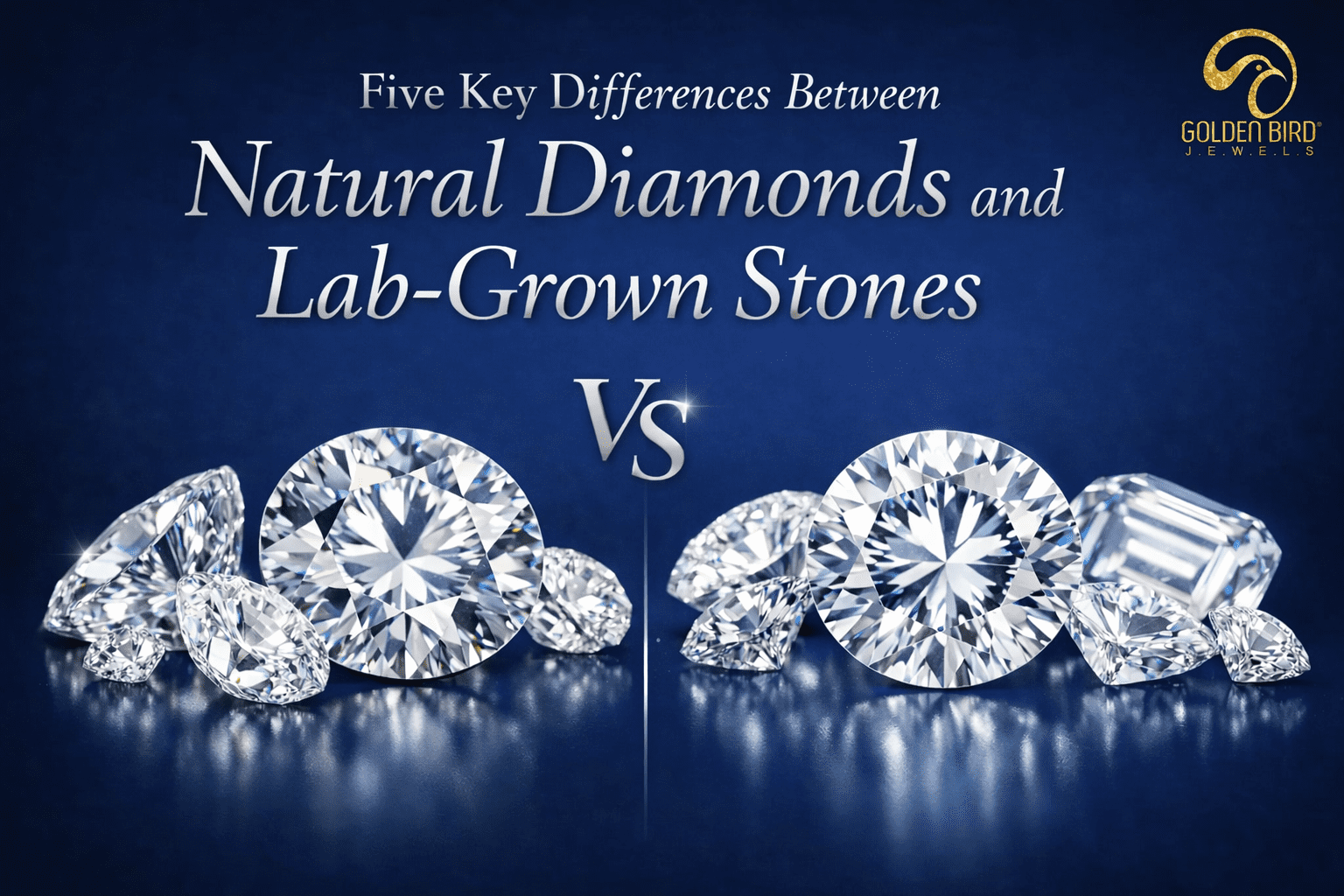
The dialogue about diamonds has shifted. A one option market has given way to a more ambiguous decision: natural diamonds or lab grown stones, which are chemically identical to those formed under tons of rock over millions of years (as well as 20 to 40 percent cheaper). Both are visually stunning. Each is a true diamond by chemical composition. But they differ in ways that count not only in price, but also in perception and provenance and long-term expectations.
Recognising these differences helps purchasers make informed, confident decisions without relying on out-of-date assumptions
1.Origin: Time Versus Technology
The biggest difference is something very basic about how these two stones forms.
Natural diamonds develop deep inside the Earth over billions of years, under high heat and pressure. Their appeal comes directly gives from this geological rarity sense of time, depth and natural history.
Though lab grown diamonds are made to the same quality and chemical composition that exist beneath the Earth’s surface, they do not come out of an actual mine; instead, the gemstones are produced with state of the art technology that replicates such conditions in controlled environments. The result is gemstone quality diamond that is chemically, physically and optically identical to one mined below the earth but made over a few weeks, instead of many millennia.
And this difference doesn’t render one more “real” than the other. It’s just pointing to two ways of getting to the same place: carbon in crystalline
2. Rarity Versus Consistency
Rarity has long defined traditional diamond value. Each natural diamond carries unique characteristics shaped by its natural formation, including inclusions and variations that can’t be replicated.
Lab grown stones offer consistency instead. Their controlled creation allows for predictable quality, symmetry, and clarity. Buyers often find it easier to select larger or higher clarity stones without the compromises typically required in the natural diamond market.
This distinction appeals to different mindsets. Some value uniqueness shaped by nature; others prefer precision shaped by intention. Neither preference is superior only personal.
3. Price Structure and Value Perception
Price is often the most discussed and misunderstood difference.
Natural diamonds carry higher price points due to mining costs, supply limitations, and long established market structures. Their value is closely tied to rarity and historical demand.
Lab grown diamonds typically cost significantly less, allowing buyers to prioritize size, cut quality, or setting design. This price difference doesn’t reflect quality; it reflects production scalability.
4. Environmental and Ethical Considerations
Today’s luxury means more than eye candy.
Natural diamonds, by contrast, can range widely depending on their origin and policing of sourcing. Responsible mining is possible but must be closely verified.
Neither level is good or bad ethic here is about transparency. What’s new is the buyer awareness. Considerations such as doing good and ethical factors are no longer an add-on, they’re a part of the purchase journey.
5. Emotional and Cultural Significance
Emotional value has always been attached to diamonds in engagement rings and family jewelry especially.
Lab grown diamonds, for their part, represent another emotional language: that of modernity and progress and conscious choice. For couples constructing their own definitions of legacy, the lab-grown stones feel in line with how they live now.
What Hasn’t Changed
Despite these differences, it’s important to recognize what remains the same.
Both natural and lab-grown diamonds share identical chemical composition, brilliance, durability, and hardness. Both are suitable for daily wear. Both can last generations when crafted well.