

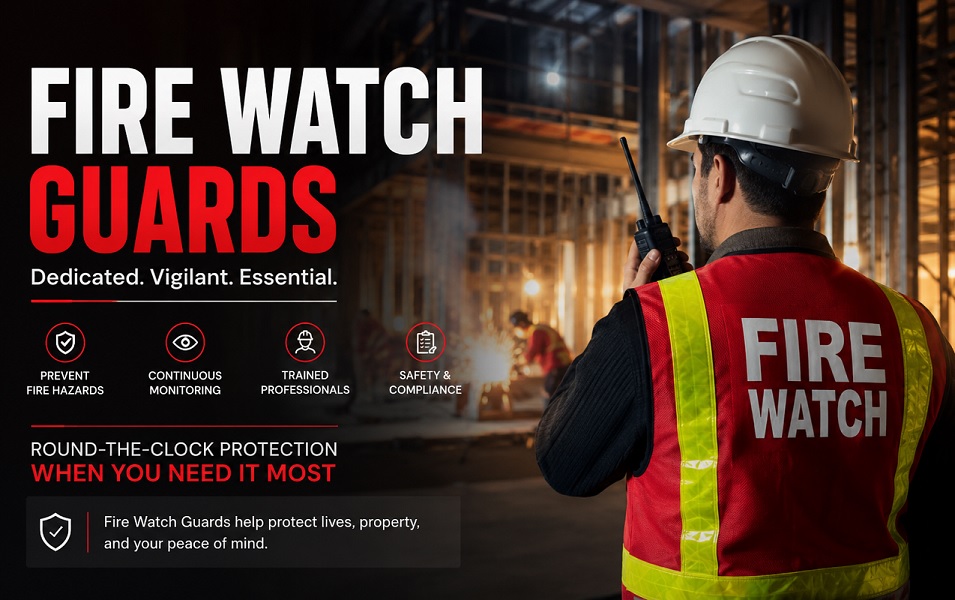
When a fire suppression system goes offline — even for a few hours — the clock starts ticking. A faulty sprinkler, a tripped alarm panel, a construction zone with exposed wiring: any one of these scenarios can transform a manageable risk into a catastrophic loss. Fire watch guards are the trained professionals standing between that risk and real-world disaster, and in a business landscape where liability, compliance, and human safety are non-negotiable, their role has never been more critical.
The demand for rapid fire watch response has surged across industries. From high-rise developments in Chicago to sprawling warehouses in Texas, facility managers and risk officers are rethinking how they approach fire protection gaps — and why waiting is never a viable strategy.
The Gap between Risk and Readiness
Most building operators assume that fire protection is a passive system. Install the sprinklers, test the alarms, file the inspection paperwork, and move on. That assumption cracks the moment a system goes down for maintenance or fails an inspection.
Local fire codes across most U.S. jurisdictions are clear: when automatic fire suppression or detection systems are impaired, a continuous fire watch must be established — often within the hour. This is not optional. It is legally binding, and failure to comply can result in building shutdowns, heavy fines, and in worst-case scenarios, criminal liability following an incident.
What separates a reactive scramble from a professional response is preparation. Companies like Just Fire Watch have built their entire service model around speed — deploying certified personnel quickly, with the documentation and training required to satisfy both fire marshals and insurance carriers. In emergency protection, minutes matter more than most people realize.
What Fire Watch Guards Actually Do
There is a persistent misconception that a fire watch guard is simply someone walking around with a flashlight. The reality is far more disciplined.
A qualified guard on fire watch duty is responsible for continuous patrol of designated areas, real-time hazard identification, coordination with local fire departments, and meticulous logbook documentation — all while being prepared to initiate emergency evacuation procedures at a moment’s notice.
They monitor hot work operations, flag ignition sources, and serve as the physical eyes of a system that technology, temporarily, cannot provide. In environments like hospitals, data centers, hotels, and active construction sites, this human layer of protection is not a redundancy — it is a necessity.
Beyond the physical presence, the paperwork these guards generate carries legal weight. Fire watch logs are often the first documents a fire investigator or insurance adjuster requests following an incident. Gaps in those logs can void coverage and expose businesses to devastating liability.
Why Speed of Deployment Is Everything
Emergencies do not schedule themselves around business hours. A sprinkler line can burst at 2 a.m. on a holiday weekend. A contractor can accidentally disable a smoke detection zone on a Friday afternoon. When these situations occur, the window for compliant fire watch deployment is narrow.
This is precisely why the operational model of a modern fire watch company has evolved. The best providers operate 24/7 dispatch systems, maintain rosters of pre-screened and certified guards, and can mobilize teams to virtually any location within hours. For large commercial clients, that speed directly translates to reduced exposure — both financial and physical.
Just Fire Watch, operating across the United States, has structured its service around this urgency. The company’s positioning reflects a broader industry truth: when compliance windows are tight and the stakes involve human lives, a slow response is no response at all.
The Regulatory Landscape Driving Demand
The National Fire Protection Association’s NFPA 101 Life Safety Code and NFPA 25 primarily govern fire watch requirements. NFPA 25 covers inspection, testing, and maintenance of water-based fire protection systems. Fire authorities having jurisdiction (AHJs) across the country adopt these codes — often with local amendments.
What many property owners and facility managers underestimate is how frequently these requirements are triggered. System impairments happen during routine maintenance, following pipe freezes, during major renovations, or after equipment failures. Each impairment can mandate immediate fire watch deployment, sometimes for 24 hours or more until the system is restored and certified.
Insurance carriers are equally attentive. Many commercial property policies include explicit language requiring fire watch protocols during system impairments. Failure to deploy qualified personnel can result in a denial of claims that would otherwise be straightforward. The financial argument for professional fire watch services, in this context, is nearly irrefutable.
Industries Where Fire Watch Is Non-Negotiable
Certain sectors carry elevated risk profiles that make fire watch services a recurring operational reality rather than a rare emergency response.
Construction is the most obvious. Hot work — welding, cutting, grinding — is conducted daily on active job sites, and most general contractors now require documented fire watch protocols as a condition of their safety plans. OSHA standards align with NFPA guidelines here, creating a compliance convergence that drives demand.
Healthcare facilities face a different but equally urgent challenge. A hospital cannot simply shut down when a suppression system needs service. The Joint Commission, which accredits healthcare organizations, has specific requirements for interim life safety measures during fire system impairments — and fire watch is a central component of those measures.
Hotels, entertainment venues, manufacturing plants, and data centers all share a common thread: they are densely occupied or house irreplaceable assets, and their fire protection infrastructure is too critical to leave unmonitored during any period of impairment. The question for facility managers in these sectors is not whether fire watch will ever be needed — it is whether the right provider is already on speed dial.
The Human Element That Technology Cannot Replace
Automation has transformed nearly every corner of commercial operations. Sensors, AI-driven monitoring platforms, and IoT-connected building systems have made real-time risk management more sophisticated than ever. And yet, when the systems those technologies depend on go offline, the irreplaceable element remains human judgment.
A trained fire watch guard reads an environment the way a seasoned professional reads a room — picking up on subtle cues, deviations from normal conditions, and the kind of anomalies that no algorithm has yet learned to catch. The smell of smoldering material behind a wall. The sound of a hissing gas line. The sight of debris accumulating near an electrical panel.
These are not abstract scenarios. Real incidents — where a trained professional made the difference between early intervention and catastrophic loss — inspire these examples. Technology will continue to evolve, but it won’t disrupt the human layer of protection in fire safety; instead, it will reinforce it.
Choosing the Right Fire Watch Provider
Not all fire watch services are created equal, and the difference becomes starkly apparent when a genuine emergency unfolds.
The criteria for evaluating a provider should include verifiable certification and training standards for deployed guards, the ability to provide rapid deployment at any hour, a demonstrated understanding of local fire code requirements, and a clear documentation process that satisfies both AHJ expectations and insurance carrier requirements.
Reputation matters, too. Providers who serve high-stakes clients — hospitals, data centers, major commercial developers — have built their operational infrastructure to meet those demands. That institutional experience carries over into every deployment, regardless of the client’s size.
Transparency is another differentiator. A credible fire watch company will be upfront about what their guards are trained to do, what jurisdiction-specific requirements apply to your situation, and how their documentation process works. Ambiguity in any of those areas is a signal worth heeding.
The True Cost of Unprotected Risk
The financial math of fire watch services is straightforward once the alternative is fully understood. The cost of deploying qualified fire watch guards for a 24 or 48-hour system impairment is measurable and predictable. The cost of a fire incident during an unprotected impairment window — insurance denial, property loss, litigation, reputational damage, regulatory penalties — is not.
Businesses that have experienced fire losses during compliance gaps rarely need convincing twice. The ones that haven’t are making a calculated bet that their systems will never fail at the wrong moment. Given that fire suppression systems across the country are aging, understaffed maintenance teams are increasingly stretched thin, and construction activity continues to intensify, that bet carries longer odds than many assume.
Emergency protection is not a line item to optimize away. It is the infrastructure of confidence — the assurance that when automated systems fall short, trained human expertise is already on site, documented, and ready. That assurance is what fire watch guards provide, and why the companies and facilities that understand risk are making sure they have access to it before they ever need it.