

For many GCC nationals, the UK Electronic Travel Authorisation (ETA) is a welcome upgrade from the old visa waiver system. It is faster, digital, and valid for two years. But there is one section of the app that causes hesitation: The “Suitability” Questions.
You are staring at the screen, asking yourself: Does a speeding ticket in Dubai count as a criminal record? What if I had a visa refused ten years ago? If I check “Yes,” will I be banned?
Here is the reality: The UK Home Office uses these questions to assess risk, not to trap honest travelers. However, the definitions of “crime” and “conviction” in UK law may differ from what you are used to.
This guide on UK ETA security questions for GCC travelers translates the legalese into plain English, helping you navigate the security section with confidence and avoid the one mistake that triggers a 10-year ban: Deception.
Understanding the UK ETA “Suitability” Check
The security section of your ETA application is technically known as the Suitability Check. Unlike the biographical section (name, passport number), which is fact-checked against your passport chip, this section relies on self-declaration cross-referenced with international security databases.
The Golden Rule: The system is designed to approve low-risk travelers automatically. If you have a clean record, you will likely be approved within hours. If you have a complex history, your application isn’t necessarily doomed—it just moves from “Automated” to “Manual Review” by a human caseworker.
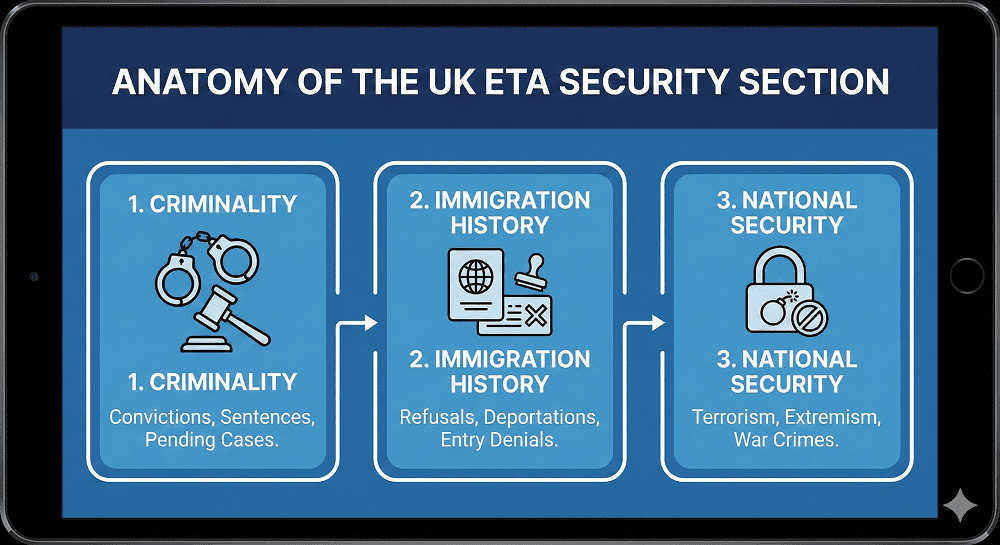
The 4 Core Security Sections: What You Need to Declare
To get approved, you must answer questions in four specific categories.
The UK ETA Suitability questions cover:
- Criminality: Have you ever been convicted of a criminal offense or served a prison sentence?
- Terrorism & Extremism: Have you ever been involved with war crimes, terrorist groups, or extremist organizations?
- Immigration History: Have you ever been deported, overstayed a visa, or been refused entry to the UK or any other country?
- Character & Conduct: Is there any reason your presence in the UK would not be conducive to the public good?
Question 1: Criminal Convictions & The “12-Month Rules”
This is where most confusion arises. The UK differentiates between minor offenses and serious criminality based on the sentence imposed and the time passed.
When is a Refusal Mandatory?
The ETA system has strict rules for “mandatory refusal.” You will almost certainly be refused an ETA (and must apply for a Visa instead) if:
- The 12-Month Sentence Rule: You have ever received a custodial (prison) sentence of 12 months or more. It does not matter if this happened 20 years ago.
- The Recent Conviction Rule: You have been convicted of any criminal offense in the last 12 months (even if you didn’t go to prison).
What If My Conviction Was Minor or Long Ago?
If you had a prison sentence of less than 12 months, or a non-custodial sentence (like a fine or community service) more than 12 months ago, you are not automatically banned.
However, you must still declare it. Checking “Yes” triggers a manual review where a caseworker looks at the context. If you check “No” and they find it on a database, you will be refused for deception.
| Scenario | Outcome if Declared | Outcome if Hidden |
| Prison sentence > 12 months | Refused (Apply for Visa) | 10-Year Ban |
| Conviction < 12 months ago | Likely Refused | 10-Year Ban |
| Old/Minor Conviction | Manual Review (Possible Approval) | 10-Year Ban |
Common GCC Confusion: Traffic Fines vs. Criminal Records
In many GCC countries, traffic violations (like speeding or parking fines) are processed efficiently through apps like MOI or metrash2. Do these count?
Generally, No.
You do not need to declare fixed penalty notices (speeding tickets, parking fines) that were settled by paying a fine without going to court. In the eyes of UK immigration, these are civil penalties, not criminal convictions.
The Exception:
You must declare driving offenses that resulted in a court appearance and a criminal conviction. Examples include:
- Driving under the influence (DUI/DWI).
- Dangerous driving causing injury or death.
- Driving while disqualified.
If your “fine” came from a judge in a courtroom, declare it. If it came from a speed camera and you paid it online, you generally do not need to declare it.
Immigration History: The “Global” Scope
The question asks: “Have you ever been refused a visa… for the UK or any other country?”
Many travelers skim this and miss the words “any other country.”
- If you were refused a US Visa in 2015? Declare it.
- If you were denied a Schengen visa last year? Declare it.
- If you overstayed in the UK by two days five years ago? Declare it.
The UK shares immigration data with the US, Canada, Australia, and New Zealand (the “Five Eyes” alliance). If you hide a US visa refusal, the UK system will likely know, and you will be flagged for deception.
The “Deception” Trap: Why You Must Never Hide Information
This is the most critical advice in this guide.
Under UK immigration rules (Part 9), using “Deception”—defined as making false representations or withholding material facts—carries a mandatory 10-year ban on entering the UK.
It is far better to have an ETA refused because of an honest declaration (and then successfully apply for a Standard Visitor Visa) than to be banned for a decade because you tried to hide a minor issue.
Frequently Asked Questions (FAQ)
What questions are asked on the UK ETA security section?
The security section asks about criminality, terrorism, immigration history, and character.
Specifically, you must answer whether you have criminal convictions (including international ones), involvements with extremist groups, past visa refusals or deportations from any country, and if you pose a risk to national security.
Can I get a UK ETA if I have a criminal record?
It depends on the sentence length and how much time has passed.
You will be automatically refused if you served a prison sentence of 12 months or more (ever) or had any conviction in the last 12 months. For lighter or older sentences, you may still apply, but your application will go to a manual review.
Does a speeding ticket count as a criminal record for UK ETA?
No, standard fixed penalty notices do not need to be declared.
If you paid a fine for speeding or parking without attending court, this is not considered a criminal conviction. However, serious driving offenses that resulted in a court conviction (like DUI) must be declared.
What happens if I lie on my UK ETA application?
You risk a mandatory 10-year ban from the UK.
Withholding information or lying is classified as “deception.” If the Home Office discovers you failed to declare a conviction or visa refusal, your ETA will be denied, and you may be banned from applying for any UK visa for ten years.
How far back do UK ETA background checks go?
Background checks cover your entire lifetime.
There is no “expiration date” for declaring serious issues. While the automatic refusal rules focus on the last 12 months for minor crimes, you must truthfully declare your entire history regarding serious convictions, immigration breaches, or associations with extremist groups.
