
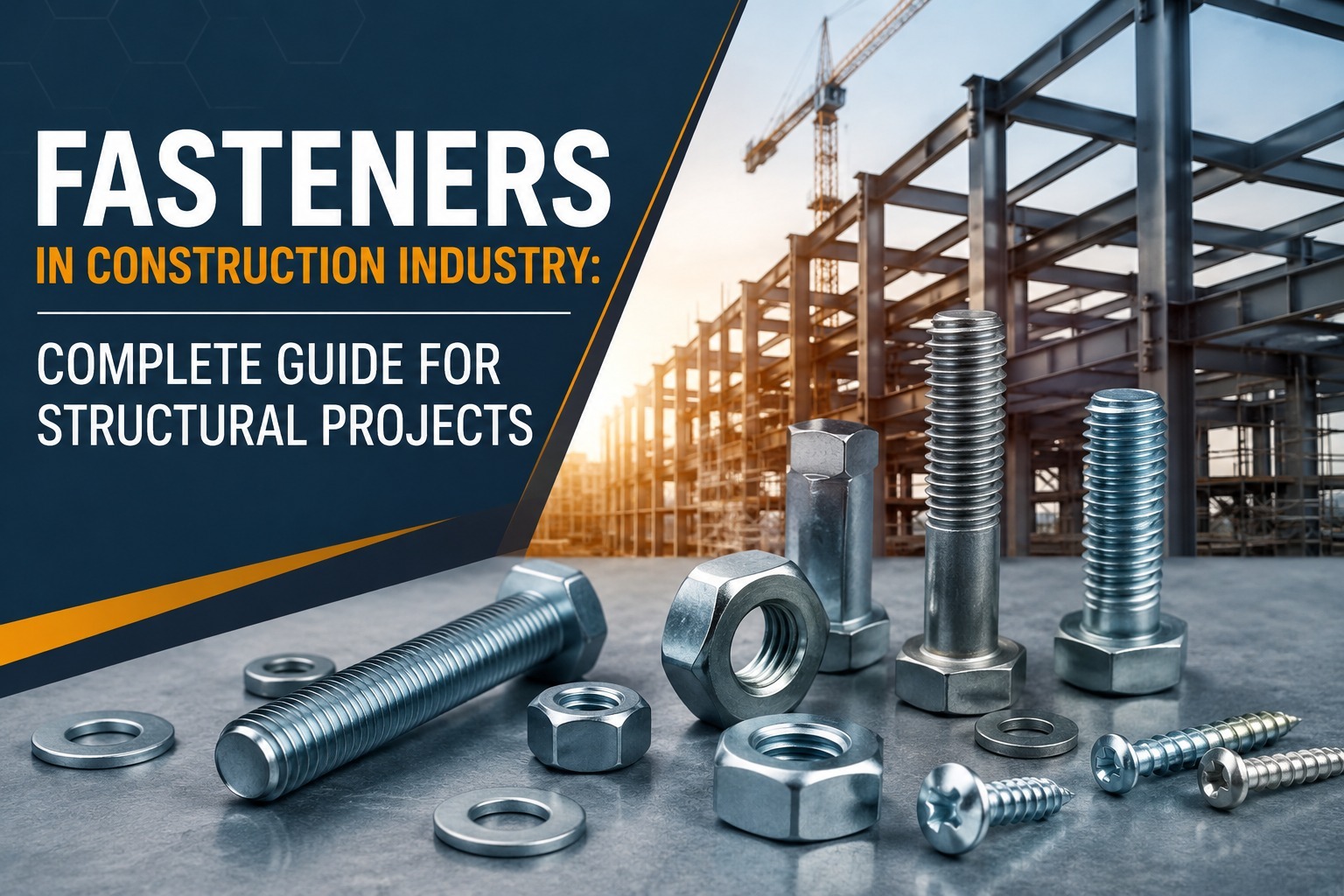
Reliable structural connections are extremely important for ensuring the safety, stability and longevity of buildings and infrastructure. In this, fasteners play a very critical role in the structural projects that they are employed in, by not only maintaining alignment, but also transferring loads, and helping secure different components together.
Aside from being able to transfer the load, fasteners help structures with various issues such as withstand vibration, thermal expansion, wind pressures, seismic activity as well as other environmental factors that can negatively impact long-term performance.
By selecting the right type of fastening solution, we can ensure structural integrity, operational reliability and service life across a wide range of construction applications.
Construction Fastener Types
Construction fasteners are used in a variety of applications and performance conditions.
Bolts are one of the most often used structural fasteners. They offer robust detachable joints. They are frequently employed in steel buildings, equipment installations and infrastructure projects.
Nuts and bolts interact to provide secure clamping forces that keep components together under load.
Screws are often used in low load bearing structural applications, cladding systems, roofing applications and interior building projects.
Anchors are fixed connections between structural members and concrete or masonry surfaces. Also important are they in foundation construction, equipment installation and retrofit jobs.
Structural Bolts and Why They Matter
Structural bolts are built to endure heavy loads and tough working conditions. These fasteners are essential to steel construction and major infrastructure projects.
Structural bolts are made to specific mechanical property requirements, not as conventional bolts. These offer extremely strong tensile strength, good gripping force and, most importantly, dependable performance under dynamic loading circumstances.
Structural bolts are routinely utilized in bridges, high-rise structures, industrial facilities and other significant infrastructure projects. Their capacity to retain connections under harsh situations makes them vital in current building.
Proper selection and installation of structural bolts have a substantial impact on the safety and performance of a project.
Fastener Materials for Structural Projects
The material a fastener is made of has a huge part in the fastener’s performance, longevity and application.
The strength and cost of carbon steel fasteners make them frequently utilized. They are appropriate for various structural applications provided they are protected against corrosion.
Fastener Grades and What They Signify
Fastener grades reflect mechanical qualities like yield strength and tensile strength. Such categories assist engineers in choosing fasteners that will bear the expected loads and operating conditions.
The varied grades are suited for diverse uses. Most structural connections may be made with medium strength grades whereas important load-bearing assemblies need high strength grades.
The right grade is used to guarantee that the fasteners work safely and reliably over their service life.
Construction professionals who understand fastener grades may make educated judgments and remain in line with engineering standards.
Application of Fasteners in Steel Structures
High strength bolts and related hardware are widely used for the connection of beams, columns, trusses, braces and support systems. These fasteners are able to spread the stresses and loads in an efficient manner even with a regulated assembly and maintenance process at hand
Steel constructions are exposed to dynamic loads such wind loads, thermal expansion and vibration. Choosing the right fasteners will assist tolerate these stresses and yet keep the structure stable. Their performance is crucial for assuring safety and durability in steel building projects.
Fasteners in Bridge Building
Bridges are one of the most challenging structures in the building business. They are exposed to constant traffic loads, environmental exposure and dynamic pressures.
Fasteners for bridge building must be of high strength, fatigue resistance and durability. Structural bolts are important to connect steel pieces and ensure load distribution.
Correct Installation is Essential
Even the best fasteners may fail when they are improperly put. Good installation techniques are needed to get the desired performance levels.
Applying the correct torque gives you the correct clamping force, and avoids such problems as loosening, overloading or early failure.
Connection quality is also dependent on hole preparation , alignment , and surface conditions . For solid outcomes, construction teams should follow installation rules and industry norms.
Proper installation not only boosts safety, but also increases performance and decreases maintenance needs throughout the life of the building.
Quality Control and Inspection Procedures
Quality control is the important part of building of the structure. Fasteners should be checked before, during and after installation to ensure that they meet project requirements.
Inspection processes may involve visual inspection, dimensional checks, torque check and study of material certifications.
Periodic quality checks are useful to detect any problems before affecting the structural performance. They also guarantee that safety requirements and technical standards are met.
Good quality control results in a reliable project and long-term structural integrity.
Fastener Maintenance and Life Cycle Management
Many types of structural fasteners are intended for long term usage, although occasional inspection and maintenance are required. Quick resolution of these issues will avoid potential difficulties, and increase service life.
Lifecycle management is the process of monitoring the performance of fasteners over the operating life of a structure. This proactive strategy helps in planning for safety, dependability and cost efficient maintenance.
A good fastening system contributes to the sustainability and performance of the project.
Load Transfer in Structural Connections: Understanding
One of the key tasks of fasteners in construction is the transmission of loads. Beams, columns, trusses and braces all need to work together to sustain different pressures that are operating on a building or infrastructure project. Fasteners make tight connections that allow these loads to be securely transferred from one component to another.
Fasteners distribute the load across the assembly when the structure is exposed to weight, wind, seismic activity or operating pressures. The correct transmission of loads avoids too much pressure being concentrated in one place, which reduces the chances of structural failure or damage.
Fasteners are chosen at the design stage by engineers who measure anticipated loads to determine the kind, amount and quality of fasteners needed. These calculations are done to guarantee that each connection works well both in regular and exceptional situations.
One of the primary reasons high-quality fasteners are a must-have for structural building projects is reliable load transmission.
Summary
Fasteners are crucial components that provide safety, stability and endurance for structural building projects. At Fastener World (India) we recognize that solid and dependable connections are the basis of any flourishing structural project.