
The aesthetic medicine industry is undergoing a philosophical transformation. For two decades, the dominant approach was replacement — fill what’s lost, smooth what’s wrinkled, add what’s missing. Volume, hydration, paralysis of dynamic muscles. The tools were effective but fundamentally compensatory.
The emerging paradigm is regeneration. Instead of replacing what the body has lost, regenerative approaches activate the body’s own repair mechanisms to rebuild tissue from within. Two technologies are leading this shift: exosomes and calcium hydroxyapatite (CaHA) biostimulators. They work through entirely different biological mechanisms, address different clinical needs, and occupy different places on a treatment menu — but together, they represent the most significant expansion of the aesthetic toolkit since the introduction of hyaluronic acid fillers.
Exosomes: Cellular Communication Molecules
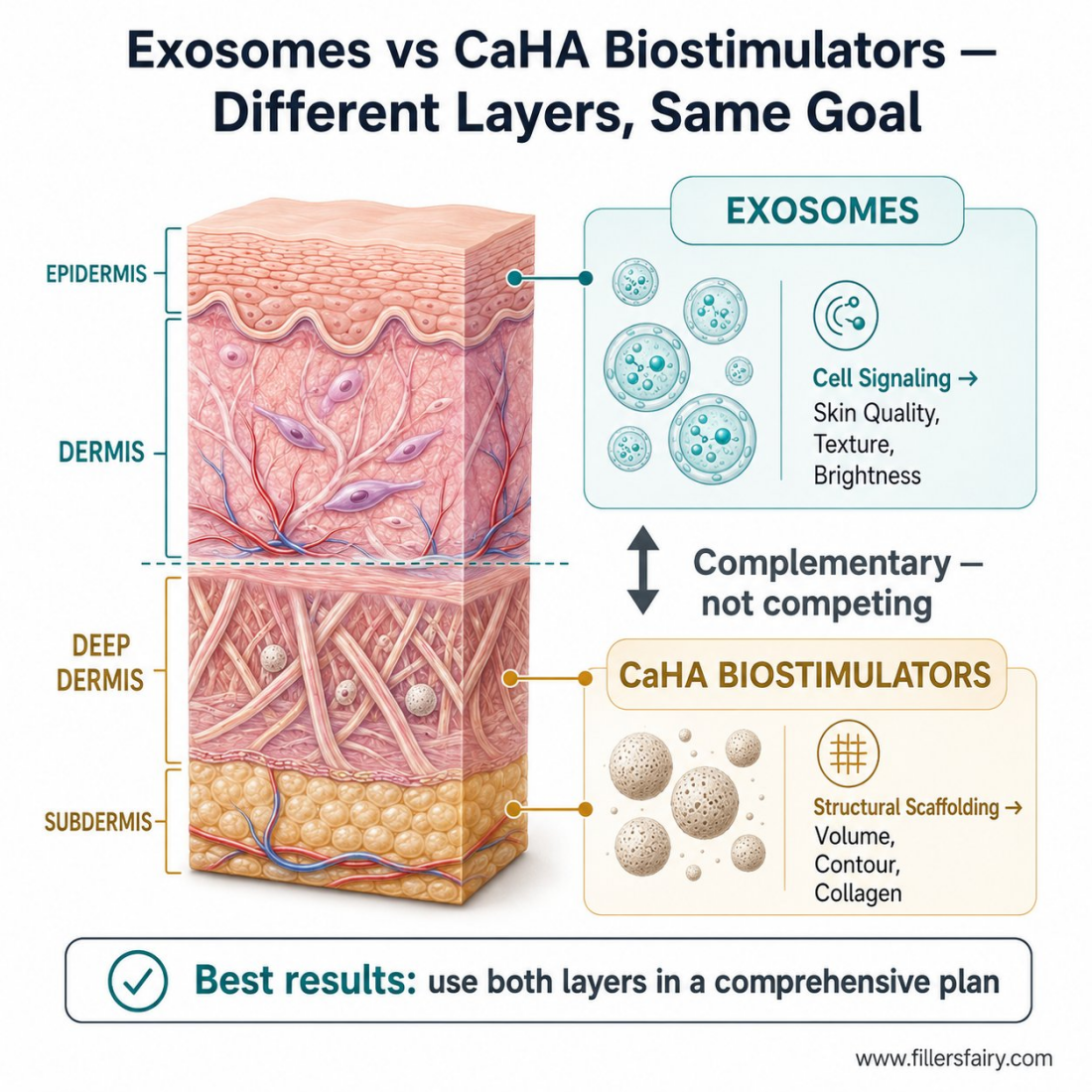
Exosomes are extracellular vesicles in the 50 to 200 nanometer range — far smaller than cells, smaller even than most bacteria. They function as the body’s intercellular messaging system, carrying cargo (proteins, lipids, and nucleic acids including miRNAs) from a donor cell to recipient cells, delivering molecular instructions that modulate gene expression, immune response, and tissue repair.
In aesthetic medicine, exosomes are applied topically after creating microchannels in the skin via microneedling, RF microneedling, or fractional laser. The exosomes penetrate through these channels into the dermal layer, where they are internalized by fibroblasts and other target cells. The cargo they deliver triggers downstream effects including collagen and elastin synthesis, melanin inhibition for brightening, anti-inflammatory cytokine modulation, and accelerated wound healing.
The clinical advantages of exosome therapy are specificity and efficiency. Rather than flooding the tissue with a single active ingredient and hoping it reaches the right cells, exosomes deliver a precisely curated package of signaling molecules directly into recipient cells — the way the body’s own repair system communicates.
The ASCE+ SRLV exosome skin booster by ExoCoBio is the most established exosome product in the Korean aesthetic market. What distinguishes it from competitors is its source material: rather than using human adipose tissue or umbilical cord derivatives, ASCE+ SRLV uses exosomes derived from Damask Rose (Rosa Damascena) stem cells — a plant-based source that eliminates the immunogenicity and ethical sourcing concerns associated with human-tissue-derived exosomes. Each vial contains 5 billion exosomes carrying 96 types of miRNAs and over 200 types of proteins, delivered via a lyophilized powder format that is reconstituted with an activator solution before application.
For practitioners, exosomes occupy a unique position on the treatment menu. They are not fillers — they add no volume. They are not traditional skin boosters — they don’t rely on HA hydration. They are cell-signaling agents that reprogram dermal biology toward regeneration. This makes them ideal for stacking with other treatments: post-laser recovery, post-microneedling enhancement, or as a regenerative layer added to standard skin booster protocols.
CaHA Biostimulators: Structural Collagen Scaffolding
Calcium hydroxyapatite biostimulators work through a fundamentally different mechanism. CaHA is a mineral that occurs naturally in human bones and teeth. When formulated into smooth, uniform microspheres and suspended in a gel carrier, it serves as both an immediate volumizer and a long-term collagen scaffold.
Upon injection into the subdermis, the gel carrier provides instant volume correction — patients see contour improvement immediately. Over the following weeks and months, fibroblasts migrate to the CaHA microspheres and begin depositing new type I and type III collagen around the particles. The microspheres gradually biodegrade into calcium and phosphate ions (both naturally occurring in the body), but the collagen matrix they stimulated remains, providing structural support that lasts 18 to 24 months.
The Volassom CaHA collagen stimulator by CGBio represents the Korean approach to this technology. Its distinguishing feature is a proprietary lattice-pore microsphere architecture — rather than solid CaHA beads, Volassom’s microspheres have an internal network-like structure that provides larger surface area for collagen scaffolding and more uniform biodegradation. The product has been clinically studied at Seoul National University Hospital and Asan Medical Center, with results published in the Journal of Cosmetic Dermatology confirming dual benefits in both volume restoration and skin quality improvement over 24 weeks.
CaHA biostimulators occupy a different position than exosomes on the treatment menu. They are structural agents — best suited for midface volumization, jawline definition, nasolabial folds, and hand rejuvenation. They are not appropriate for lips or periorbital areas, and they cannot be dissolved with hyaluronidase if the result is unsatisfactory. These constraints make patient selection and injection technique particularly important.
Complementary, Not Competing
The most important insight for practitioners evaluating these technologies is that exosomes and CaHA biostimulators are not competitors — they are complementary tools that address different layers and mechanisms of facial aging.
Exosomes work at the cellular signaling level, reprogramming dermal biology to improve skin quality, texture, brightness, and barrier function. They operate in the superficial to mid-dermis and produce their effects through biological signaling rather than structural filling.
CaHA biostimulators work at the structural level, providing volumetric correction and stimulating collagen scaffolding in the deep dermis and subdermis. Their effects are architectural — lifting, contouring, and rebuilding the structural framework that supports the skin.
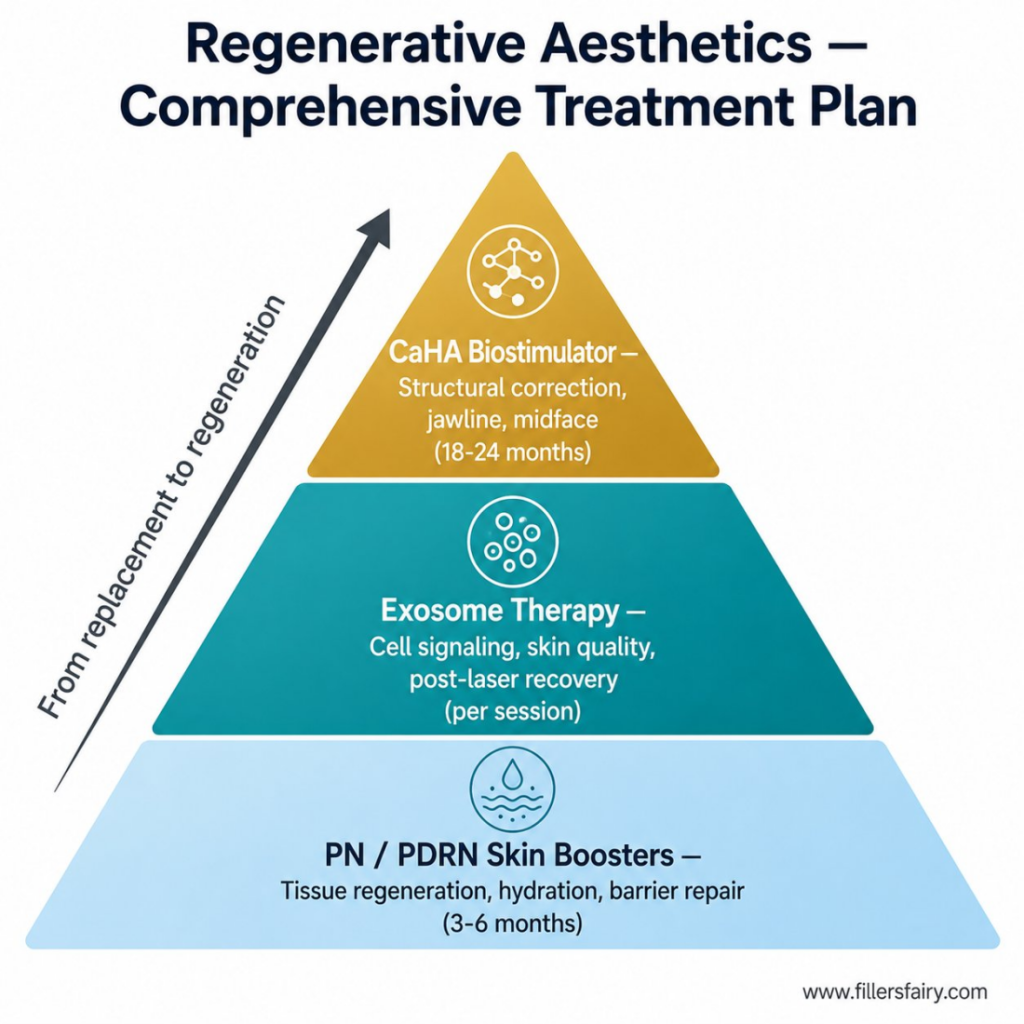
A comprehensive regenerative treatment plan might use CaHA for structural correction of midface volume loss and jawline definition, then layer exosome therapy on top for skin quality improvement across the entire face. The CaHA addresses the “architecture” while the exosomes address the “surface finish.” Neither technology alone achieves what both together can accomplish.
Implications for Practice Strategy
For clinic owners, these two technologies represent distinct opportunities.
Adding exosome therapy is a relatively low barrier decision. The products are applied topically after microneedling — a procedure most clinics already offer. The additional cost per treatment is modest, the treatment time adds only minutes to an existing microneedling session, and the regenerative positioning commands a premium price point. Exosomes are, in effect, a revenue enhancer for an existing service category.
Adding CaHA biostimulators requires more investment in training, particularly for practitioners accustomed to working exclusively with HA fillers. The injection technique is different (cannula-based, subdermal), the product behavior is different (not reversible), and the clinical decision-making is different (structural rather than superficial). But the payoff is a treatment with 18 to 24 month durability — meaning fewer sessions per patient for longer-lasting results, which supports premium pricing.
The clinics that will capture the most value from the regenerative shift are those that offer both technologies, positioning them as complementary layers within a comprehensive facial rejuvenation program. This is the approach already being adopted by leading Korean clinics — and as with most Korean aesthetic innovations, the rest of the world tends to follow within two to three years.
*About the author: FillersFairy is a B2B supplier specializing in Korean aesthetic products for clinics and medspas worldwide.*